mirror of
https://github.com/huggingface/lerobot.git
synced 2026-05-31 10:51:35 +00:00
Compare commits
14 Commits
codex/robo
...
e3e9374e2c
| Author | SHA1 | Date | |
|---|---|---|---|

|
e3e9374e2c | ||
|
|
c1a0c601e2 | ||
|
|
1ca38d9748 | ||
|
|
5a6aa64570 | ||
|
|
0b06790da0 | ||
|
|
b43dc39ba4 | ||
|
|
2b71221194 | ||
|
|
8833d735a1 | ||
|
|
ba27aab79c | ||
|
|
5adad11128 | ||
|
|
a07f22e22c | ||
|
|
282c31cfef | ||
|
|
a147fa4439 | ||
|
|
0f1c9b0851 |
535
.github/workflows/benchmark_tests.yml
vendored
535
.github/workflows/benchmark_tests.yml
vendored
@@ -118,7 +118,7 @@ jobs:
|
||||
bash -c "
|
||||
hf auth login --token \"\$HF_USER_TOKEN\" --add-to-git-credential 2>/dev/null || true
|
||||
lerobot-eval \
|
||||
--policy.path=pepijn223/smolvla_libero \
|
||||
--policy.path=lerobot/smolvla_libero \
|
||||
--env.type=libero \
|
||||
--env.task=libero_spatial \
|
||||
--eval.batch_size=1 \
|
||||
@@ -147,7 +147,7 @@ jobs:
|
||||
--artifacts-dir /tmp/libero-artifacts \
|
||||
--env libero \
|
||||
--task libero_spatial \
|
||||
--policy pepijn223/smolvla_libero
|
||||
--policy lerobot/smolvla_libero
|
||||
|
||||
- name: Upload Libero rollout video
|
||||
if: always()
|
||||
@@ -270,7 +270,7 @@ jobs:
|
||||
bash -c "
|
||||
hf auth login --token \"\$HF_USER_TOKEN\" --add-to-git-credential 2>/dev/null || true
|
||||
lerobot-eval \
|
||||
--policy.path=pepijn223/smolvla_metaworld \
|
||||
--policy.path=lerobot/smolvla_metaworld \
|
||||
--env.type=metaworld \
|
||||
--env.task=metaworld-push-v3 \
|
||||
--eval.batch_size=1 \
|
||||
@@ -299,7 +299,7 @@ jobs:
|
||||
--artifacts-dir /tmp/metaworld-artifacts \
|
||||
--env metaworld \
|
||||
--task metaworld-push-v3 \
|
||||
--policy pepijn223/smolvla_metaworld
|
||||
--policy lerobot/smolvla_metaworld
|
||||
|
||||
- name: Upload MetaWorld rollout video
|
||||
if: always()
|
||||
@@ -317,6 +317,115 @@ jobs:
|
||||
path: /tmp/metaworld-artifacts/metrics.json
|
||||
if-no-files-found: warn
|
||||
|
||||
# ── ROBOTWIN 2.0 ──────────────────────────────────────────────────────────
|
||||
# Isolated image: full RoboTwin 2.0 stack — SAPIEN, mplib, CuRobo,
|
||||
# pytorch3d, + simulation assets (~4 GB).
|
||||
# Build takes ~20 min on first run; subsequent runs hit the layer cache.
|
||||
# Requires an NVIDIA GPU runner with CUDA 12.1 drivers.
|
||||
robotwin-integration-test:
|
||||
name: RoboTwin 2.0 — build image + 1-episode eval
|
||||
runs-on:
|
||||
group: aws-g6-4xlarge-plus
|
||||
env:
|
||||
HF_USER_TOKEN: ${{ secrets.LEROBOT_HF_USER }}
|
||||
ROBOTWIN_POLICY: lerobot/smolvla_robotwin
|
||||
ROBOTWIN_TASKS: beat_block_hammer,click_bell,handover_block,stack_blocks_two,click_alarmclock,open_microwave,adjust_bottle,lift_pot,stamp_seal,turn_switch
|
||||
|
||||
steps:
|
||||
- uses: actions/checkout@de0fac2e4500dabe0009e67214ff5f5447ce83dd # v6.0.2
|
||||
with:
|
||||
persist-credentials: false
|
||||
lfs: true
|
||||
|
||||
- name: Set up Docker Buildx
|
||||
uses: docker/setup-buildx-action@v3 # zizmor: ignore[unpinned-uses]
|
||||
with:
|
||||
cache-binary: false
|
||||
|
||||
- name: Login to Docker Hub
|
||||
if: ${{ env.DOCKERHUB_USERNAME != '' }}
|
||||
uses: docker/login-action@v3 # zizmor: ignore[unpinned-uses]
|
||||
with:
|
||||
username: ${{ secrets.DOCKERHUB_LEROBOT_USERNAME }}
|
||||
password: ${{ secrets.DOCKERHUB_LEROBOT_PASSWORD }}
|
||||
env:
|
||||
DOCKERHUB_USERNAME: ${{ secrets.DOCKERHUB_LEROBOT_USERNAME }}
|
||||
|
||||
# Build the full-install image: SAPIEN, mplib, CuRobo, pytorch3d +
|
||||
# simulation assets (~4 GB). Layer cache lives in the runner's local
|
||||
# Docker daemon — reused across re-runs on the same machine.
|
||||
- name: Build RoboTwin 2.0 benchmark image
|
||||
uses: docker/build-push-action@v6 # zizmor: ignore[unpinned-uses]
|
||||
with:
|
||||
context: .
|
||||
file: docker/Dockerfile.benchmark.robotwin
|
||||
push: false
|
||||
load: true
|
||||
tags: lerobot-benchmark-robotwin:ci
|
||||
cache-from: type=local,src=/tmp/.buildx-cache-robotwin
|
||||
cache-to: type=local,dest=/tmp/.buildx-cache-robotwin,mode=max
|
||||
|
||||
- name: Run RoboTwin 2.0 smoke eval (10 tasks, 1 episode each)
|
||||
if: env.HF_USER_TOKEN != ''
|
||||
run: |
|
||||
# Named container (no --rm) so we can docker cp artifacts out.
|
||||
docker run --name robotwin-eval --gpus all \
|
||||
--shm-size=4g \
|
||||
-e HF_HOME=/tmp/hf \
|
||||
-e HF_USER_TOKEN="${HF_USER_TOKEN}" \
|
||||
-e ROBOTWIN_POLICY="${ROBOTWIN_POLICY}" \
|
||||
-e ROBOTWIN_TASKS="${ROBOTWIN_TASKS}" \
|
||||
lerobot-benchmark-robotwin:ci \
|
||||
bash -c "
|
||||
hf auth login --token \"\$HF_USER_TOKEN\" --add-to-git-credential 2>/dev/null || true
|
||||
cd /opt/robotwin && lerobot-eval \
|
||||
--policy.path=\"\$ROBOTWIN_POLICY\" \
|
||||
--env.type=robotwin \
|
||||
--env.task=\"\$ROBOTWIN_TASKS\" \
|
||||
--eval.batch_size=1 \
|
||||
--eval.n_episodes=1 \
|
||||
--eval.use_async_envs=false \
|
||||
--policy.device=cuda \
|
||||
'--rename_map={\"observation.images.head_camera\": \"observation.images.camera1\", \"observation.images.left_camera\": \"observation.images.camera2\", \"observation.images.right_camera\": \"observation.images.camera3\"}' \
|
||||
--output_dir=/tmp/eval-artifacts
|
||||
python /lerobot/scripts/ci/extract_task_descriptions.py \
|
||||
--env robotwin \
|
||||
--task \"\$ROBOTWIN_TASKS\" \
|
||||
--output /tmp/eval-artifacts/task_descriptions.json
|
||||
"
|
||||
|
||||
- name: Copy RoboTwin artifacts from container
|
||||
if: always()
|
||||
run: |
|
||||
mkdir -p /tmp/robotwin-artifacts
|
||||
docker cp robotwin-eval:/tmp/eval-artifacts/. /tmp/robotwin-artifacts/ 2>/dev/null || true
|
||||
docker rm -f robotwin-eval || true
|
||||
|
||||
- name: Parse RoboTwin eval metrics
|
||||
if: always()
|
||||
run: |
|
||||
python3 scripts/ci/parse_eval_metrics.py \
|
||||
--artifacts-dir /tmp/robotwin-artifacts \
|
||||
--env robotwin \
|
||||
--task "${ROBOTWIN_TASKS}" \
|
||||
--policy "${ROBOTWIN_POLICY}"
|
||||
|
||||
- name: Upload RoboTwin rollout video
|
||||
if: always()
|
||||
uses: actions/upload-artifact@v4
|
||||
with:
|
||||
name: robotwin-rollout-video
|
||||
path: /tmp/robotwin-artifacts/videos/
|
||||
if-no-files-found: warn
|
||||
|
||||
- name: Upload RoboTwin eval metrics
|
||||
if: always()
|
||||
uses: actions/upload-artifact@v4
|
||||
with:
|
||||
name: robotwin-metrics
|
||||
path: /tmp/robotwin-artifacts/metrics.json
|
||||
if-no-files-found: warn
|
||||
|
||||
# ── ROBOCASA365 ──────────────────────────────────────────────────────────
|
||||
# Isolated image: robocasa + robosuite installed manually as editable
|
||||
# clones (no `lerobot[robocasa]` extra — robocasa's setup.py pins
|
||||
@@ -416,3 +525,421 @@ jobs:
|
||||
name: robocasa-metrics
|
||||
path: /tmp/robocasa-artifacts/metrics.json
|
||||
if-no-files-found: warn
|
||||
|
||||
# ── ROBOCEREBRA ───────────────────────────────────────────────────────────
|
||||
# Reuses the LIBERO simulator (libero_10 suite) with RoboCerebra camera
|
||||
# defaults (image/wrist_image). The image is layered on
|
||||
# huggingface/lerobot-gpu, which already ships [libero] as part of [all].
|
||||
robocerebra-integration-test:
|
||||
name: RoboCerebra — build image + 1-episode eval
|
||||
runs-on:
|
||||
group: aws-g6-4xlarge-plus
|
||||
env:
|
||||
HF_USER_TOKEN: ${{ secrets.LEROBOT_HF_USER }}
|
||||
|
||||
steps:
|
||||
- uses: actions/checkout@de0fac2e4500dabe0009e67214ff5f5447ce83dd # v6.0.2
|
||||
with:
|
||||
persist-credentials: false
|
||||
lfs: true
|
||||
|
||||
- name: Set up Docker Buildx
|
||||
uses: docker/setup-buildx-action@v3 # zizmor: ignore[unpinned-uses]
|
||||
with:
|
||||
cache-binary: false
|
||||
|
||||
- name: Login to Docker Hub
|
||||
if: ${{ env.DOCKERHUB_USERNAME != '' }}
|
||||
uses: docker/login-action@v3 # zizmor: ignore[unpinned-uses]
|
||||
with:
|
||||
username: ${{ secrets.DOCKERHUB_LEROBOT_USERNAME }}
|
||||
password: ${{ secrets.DOCKERHUB_LEROBOT_PASSWORD }}
|
||||
env:
|
||||
DOCKERHUB_USERNAME: ${{ secrets.DOCKERHUB_LEROBOT_USERNAME }}
|
||||
|
||||
- name: Build RoboCerebra benchmark image
|
||||
uses: docker/build-push-action@v6 # zizmor: ignore[unpinned-uses]
|
||||
with:
|
||||
context: .
|
||||
file: docker/Dockerfile.benchmark.robocerebra
|
||||
push: false
|
||||
load: true
|
||||
tags: lerobot-benchmark-robocerebra:ci
|
||||
cache-from: type=local,src=/tmp/.buildx-cache-robocerebra
|
||||
cache-to: type=local,dest=/tmp/.buildx-cache-robocerebra,mode=max
|
||||
|
||||
- name: Run RoboCerebra smoke eval (1 episode)
|
||||
if: env.HF_USER_TOKEN != ''
|
||||
run: |
|
||||
docker run --name robocerebra-eval --gpus all \
|
||||
--shm-size=4g \
|
||||
-e HF_HOME=/tmp/hf \
|
||||
-e HF_USER_TOKEN="${HF_USER_TOKEN}" \
|
||||
-e HF_HUB_DOWNLOAD_TIMEOUT=300 \
|
||||
-e LIBERO_DATA_FOLDER=/tmp/libero_data \
|
||||
lerobot-benchmark-robocerebra:ci \
|
||||
bash -c "
|
||||
hf auth login --token \"\$HF_USER_TOKEN\" --add-to-git-credential 2>/dev/null || true
|
||||
lerobot-eval \
|
||||
--policy.path=lerobot/smolvla_robocerebra \
|
||||
--env.type=libero \
|
||||
--env.task=libero_10 \
|
||||
--env.fps=20 \
|
||||
--env.obs_type=pixels_agent_pos \
|
||||
--env.observation_height=256 \
|
||||
--env.observation_width=256 \
|
||||
'--env.camera_name_mapping={\"agentview_image\": \"image\", \"robot0_eye_in_hand_image\": \"wrist_image\"}' \
|
||||
--eval.batch_size=1 \
|
||||
--eval.n_episodes=1 \
|
||||
--eval.use_async_envs=false \
|
||||
--policy.device=cuda \
|
||||
'--rename_map={\"observation.images.image\": \"observation.images.camera1\", \"observation.images.wrist_image\": \"observation.images.camera2\"}' \
|
||||
--policy.empty_cameras=1 \
|
||||
--output_dir=/tmp/eval-artifacts
|
||||
python scripts/ci/extract_task_descriptions.py \
|
||||
--env libero --task libero_10 \
|
||||
--output /tmp/eval-artifacts/task_descriptions.json
|
||||
"
|
||||
|
||||
- name: Copy RoboCerebra artifacts from container
|
||||
if: always()
|
||||
run: |
|
||||
mkdir -p /tmp/robocerebra-artifacts
|
||||
docker cp robocerebra-eval:/tmp/eval-artifacts/. /tmp/robocerebra-artifacts/ 2>/dev/null || true
|
||||
docker rm -f robocerebra-eval || true
|
||||
|
||||
- name: Parse RoboCerebra eval metrics
|
||||
if: always()
|
||||
run: |
|
||||
python3 scripts/ci/parse_eval_metrics.py \
|
||||
--artifacts-dir /tmp/robocerebra-artifacts \
|
||||
--env robocerebra \
|
||||
--task libero_10 \
|
||||
--policy lerobot/smolvla_robocerebra
|
||||
|
||||
- name: Upload RoboCerebra rollout video
|
||||
if: always()
|
||||
uses: actions/upload-artifact@v4 # zizmor: ignore[unpinned-uses]
|
||||
with:
|
||||
name: robocerebra-rollout-video
|
||||
path: /tmp/robocerebra-artifacts/videos/
|
||||
if-no-files-found: warn
|
||||
|
||||
- name: Upload RoboCerebra eval metrics
|
||||
if: always()
|
||||
uses: actions/upload-artifact@v4 # zizmor: ignore[unpinned-uses]
|
||||
with:
|
||||
name: robocerebra-metrics
|
||||
path: /tmp/robocerebra-artifacts/metrics.json
|
||||
if-no-files-found: warn
|
||||
|
||||
# ── ROBOMME ───────────────────────────────────────────────────────────────
|
||||
# Isolated image: mani-skill/SAPIEN/Vulkan chain with gymnasium and numpy
|
||||
# overrides (robomme can't be a pyproject extra due to numpy<2 pin).
|
||||
robomme-integration-test:
|
||||
name: RoboMME — build image + 1-episode eval
|
||||
runs-on:
|
||||
group: aws-g6-4xlarge-plus
|
||||
env:
|
||||
HF_USER_TOKEN: ${{ secrets.LEROBOT_HF_USER }}
|
||||
ROBOMME_POLICY: lerobot/smolvla_robomme
|
||||
ROBOMME_TASKS: PickXtimes,BinFill,StopCube,MoveCube,InsertPeg,SwingXtimes,VideoUnmask,ButtonUnmask,PickHighlight,PatternLock
|
||||
|
||||
steps:
|
||||
- uses: actions/checkout@de0fac2e4500dabe0009e67214ff5f5447ce83dd # v6.0.2
|
||||
with:
|
||||
persist-credentials: false
|
||||
lfs: true
|
||||
|
||||
- name: Set up Docker Buildx
|
||||
uses: docker/setup-buildx-action@v3 # zizmor: ignore[unpinned-uses]
|
||||
with:
|
||||
cache-binary: false
|
||||
|
||||
- name: Login to Docker Hub
|
||||
if: ${{ env.DOCKERHUB_USERNAME != '' }}
|
||||
uses: docker/login-action@v3 # zizmor: ignore[unpinned-uses]
|
||||
with:
|
||||
username: ${{ secrets.DOCKERHUB_LEROBOT_USERNAME }}
|
||||
password: ${{ secrets.DOCKERHUB_LEROBOT_PASSWORD }}
|
||||
env:
|
||||
DOCKERHUB_USERNAME: ${{ secrets.DOCKERHUB_LEROBOT_USERNAME }}
|
||||
|
||||
- name: Build RoboMME benchmark image
|
||||
uses: docker/build-push-action@v6 # zizmor: ignore[unpinned-uses]
|
||||
with:
|
||||
context: .
|
||||
file: docker/Dockerfile.benchmark.robomme
|
||||
push: false
|
||||
load: true
|
||||
tags: lerobot-benchmark-robomme:ci
|
||||
|
||||
- name: Run RoboMME smoke eval (10 tasks, 1 episode each)
|
||||
if: env.HF_USER_TOKEN != ''
|
||||
run: |
|
||||
docker run --name robomme-eval --gpus all \
|
||||
--shm-size=4g \
|
||||
-e HF_HOME=/tmp/hf \
|
||||
-e HF_USER_TOKEN="${HF_USER_TOKEN}" \
|
||||
-e HF_HUB_DOWNLOAD_TIMEOUT=300 \
|
||||
-e ROBOMME_POLICY="${ROBOMME_POLICY}" \
|
||||
-e ROBOMME_TASKS="${ROBOMME_TASKS}" \
|
||||
lerobot-benchmark-robomme:ci \
|
||||
bash -c "
|
||||
hf auth login --token \"\$HF_USER_TOKEN\" --add-to-git-credential 2>/dev/null || true
|
||||
lerobot-eval \
|
||||
--policy.path=\"\$ROBOMME_POLICY\" \
|
||||
--env.type=robomme \
|
||||
--env.task=\"\$ROBOMME_TASKS\" \
|
||||
--env.dataset_split=test \
|
||||
--env.task_ids=[0] \
|
||||
--eval.batch_size=1 \
|
||||
--eval.n_episodes=1 \
|
||||
--eval.use_async_envs=false \
|
||||
--policy.device=cuda \
|
||||
'--rename_map={\"observation.images.image\": \"observation.images.camera1\", \"observation.images.wrist_image\": \"observation.images.camera2\"}' \
|
||||
--policy.empty_cameras=3 \
|
||||
--output_dir=/tmp/eval-artifacts
|
||||
python scripts/ci/extract_task_descriptions.py \
|
||||
--env robomme --task \"\$ROBOMME_TASKS\" \
|
||||
--output /tmp/eval-artifacts/task_descriptions.json
|
||||
"
|
||||
|
||||
- name: Copy RoboMME artifacts from container
|
||||
if: always()
|
||||
run: |
|
||||
mkdir -p /tmp/robomme-artifacts
|
||||
docker cp robomme-eval:/tmp/eval-artifacts/. /tmp/robomme-artifacts/ 2>/dev/null || true
|
||||
docker rm -f robomme-eval || true
|
||||
|
||||
- name: Parse RoboMME eval metrics
|
||||
if: always()
|
||||
run: |
|
||||
python3 scripts/ci/parse_eval_metrics.py \
|
||||
--artifacts-dir /tmp/robomme-artifacts \
|
||||
--env robomme \
|
||||
--task "${ROBOMME_TASKS}" \
|
||||
--policy "${ROBOMME_POLICY}"
|
||||
|
||||
- name: Upload RoboMME rollout video
|
||||
if: always()
|
||||
uses: actions/upload-artifact@v4 # zizmor: ignore[unpinned-uses]
|
||||
with:
|
||||
name: robomme-rollout-video
|
||||
path: /tmp/robomme-artifacts/videos/
|
||||
if-no-files-found: warn
|
||||
|
||||
- name: Upload RoboMME eval metrics
|
||||
if: always()
|
||||
uses: actions/upload-artifact@v4 # zizmor: ignore[unpinned-uses]
|
||||
with:
|
||||
name: robomme-metrics
|
||||
path: /tmp/robomme-artifacts/metrics.json
|
||||
if-no-files-found: warn
|
||||
|
||||
# ── LIBERO-plus ───────────────────────────────────────────────────────────
|
||||
# Isolated image: LIBERO-plus fork cloned into /home/user_lerobot on top of
|
||||
# huggingface/lerobot-gpu (see docker/Dockerfile.benchmark.libero_plus).
|
||||
libero-plus-integration-test:
|
||||
name: LIBERO-plus — build image + 1-episode eval
|
||||
runs-on:
|
||||
group: aws-g6-4xlarge-plus
|
||||
env:
|
||||
HF_USER_TOKEN: ${{ secrets.LEROBOT_HF_USER }}
|
||||
LIBERO_PLUS_SUITE: libero_spatial
|
||||
LIBERO_PLUS_POLICY: lerobot/smolvla_libero_plus
|
||||
LIBERO_PLUS_TASK_IDS: "[0,100,260,500,1000,1500,2000,2400]"
|
||||
|
||||
steps:
|
||||
- uses: actions/checkout@de0fac2e4500dabe0009e67214ff5f5447ce83dd # v6.0.2
|
||||
with:
|
||||
persist-credentials: false
|
||||
lfs: true
|
||||
|
||||
- name: Set up Docker Buildx
|
||||
uses: docker/setup-buildx-action@v3 # zizmor: ignore[unpinned-uses]
|
||||
with:
|
||||
cache-binary: false
|
||||
|
||||
- name: Login to Docker Hub
|
||||
if: ${{ env.DOCKERHUB_USERNAME != '' }}
|
||||
uses: docker/login-action@v3 # zizmor: ignore[unpinned-uses]
|
||||
with:
|
||||
username: ${{ secrets.DOCKERHUB_LEROBOT_USERNAME }}
|
||||
password: ${{ secrets.DOCKERHUB_LEROBOT_PASSWORD }}
|
||||
env:
|
||||
DOCKERHUB_USERNAME: ${{ secrets.DOCKERHUB_LEROBOT_USERNAME }}
|
||||
|
||||
- name: Build LIBERO-plus benchmark image
|
||||
uses: docker/build-push-action@v6 # zizmor: ignore[unpinned-uses]
|
||||
with:
|
||||
context: .
|
||||
file: docker/Dockerfile.benchmark.libero_plus
|
||||
push: false
|
||||
load: true
|
||||
tags: lerobot-benchmark-libero-plus:ci
|
||||
cache-from: type=local,src=/tmp/.buildx-cache-libero-plus
|
||||
cache-to: type=local,dest=/tmp/.buildx-cache-libero-plus,mode=max
|
||||
|
||||
- name: Run LIBERO-plus smoke eval (1 episode)
|
||||
if: env.HF_USER_TOKEN != ''
|
||||
run: |
|
||||
docker run --name libero-plus-eval --gpus all \
|
||||
--shm-size=4g \
|
||||
-e HF_HOME=/tmp/hf \
|
||||
-e HF_USER_TOKEN="${HF_USER_TOKEN}" \
|
||||
-e HF_HUB_DOWNLOAD_TIMEOUT=300 \
|
||||
-e LIBERO_PLUS_SUITE="${LIBERO_PLUS_SUITE}" \
|
||||
-e LIBERO_PLUS_POLICY="${LIBERO_PLUS_POLICY}" \
|
||||
-e LIBERO_PLUS_TASK_IDS="${LIBERO_PLUS_TASK_IDS}" \
|
||||
lerobot-benchmark-libero-plus:ci \
|
||||
bash -c "
|
||||
hf auth login --token \"\$HF_USER_TOKEN\" --add-to-git-credential 2>/dev/null || true
|
||||
lerobot-eval \
|
||||
--policy.path=\"\$LIBERO_PLUS_POLICY\" \
|
||||
--env.type=libero_plus \
|
||||
--env.task=\"\$LIBERO_PLUS_SUITE\" \
|
||||
--env.task_ids=\"\$LIBERO_PLUS_TASK_IDS\" \
|
||||
--eval.batch_size=1 \
|
||||
--eval.n_episodes=1 \
|
||||
--eval.use_async_envs=false \
|
||||
--policy.device=cuda \
|
||||
'--env.camera_name_mapping={\"agentview_image\": \"camera1\", \"robot0_eye_in_hand_image\": \"camera2\"}' \
|
||||
--policy.empty_cameras=1 \
|
||||
--output_dir=/tmp/eval-artifacts
|
||||
python scripts/ci/extract_task_descriptions.py \
|
||||
--env libero_plus --task \"\$LIBERO_PLUS_SUITE\" \
|
||||
--output /tmp/eval-artifacts/task_descriptions.json
|
||||
"
|
||||
|
||||
- name: Copy LIBERO-plus artifacts from container
|
||||
if: always()
|
||||
run: |
|
||||
mkdir -p /tmp/libero-plus-artifacts
|
||||
docker cp libero-plus-eval:/tmp/eval-artifacts/. /tmp/libero-plus-artifacts/ 2>/dev/null || true
|
||||
docker rm -f libero-plus-eval || true
|
||||
|
||||
- name: Parse LIBERO-plus eval metrics
|
||||
if: always()
|
||||
run: |
|
||||
python3 scripts/ci/parse_eval_metrics.py \
|
||||
--artifacts-dir /tmp/libero-plus-artifacts \
|
||||
--env libero_plus \
|
||||
--task "${LIBERO_PLUS_SUITE}" \
|
||||
--policy "${LIBERO_PLUS_POLICY}"
|
||||
|
||||
- name: Upload LIBERO-plus rollout video
|
||||
if: always()
|
||||
uses: actions/upload-artifact@v4 # zizmor: ignore[unpinned-uses]
|
||||
with:
|
||||
name: libero-plus-rollout-video
|
||||
path: /tmp/libero-plus-artifacts/videos/
|
||||
if-no-files-found: warn
|
||||
|
||||
- name: Upload LIBERO-plus eval metrics
|
||||
if: always()
|
||||
uses: actions/upload-artifact@v4 # zizmor: ignore[unpinned-uses]
|
||||
with:
|
||||
name: libero-plus-metrics
|
||||
path: /tmp/libero-plus-artifacts/metrics.json
|
||||
if-no-files-found: warn
|
||||
|
||||
# ── VLABENCH ─────────────────────────────────────────────────────────────
|
||||
# Isolated image: lerobot[vlabench] only (VLABench, mujoco==3.2.2, dm-control chain)
|
||||
vlabench-integration-test:
|
||||
name: VLABench — build image + 1-episode eval
|
||||
runs-on:
|
||||
group: aws-g6-4xlarge-plus
|
||||
env:
|
||||
HF_USER_TOKEN: ${{ secrets.LEROBOT_HF_USER }}
|
||||
|
||||
steps:
|
||||
- uses: actions/checkout@de0fac2e4500dabe0009e67214ff5f5447ce83dd # v6.0.2
|
||||
with:
|
||||
persist-credentials: false
|
||||
lfs: true
|
||||
|
||||
- name: Set up Docker Buildx
|
||||
uses: docker/setup-buildx-action@v3 # zizmor: ignore[unpinned-uses]
|
||||
with:
|
||||
cache-binary: false
|
||||
|
||||
- name: Login to Docker Hub
|
||||
if: ${{ env.DOCKERHUB_USERNAME != '' }}
|
||||
uses: docker/login-action@v3 # zizmor: ignore[unpinned-uses]
|
||||
with:
|
||||
username: ${{ secrets.DOCKERHUB_LEROBOT_USERNAME }}
|
||||
password: ${{ secrets.DOCKERHUB_LEROBOT_PASSWORD }}
|
||||
env:
|
||||
DOCKERHUB_USERNAME: ${{ secrets.DOCKERHUB_LEROBOT_USERNAME }}
|
||||
|
||||
- name: Build VLABench benchmark image
|
||||
uses: docker/build-push-action@v6 # zizmor: ignore[unpinned-uses]
|
||||
with:
|
||||
context: .
|
||||
file: docker/Dockerfile.benchmark.vlabench
|
||||
push: false
|
||||
load: true
|
||||
tags: lerobot-benchmark-vlabench:ci
|
||||
build-args: |
|
||||
VLABENCH_ASSETS_REPO=lerobot/vlabench-assets
|
||||
|
||||
- name: Run VLABench smoke eval (10 tasks, 1 episode each)
|
||||
if: env.HF_USER_TOKEN != ''
|
||||
run: |
|
||||
docker run --name vlabench-eval --gpus all \
|
||||
--shm-size=4g \
|
||||
-e HF_HOME=/tmp/hf \
|
||||
-e HF_USER_TOKEN="${HF_USER_TOKEN}" \
|
||||
-e HF_HUB_DOWNLOAD_TIMEOUT=300 \
|
||||
-e MUJOCO_GL=egl \
|
||||
lerobot-benchmark-vlabench:ci \
|
||||
bash -c "
|
||||
hf auth login --token \"\$HF_USER_TOKEN\" --add-to-git-credential 2>/dev/null || true
|
||||
lerobot-eval \
|
||||
--policy.path=lerobot/smolvla_vlabench \
|
||||
--env.type=vlabench \
|
||||
--env.task=select_fruit,select_toy,select_book,select_painting,select_drink,select_ingredient,select_billiards,select_poker,add_condiment,insert_flower \
|
||||
--eval.batch_size=1 \
|
||||
--eval.n_episodes=1 \
|
||||
--eval.use_async_envs=false \
|
||||
--policy.device=cuda \
|
||||
'--rename_map={\"observation.images.image\": \"observation.images.camera1\", \"observation.images.second_image\": \"observation.images.camera2\", \"observation.images.wrist_image\": \"observation.images.camera3\"}' \
|
||||
--output_dir=/tmp/eval-artifacts
|
||||
python scripts/ci/extract_task_descriptions.py \
|
||||
--env vlabench \
|
||||
--task select_fruit,select_toy,select_book,select_painting,select_drink,select_ingredient,select_billiards,select_poker,add_condiment,insert_flower \
|
||||
--output /tmp/eval-artifacts/task_descriptions.json
|
||||
"
|
||||
|
||||
- name: Copy VLABench artifacts from container
|
||||
if: always()
|
||||
run: |
|
||||
mkdir -p /tmp/vlabench-artifacts
|
||||
docker cp vlabench-eval:/tmp/eval-artifacts/. /tmp/vlabench-artifacts/ 2>/dev/null || true
|
||||
docker rm -f vlabench-eval || true
|
||||
|
||||
- name: Parse VLABench eval metrics
|
||||
if: always()
|
||||
run: |
|
||||
python3 scripts/ci/parse_eval_metrics.py \
|
||||
--artifacts-dir /tmp/vlabench-artifacts \
|
||||
--env vlabench \
|
||||
--task select_fruit,select_toy,select_book,select_painting,select_drink,select_ingredient,select_billiards,select_poker,add_condiment,insert_flower \
|
||||
--policy lerobot/smolvla_vlabench
|
||||
|
||||
- name: Upload VLABench rollout video
|
||||
if: always()
|
||||
uses: actions/upload-artifact@v4 # zizmor: ignore[unpinned-uses]
|
||||
with:
|
||||
name: vlabench-rollout-video
|
||||
path: /tmp/vlabench-artifacts/videos/
|
||||
if-no-files-found: warn
|
||||
|
||||
- name: Upload VLABench eval metrics
|
||||
if: always()
|
||||
uses: actions/upload-artifact@v4 # zizmor: ignore[unpinned-uses]
|
||||
with:
|
||||
name: vlabench-metrics
|
||||
path: /tmp/vlabench-artifacts/metrics.json
|
||||
if-no-files-found: warn
|
||||
|
||||
84
docker/Dockerfile.benchmark.libero_plus
Normal file
84
docker/Dockerfile.benchmark.libero_plus
Normal file
@@ -0,0 +1,84 @@
|
||||
# Copyright 2026 The HuggingFace Inc. team. All rights reserved.
|
||||
#
|
||||
# Licensed under the Apache License, Version 2.0 (the "License");
|
||||
# you may not use this file except in compliance with the License.
|
||||
# You may obtain a copy of the License at
|
||||
#
|
||||
# http://www.apache.org/licenses/LICENSE-2.0
|
||||
#
|
||||
# Unless required by applicable law or agreed to in writing, software
|
||||
# distributed under the License is distributed on an "AS IS" BASIS,
|
||||
# WITHOUT WARRANTIES OR CONDITIONS OF ANY KIND, either express or implied.
|
||||
# See the License for the specific language governing permissions and
|
||||
# limitations under the License.
|
||||
|
||||
# Benchmark image for LIBERO-plus integration tests.
|
||||
# Extends the nightly GPU image (which has lerobot[all]) with the LIBERO-plus
|
||||
# fork source + its 6.4 GB perturbation assets.
|
||||
#
|
||||
# Build: docker build -f docker/Dockerfile.benchmark.libero_plus -t lerobot-benchmark-libero-plus .
|
||||
# Run: docker run --gpus all --rm lerobot-benchmark-libero-plus lerobot-eval ...
|
||||
|
||||
FROM huggingface/lerobot-gpu:latest
|
||||
ENV MUJOCO_GL=egl
|
||||
|
||||
# unzip for the 6.4 GB assets.zip; the rest are LIBERO-plus build-time extras
|
||||
# (wand / ImageMagick / fontconfig) not in the nightly base.
|
||||
USER root
|
||||
RUN apt-get update \
|
||||
&& apt-get install -y --no-install-recommends \
|
||||
unzip libexpat1 libfontconfig1-dev libmagickwand-dev \
|
||||
&& apt-get clean && rm -rf /var/lib/apt/lists/*
|
||||
USER user_lerobot
|
||||
|
||||
# robosuite==1.4.1 is mandatory (the fork uses `single_arm_env` removed in
|
||||
# v1.5+). The rest are LIBERO-plus runtime deps pulled from its setup.py.
|
||||
# We install these explicitly instead of via the [libero_plus] extra because
|
||||
# the extra's `libero @ git+...` dep installs as a namespace package and then
|
||||
# clone and PYTHONPATH-override it below.
|
||||
RUN uv pip install --no-cache \
|
||||
"robosuite==1.4.1" \
|
||||
"bddl==1.0.1" \
|
||||
"easydict==1.13" \
|
||||
"mujoco==3.7.0" \
|
||||
"matplotlib==3.10.8" \
|
||||
"Wand==0.6.13" \
|
||||
"scikit-image==0.25.2" \
|
||||
"gym==0.26.2"
|
||||
|
||||
# Clone LIBERO-plus and make it importable as `libero`. The nightly base has
|
||||
# hf-libero (10 tasks) preinstalled via lerobot[libero]; uninstall it so
|
||||
# Python resolves `import libero` to the 2402-task LIBERO-plus module instead.
|
||||
# Pinned to the current upstream main SHA so benchmark builds stay reproducible.
|
||||
ARG LIBERO_PLUS_SHA=4976dc3
|
||||
ENV LIBERO_PLUS_ROOT=/home/user_lerobot/libero-plus/libero/libero
|
||||
RUN git clone https://github.com/sylvestf/LIBERO-plus.git /home/user_lerobot/libero-plus \
|
||||
&& git -C /home/user_lerobot/libero-plus checkout ${LIBERO_PLUS_SHA} \
|
||||
&& cd /home/user_lerobot/libero-plus && uv pip install --no-cache --no-deps -e "." \
|
||||
&& (uv pip uninstall hf-libero 2>/dev/null || true)
|
||||
ENV PYTHONPATH="/home/user_lerobot/libero-plus:${PYTHONPATH}"
|
||||
|
||||
# Perturbation textures/scenes: bddl_base_domain.py resolves XMLs via
|
||||
# DIR_PATH/../assets (package-relative, ignoring ~/.libero/config.yaml). All
|
||||
# 2402 tasks reference files that ship only in Sylvest/LIBERO-plus's
|
||||
# assets.zip (6.4 GB) under a deep author-internal prefix — extract and
|
||||
# flatten it under ${LIBERO_PLUS_ROOT}/assets.
|
||||
RUN python -c "\
|
||||
from huggingface_hub import hf_hub_download; \
|
||||
hf_hub_download(repo_id='Sylvest/LIBERO-plus', repo_type='dataset', \
|
||||
filename='assets.zip', local_dir='/tmp/libero-plus-dl')" \
|
||||
&& unzip -q /tmp/libero-plus-dl/assets.zip -d /tmp/libero-plus-dl/extract \
|
||||
&& ASSETS_DIR=$(find /tmp/libero-plus-dl/extract -type d -name assets | head -1) \
|
||||
&& mv "${ASSETS_DIR}" ${LIBERO_PLUS_ROOT}/assets \
|
||||
&& rm -rf /tmp/libero-plus-dl
|
||||
|
||||
# Point ~/.libero/config.yaml at the clone so LIBERO-plus's imports are
|
||||
# non-interactive (it calls input() when the config is missing).
|
||||
RUN mkdir -p /home/user_lerobot/.libero \
|
||||
&& printf "assets: ${LIBERO_PLUS_ROOT}/assets\nbddl_files: ${LIBERO_PLUS_ROOT}/bddl_files\ndatasets: ${LIBERO_PLUS_ROOT}/../datasets\ninit_states: ${LIBERO_PLUS_ROOT}/init_files\n" \
|
||||
> /home/user_lerobot/.libero/config.yaml
|
||||
|
||||
# Overlay the PR's source code on top of the nightly image.
|
||||
COPY --chown=user_lerobot:user_lerobot . .
|
||||
|
||||
CMD ["/bin/bash"]
|
||||
43
docker/Dockerfile.benchmark.robocerebra
Normal file
43
docker/Dockerfile.benchmark.robocerebra
Normal file
@@ -0,0 +1,43 @@
|
||||
# Copyright 2025 The HuggingFace Inc. team. All rights reserved.
|
||||
#
|
||||
# Licensed under the Apache License, Version 2.0 (the "License");
|
||||
# you may not use this file except in compliance with the License.
|
||||
# You may obtain a copy of the License at
|
||||
#
|
||||
# http://www.apache.org/licenses/LICENSE-2.0
|
||||
#
|
||||
# Unless required by applicable law or agreed to in writing, software
|
||||
# distributed under the License is distributed on an "AS IS" BASIS,
|
||||
# WITHOUT WARRANTIES OR CONDITIONS OF ANY KIND, either express or implied.
|
||||
# See the License for the specific language governing permissions and
|
||||
# limitations under the License.
|
||||
|
||||
# Benchmark image for RoboCerebra integration tests.
|
||||
# RoboCerebra reuses LIBERO's simulator (libero_10 suite) with a different
|
||||
# rename_map, so this image is identical to the LIBERO benchmark image —
|
||||
# extends the nightly GPU base with LIBERO assets + the PR's source code.
|
||||
#
|
||||
# Build: docker build -f docker/Dockerfile.benchmark.robocerebra -t lerobot-benchmark-robocerebra .
|
||||
# Run: docker run --gpus all --rm lerobot-benchmark-robocerebra lerobot-eval ...
|
||||
|
||||
FROM huggingface/lerobot-gpu:latest
|
||||
|
||||
# Pre-download lerobot/libero-assets from HF Hub so nothing is fetched at
|
||||
# runtime (which times out on CI). Point the libero config at the cached path.
|
||||
# libero/libero/__init__.py calls input() when ~/.libero/config.yaml is missing,
|
||||
# so we write the config before any libero import can happen.
|
||||
RUN LIBERO_DIR=$(python -c \
|
||||
"import importlib.util, os; s=importlib.util.find_spec('libero'); \
|
||||
print(os.path.join(os.path.dirname(s.origin), 'libero'))") && \
|
||||
mkdir -p /home/user_lerobot/.libero && \
|
||||
python -c "\
|
||||
from huggingface_hub import snapshot_download; \
|
||||
snapshot_download(repo_id='lerobot/libero-assets', repo_type='dataset', \
|
||||
local_dir='/home/user_lerobot/.libero/assets')" && \
|
||||
printf "assets: /home/user_lerobot/.libero/assets\nbddl_files: ${LIBERO_DIR}/bddl_files\ndatasets: ${LIBERO_DIR}/../datasets\ninit_states: ${LIBERO_DIR}/init_files\n" \
|
||||
> /home/user_lerobot/.libero/config.yaml
|
||||
|
||||
# Overlay the PR's source code on top of the nightly image.
|
||||
COPY --chown=user_lerobot:user_lerobot . .
|
||||
|
||||
CMD ["/bin/bash"]
|
||||
56
docker/Dockerfile.benchmark.robomme
Normal file
56
docker/Dockerfile.benchmark.robomme
Normal file
@@ -0,0 +1,56 @@
|
||||
# Copyright 2026 The HuggingFace Inc. team. All rights reserved.
|
||||
#
|
||||
# Licensed under the Apache License, Version 2.0 (the "License");
|
||||
# you may not use this file except in compliance with the License.
|
||||
# You may obtain a copy of the License at
|
||||
#
|
||||
# http://www.apache.org/licenses/LICENSE-2.0
|
||||
#
|
||||
# Unless required by applicable law or agreed to in writing, software
|
||||
# distributed under the License is distributed on an "AS IS" BASIS,
|
||||
# WITHOUT WARRANTIES OR CONDITIONS OF ANY KIND, either express or implied.
|
||||
# See the License for the specific language governing permissions and
|
||||
# limitations under the License.
|
||||
|
||||
# Benchmark image for RoboMME integration tests.
|
||||
# Extends the nightly GPU image (which has lerobot[all]) with Vulkan system
|
||||
# libs for ManiSkill/SAPIEN and the robomme extra. robomme isn't in [all]
|
||||
# because mani-skill hard-pins gymnasium==0.29.1 and numpy<2.0.0 which
|
||||
# conflict with lerobot's defaults; both are safe at runtime:
|
||||
# - gymnasium 0.29.x has the same 5-tuple step() API as 1.x (since 0.26)
|
||||
# - numpy 1.26.4 is API-compatible with lerobot's actual usage.
|
||||
#
|
||||
# Build: docker build -f docker/Dockerfile.benchmark.robomme -t lerobot-benchmark-robomme .
|
||||
# Run: docker run --gpus all --rm lerobot-benchmark-robomme lerobot-eval ...
|
||||
|
||||
FROM huggingface/lerobot-gpu:latest
|
||||
|
||||
# NVIDIA Container Toolkit: expose Vulkan driver capability for headless rendering.
|
||||
ENV NVIDIA_DRIVER_CAPABILITIES=all \
|
||||
VK_ICD_FILENAMES=/usr/share/vulkan/icd.d/nvidia_icd.json
|
||||
|
||||
# ManiSkill/SAPIEN's renderer needs Vulkan, which isn't in the base image.
|
||||
USER root
|
||||
RUN apt-get update \
|
||||
&& apt-get install -y --no-install-recommends \
|
||||
libvulkan1 libvulkan-dev mesa-vulkan-drivers \
|
||||
&& mkdir -p /usr/share/vulkan/icd.d \
|
||||
&& echo '{"file_format_version":"1.0.0","ICD":{"library_path":"libGLX_nvidia.so.0","api_version":"1.3.0"}}' \
|
||||
> /usr/share/vulkan/icd.d/nvidia_icd.json \
|
||||
&& apt-get clean && rm -rf /var/lib/apt/lists/*
|
||||
USER user_lerobot
|
||||
|
||||
# Install smolvla + av-dep via the PR's pyproject, then layer robomme on top
|
||||
# with gymnasium/numpy overrides. robomme isn't a pyproject extra because its
|
||||
# mani-skill pin conflicts with lerobot's base numpy>=2 (see pyproject.toml).
|
||||
COPY --chown=user_lerobot:user_lerobot setup.py pyproject.toml uv.lock README.md MANIFEST.in ./
|
||||
RUN printf 'gymnasium==0.29.1\nnumpy==1.26.4\n' > /tmp/robomme_override.txt \
|
||||
&& uv pip install --no-cache --override /tmp/robomme_override.txt \
|
||||
-e ".[smolvla,av-dep]" \
|
||||
"robomme @ git+https://github.com/RoboMME/robomme_benchmark.git@main" \
|
||||
&& python -c "import robomme; print('robomme import OK')"
|
||||
|
||||
# Overlay the PR's source code on top of the nightly image.
|
||||
COPY --chown=user_lerobot:user_lerobot . .
|
||||
|
||||
CMD ["/bin/bash"]
|
||||
138
docker/Dockerfile.benchmark.robotwin
Normal file
138
docker/Dockerfile.benchmark.robotwin
Normal file
@@ -0,0 +1,138 @@
|
||||
# Copyright 2025 The HuggingFace Inc. team. All rights reserved.
|
||||
#
|
||||
# Licensed under the Apache License, Version 2.0 (the "License");
|
||||
# you may not use this file except in compliance with the License.
|
||||
# You may obtain a copy of the License at
|
||||
#
|
||||
# http://www.apache.org/licenses/LICENSE-2.0
|
||||
#
|
||||
# Unless required by applicable law or agreed to in writing, software
|
||||
# distributed under the License is distributed on an "AS IS" BASIS,
|
||||
# WITHOUT WARRANTIES OR CONDITIONS OF ANY KIND, either express or implied.
|
||||
# See the License for the specific language governing permissions and
|
||||
# limitations under the License.
|
||||
|
||||
# Benchmark image for RoboTwin 2.0 integration tests.
|
||||
# Extends the nightly GPU image with the RoboTwin simulator stack:
|
||||
# sapien/mplib/pytorch3d + NVlabs CuRobo + embodiments.zip + objects.zip
|
||||
# (~3.96 GB of assets; background_texture.zip ~11 GB skipped for smoke eval).
|
||||
#
|
||||
# Build: docker build -f docker/Dockerfile.benchmark.robotwin -t lerobot-benchmark-robotwin .
|
||||
# Run: docker run --gpus all --rm lerobot-benchmark-robotwin \
|
||||
# lerobot-eval --env.type=robotwin --env.task=beat_block_hammer ...
|
||||
|
||||
FROM huggingface/lerobot-gpu:latest
|
||||
|
||||
ENV NVIDIA_DRIVER_CAPABILITIES=all \
|
||||
VK_ICD_FILENAMES=/usr/share/vulkan/icd.d/nvidia_icd.json \
|
||||
ROBOTWIN_ROOT=/opt/robotwin
|
||||
|
||||
# The nightly base is CUDA -base (no compiler, no Vulkan loader). CuRobo's
|
||||
# `pip install -e .` runs nvcc, and SAPIEN renders via Vulkan — add both.
|
||||
USER root
|
||||
# Pinned upstream SHA for reproducible benchmark runs. Bump when we need
|
||||
# an upstream fix; don't rely on `main` drift.
|
||||
ARG ROBOTWIN_SHA=0aeea2d669c0f8516f4d5785f0aa33ba812c14b4
|
||||
RUN apt-get update \
|
||||
&& apt-get install -y --no-install-recommends \
|
||||
cuda-nvcc-12-4 cuda-cudart-dev-12-4 \
|
||||
libvulkan1 vulkan-tools \
|
||||
&& mkdir -p /usr/share/vulkan/icd.d \
|
||||
&& echo '{"file_format_version":"1.0.0","ICD":{"library_path":"libGLX_nvidia.so.0","api_version":"1.3.0"}}' \
|
||||
> /usr/share/vulkan/icd.d/nvidia_icd.json \
|
||||
&& git clone https://github.com/RoboTwin-Platform/RoboTwin.git ${ROBOTWIN_ROOT} \
|
||||
&& git -C ${ROBOTWIN_ROOT} checkout ${ROBOTWIN_SHA} \
|
||||
&& chown -R user_lerobot:user_lerobot ${ROBOTWIN_ROOT} \
|
||||
&& apt-get clean && rm -rf /var/lib/apt/lists/*
|
||||
USER user_lerobot
|
||||
|
||||
# RoboTwin runtime deps (av is already in the base via [av-dep]).
|
||||
RUN uv pip install --no-cache \
|
||||
"sapien==3.0.0b1" "mplib==0.2.1" "transforms3d==0.4.2" "trimesh==4.4.3" \
|
||||
"open3d==0.19.0" "imageio==2.34.2" termcolor zarr pydantic h5py
|
||||
|
||||
# pytorch3d has no universal wheel; must be built from source (~10 min, cached).
|
||||
RUN uv pip install --no-cache --no-build-isolation \
|
||||
"git+https://github.com/facebookresearch/pytorch3d.git@stable"
|
||||
|
||||
# CuRobo — NVlabs motion generator; TORCH_CUDA_ARCH_LIST must be set or the
|
||||
# build aborts on an empty arch list. RoboTwin's own installer pins v0.7.8,
|
||||
# which still exposes the v1 API (`curobo.types.math`) that RoboTwin imports.
|
||||
ARG CUROBO_REF=v0.7.8
|
||||
RUN cd ${ROBOTWIN_ROOT}/envs \
|
||||
&& git clone --branch ${CUROBO_REF} --depth 1 https://github.com/NVlabs/curobo.git \
|
||||
&& cd curobo \
|
||||
&& TORCH_CUDA_ARCH_LIST="7.0;7.5;8.0;8.6;8.9;9.0" \
|
||||
uv pip install -e . --no-build-isolation --no-cache
|
||||
|
||||
# Upstream patches (mirror RoboTwin's script/_install.sh).
|
||||
# These patches target the exact versions pinned above; re-check when upgrading.
|
||||
# mplib==0.2.1: drop a broken `or collide` clause in planner.py.
|
||||
# Safe to remove once mplib > 0.2.1 ships with the fix upstream.
|
||||
# sapien==3.0.0b1: fix URDF loader encoding + .srdf extension check.
|
||||
# Safe to remove once sapien > 3.0.0b1 ships with the fix upstream.
|
||||
RUN python - <<'EOF'
|
||||
import pathlib, re, site
|
||||
for d in site.getsitepackages():
|
||||
p = pathlib.Path(d) / "mplib" / "planner.py"
|
||||
if p.exists():
|
||||
p.write_text(re.sub(r"\bor collide\b", "", p.read_text(), count=1))
|
||||
print(f"mplib patch applied: {p}")
|
||||
p = pathlib.Path(d) / "sapien" / "wrapper" / "urdf_loader.py"
|
||||
if p.exists():
|
||||
src = p.read_text().replace(
|
||||
"with open(srdf_path) as f:", 'with open(srdf_path, encoding="utf-8") as f:'
|
||||
).replace('"srdf"', '".srdf"')
|
||||
p.write_text(src)
|
||||
print(f"sapien patch applied: {p}")
|
||||
EOF
|
||||
|
||||
# Simulation assets from TianxingChen/RoboTwin2.0: embodiments (~220 MB) +
|
||||
# objects (~3.74 GB). background_texture (~11 GB) is intentionally skipped.
|
||||
# The dataset is public — no auth token needed.
|
||||
RUN python - <<'EOF'
|
||||
import os, pathlib, zipfile
|
||||
from huggingface_hub import hf_hub_download
|
||||
|
||||
assets_dir = pathlib.Path(os.environ["ROBOTWIN_ROOT"]) / "assets"
|
||||
assets_dir.mkdir(parents=True, exist_ok=True)
|
||||
for fname in ("embodiments.zip", "objects.zip"):
|
||||
local = hf_hub_download(
|
||||
repo_id="TianxingChen/RoboTwin2.0",
|
||||
repo_type="dataset",
|
||||
filename=fname,
|
||||
local_dir=str(assets_dir),
|
||||
)
|
||||
with zipfile.ZipFile(local, "r") as z:
|
||||
z.extractall(str(assets_dir))
|
||||
pathlib.Path(local).unlink()
|
||||
EOF
|
||||
|
||||
WORKDIR ${ROBOTWIN_ROOT}
|
||||
RUN python script/update_embodiment_config_path.py
|
||||
|
||||
ENV PYTHONPATH="${ROBOTWIN_ROOT}"
|
||||
|
||||
# Fail the image build early if the CuRobo package layout regresses. Importing
|
||||
# RoboTwin's planner here is too eager because CuRobo constructs CUDA-backed
|
||||
# defaults at import time, while Docker builds don't have access to an NVIDIA
|
||||
# driver.
|
||||
RUN python - <<'EOF'
|
||||
from pathlib import Path
|
||||
|
||||
from curobo.types.math import Pose
|
||||
|
||||
planner_src = (Path("/opt/robotwin/envs/robot/planner.py")).read_text()
|
||||
assert "from curobo.types.math import Pose as CuroboPose" in planner_src
|
||||
|
||||
print("CuRobo import OK:", Pose.__name__)
|
||||
print("RoboTwin planner import references curobo.types.math")
|
||||
EOF
|
||||
|
||||
# Return to the lerobot source directory (set by base image) before overlaying.
|
||||
WORKDIR /lerobot
|
||||
|
||||
# Overlay the PR's source code on top of the nightly image.
|
||||
COPY --chown=user_lerobot:user_lerobot . .
|
||||
|
||||
CMD ["/bin/bash"]
|
||||
99
docker/Dockerfile.benchmark.vlabench
Normal file
99
docker/Dockerfile.benchmark.vlabench
Normal file
@@ -0,0 +1,99 @@
|
||||
# Copyright 2025 The HuggingFace Inc. team. All rights reserved.
|
||||
#
|
||||
# Licensed under the Apache License, Version 2.0 (the "License");
|
||||
# you may not use this file except in compliance with the License.
|
||||
# You may obtain a copy of the License at
|
||||
#
|
||||
# http://www.apache.org/licenses/LICENSE-2.0
|
||||
#
|
||||
# Unless required by applicable law or agreed to in writing, software
|
||||
# distributed under the License is distributed on an "AS IS" BASIS,
|
||||
# WITHOUT WARRANTIES OR CONDITIONS OF ANY KIND, either express or implied.
|
||||
# See the License for the specific language governing permissions and
|
||||
# limitations under the License.
|
||||
|
||||
# Benchmark image for VLABench integration tests.
|
||||
# Extends the nightly GPU image with the PR's source code and VLABench setup.
|
||||
#
|
||||
# Build: docker build -f docker/Dockerfile.benchmark.vlabench -t lerobot-benchmark-vlabench .
|
||||
# Run: docker run --gpus all --rm lerobot-benchmark-vlabench lerobot-eval ...
|
||||
|
||||
FROM huggingface/lerobot-gpu:latest
|
||||
|
||||
# Install VLABench from GitHub (not on PyPI) and pin MuJoCo/dm-control.
|
||||
# Shallow-clone without submodule recursion (nested SSH-only submodules fail in CI).
|
||||
# Editable install (-e) because VLABench/utils/ has no __init__.py, so
|
||||
# find_packages() omits it from wheels; editable mode uses the source tree directly.
|
||||
# rrt-algorithms has the same packaging issue (rrt/ dir missing __init__.py).
|
||||
# Patch: constant.py calls os.listdir on ~100 asset/obj/meshes/* dirs at import
|
||||
# time. Guard the call so missing dirs return [] instead of crashing (in case
|
||||
# the asset download is partial).
|
||||
#
|
||||
# Pinned upstream SHAs for reproducible benchmark runs. Bump when you need
|
||||
# an upstream fix; don't rely on `main`/`develop` drift.
|
||||
ARG VLABENCH_SHA=cf588fe60c0c7282174fe979f5913170cfe69017
|
||||
ARG RRT_ALGORITHMS_SHA=e51d95ee489a225220d6ae2a764c4111f6ba7d85
|
||||
RUN git clone https://github.com/OpenMOSS/VLABench.git ~/VLABench && \
|
||||
git -C ~/VLABench checkout ${VLABENCH_SHA} && \
|
||||
git clone https://github.com/motion-planning/rrt-algorithms.git ~/rrt-algorithms && \
|
||||
git -C ~/rrt-algorithms checkout ${RRT_ALGORITHMS_SHA} && \
|
||||
python3 -c "\
|
||||
import pathlib; \
|
||||
p = pathlib.Path.home() / 'VLABench/VLABench/configs/constant.py'; \
|
||||
t = p.read_text(); \
|
||||
p.write_text(t.replace( \
|
||||
'subdirs = os.listdir(xml_dir)', \
|
||||
'if not os.path.isdir(xml_dir): return []\n subdirs = os.listdir(xml_dir)'))" && \
|
||||
uv pip install --no-cache -e ~/VLABench -e ~/rrt-algorithms \
|
||||
mujoco==3.2.2 dm-control==1.0.22 \
|
||||
open3d colorlog scikit-learn openai gdown
|
||||
|
||||
# Download VLABench mesh assets. Task configs reference object meshes
|
||||
# (obj/meshes/fruit/, containers/basket/, tablewares/plates/, etc.); without
|
||||
# them the task builder picks from an empty mesh list and crashes with
|
||||
# IndexError at task-build time (random.choice([]) in config_manager.py).
|
||||
#
|
||||
# Preferred source: an HF Hub mirror. Set VLABENCH_ASSETS_REPO at build time
|
||||
# (e.g. --build-arg VLABENCH_ASSETS_REPO=lerobot/vlabench-assets) and we'll
|
||||
# snapshot_download the repo into VLABench's assets dir. This is the reliable
|
||||
# path for CI — Google Drive frequently returns HTTP 429 ("Too many users have
|
||||
# viewed or downloaded this file recently") on shared academic files.
|
||||
#
|
||||
# After download we *validate* that at least one XML exists under each
|
||||
# task-critical subtree and fail the build loudly if not. Silent-empty asset
|
||||
# dirs are the #1 cause of VLABench runtime crashes in CI, so we surface them
|
||||
# here rather than after a 10-minute eval build.
|
||||
#
|
||||
# Fallback: VLABench's own gdown-based script. Best-effort only.
|
||||
ARG VLABENCH_ASSETS_REPO=""
|
||||
RUN ASSETS_DIR="$HOME/VLABench/VLABench/assets" && \
|
||||
if [ -n "${VLABENCH_ASSETS_REPO}" ]; then \
|
||||
echo "Downloading VLABench assets from HF Hub: ${VLABENCH_ASSETS_REPO}" && \
|
||||
uv pip install --no-cache "huggingface_hub[hf_xet]>=0.26" && \
|
||||
python -c "from huggingface_hub import snapshot_download; \
|
||||
p = snapshot_download(repo_id='${VLABENCH_ASSETS_REPO}', repo_type='dataset', \
|
||||
local_dir='${ASSETS_DIR}', allow_patterns=['obj/**', 'scenes/**']); \
|
||||
print('snapshot_download returned:', p)"; \
|
||||
else \
|
||||
echo "No VLABENCH_ASSETS_REPO set — falling back to gdown" && \
|
||||
python ~/VLABench/scripts/download_assets.py --choice all; \
|
||||
fi && \
|
||||
python -c "\
|
||||
from pathlib import Path; \
|
||||
import sys; \
|
||||
root = Path('${ASSETS_DIR}'); \
|
||||
checks = ['obj/meshes/tablewares/plates', 'obj/meshes/containers/basket', 'obj/meshes/fruit', 'obj/meshes/containers/tray']; \
|
||||
failed = []; \
|
||||
print(f'Validating VLABench assets under {root}'); \
|
||||
[print(f' {c}: {len(list((root/c).rglob(\"*.xml\")))} XMLs') for c in checks]; \
|
||||
[failed.append(c) for c in checks if not any((root/c).rglob('*.xml'))]; \
|
||||
sys.exit(f'Empty asset dirs (no *.xml): {failed}') if failed else print('All asset dirs populated.')"
|
||||
|
||||
# Overlay the PR's source code on top of the nightly image.
|
||||
COPY --chown=user_lerobot:user_lerobot . .
|
||||
|
||||
# Re-install lerobot editably so the new source (with VLABenchEnv registration
|
||||
# and updated obs handling) replaces the stale package baked into the nightly image.
|
||||
RUN uv pip install --no-cache --no-deps -e .
|
||||
|
||||
CMD ["/bin/bash"]
|
||||
@@ -31,8 +31,10 @@
|
||||
title: Porting Large Datasets
|
||||
- local: using_dataset_tools
|
||||
title: Using the Dataset Tools
|
||||
- local: dataset_subtask
|
||||
title: Using Subtasks in the Dataset
|
||||
- local: language_and_recipes
|
||||
title: Language Columns and Recipes
|
||||
- local: tools
|
||||
title: Tools
|
||||
- local: streaming_video_encoding
|
||||
title: Streaming Video Encoding
|
||||
title: "Datasets"
|
||||
@@ -77,12 +79,22 @@
|
||||
title: Adding a New Benchmark
|
||||
- local: libero
|
||||
title: LIBERO
|
||||
- local: libero_plus
|
||||
title: LIBERO-plus
|
||||
- local: metaworld
|
||||
title: Meta-World
|
||||
- local: robotwin
|
||||
title: RoboTwin 2.0
|
||||
- local: robocasa
|
||||
title: RoboCasa365
|
||||
- local: robocerebra
|
||||
title: RoboCerebra
|
||||
- local: robomme
|
||||
title: RoboMME
|
||||
- local: envhub_isaaclab_arena
|
||||
title: NVIDIA IsaacLab Arena Environments
|
||||
- local: vlabench
|
||||
title: VLABench
|
||||
title: "Benchmarks"
|
||||
- sections:
|
||||
- local: introduction_processors
|
||||
|
||||
@@ -1,277 +0,0 @@
|
||||
# Using Subtasks in LeRobot Datasets
|
||||
|
||||
Subtask support in robotics datasets has proven effective in improving robot reasoning and understanding. Subtasks are particularly useful for:
|
||||
|
||||
- **Hierarchical policies**: Building policies that include subtask predictions to visualize robot reasoning in real time
|
||||
- **Reward modeling**: Helping reward models understand task progression (e.g., SARM-style stage-aware reward models)
|
||||
- **Task decomposition**: Breaking down complex manipulation tasks into atomic, interpretable steps
|
||||
|
||||
LeRobotDataset now supports subtasks as part of its dataset structure, alongside tasks.
|
||||
|
||||
## What are Subtasks?
|
||||
|
||||
While a **task** describes the overall goal (e.g., "Pick up the apple and place it in the basket"), **subtasks** break down the execution into finer-grained steps:
|
||||
|
||||
1. "Approach the apple"
|
||||
2. "Grasp the apple"
|
||||
3. "Lift the apple"
|
||||
4. "Move to basket"
|
||||
5. "Release the apple"
|
||||
|
||||
Each frame in the dataset can be annotated with its corresponding subtask, enabling models to learn and predict these intermediate stages.
|
||||
|
||||
<img
|
||||
src="https://huggingface.co/datasets/huggingface/documentation-images/resolve/main/lerobot/subtask-asset.png"
|
||||
alt="An overview of subtask annotation showing how frames are labeled with intermediate subtask stages"
|
||||
width="80%"
|
||||
/>
|
||||
|
||||
<p>
|
||||
<em>Figure: Overview of subtask annotation.</em>
|
||||
</p>
|
||||
|
||||
**Reference:** _Subtask-learning based for robot self-assembly in flexible collaborative assembly in manufacturing_, Original Article, Published: 19 April 2022.
|
||||
|
||||
## Dataset Structure
|
||||
|
||||
Subtask information is stored in the dataset metadata:
|
||||
|
||||
```
|
||||
my-dataset/
|
||||
├── data/
|
||||
│ └── ...
|
||||
├── meta/
|
||||
│ ├── info.json
|
||||
│ ├── stats.json
|
||||
│ ├── tasks.parquet
|
||||
│ ├── subtasks.parquet # Subtask index → subtask string mapping
|
||||
│ └── episodes/
|
||||
│ └── ...
|
||||
└── videos/
|
||||
└── ...
|
||||
```
|
||||
|
||||
### Subtasks Parquet File
|
||||
|
||||
The `meta/subtasks.parquet` file maps subtask indices to their natural language descriptions:
|
||||
|
||||
| subtask_index | subtask (index column) |
|
||||
| ------------- | ---------------------- |
|
||||
| 0 | "Approach the apple" |
|
||||
| 1 | "Grasp the apple" |
|
||||
| 2 | "Lift the apple" |
|
||||
| ... | ... |
|
||||
|
||||
### Frame-Level Annotations
|
||||
|
||||
Each frame in the dataset can include a `subtask_index` field that references the subtasks parquet file:
|
||||
|
||||
```python
|
||||
# Example frame data in the parquet file
|
||||
{
|
||||
"index": 42,
|
||||
"timestamp": 1.4,
|
||||
"episode_index": 0,
|
||||
"task_index": 0,
|
||||
"subtask_index": 2, # References "Lift the apple"
|
||||
"observation.state": [...],
|
||||
"action": [...],
|
||||
}
|
||||
```
|
||||
|
||||
## Annotating Datasets with Subtasks
|
||||
|
||||
We provide a HuggingFace Space for easily annotating any LeRobotDataset with subtasks:
|
||||
|
||||
**[https://huggingface.co/spaces/lerobot/annotate](https://huggingface.co/spaces/lerobot/annotate)**
|
||||
|
||||
After completing your annotation:
|
||||
|
||||
1. Click "Push to Hub" to upload your annotated dataset
|
||||
2. You can also run the annotation space locally by following the instructions at [github.com/huggingface/lerobot-annotate](https://github.com/huggingface/lerobot-annotate)
|
||||
|
||||
## Loading Datasets with Subtasks
|
||||
|
||||
When you load a dataset with subtask annotations, the subtask information is automatically available:
|
||||
|
||||
```python
|
||||
from lerobot.datasets import LeRobotDataset
|
||||
|
||||
# Load a dataset with subtask annotations
|
||||
dataset = LeRobotDataset("jadechoghari/collect-fruit-annotated")
|
||||
|
||||
# Access a sample
|
||||
sample = dataset[100]
|
||||
|
||||
# The sample includes both task and subtask information
|
||||
print(sample["task"]) # "Collect the fruit"
|
||||
print(sample["subtask"]) # "Grasp the apple"
|
||||
print(sample["task_index"]) # tensor(0)
|
||||
print(sample["subtask_index"]) # tensor(2)
|
||||
```
|
||||
|
||||
### Checking for Subtask Support
|
||||
|
||||
You can check if a dataset has subtask annotations:
|
||||
|
||||
```python
|
||||
# Check if subtasks are available
|
||||
has_subtasks = (
|
||||
"subtask_index" in dataset.features
|
||||
and dataset.meta.subtasks is not None
|
||||
)
|
||||
|
||||
if has_subtasks:
|
||||
print(f"Dataset has {len(dataset.meta.subtasks)} unique subtasks")
|
||||
print("Subtasks:", list(dataset.meta.subtasks.index))
|
||||
```
|
||||
|
||||
## Using Subtasks for Training
|
||||
|
||||
### With the Tokenizer Processor
|
||||
|
||||
The `TokenizerProcessor` automatically handles subtask tokenization for Vision-Language Action (VLA) models:
|
||||
|
||||
```python
|
||||
from lerobot.processor import TokenizerProcessorStep
|
||||
|
||||
# Create a tokenizer processor step
|
||||
tokenizer_processor = TokenizerProcessorStep(
|
||||
tokenizer_name_or_path="google/paligemma-3b-pt-224",
|
||||
padding="max_length",
|
||||
max_length=64,
|
||||
)
|
||||
|
||||
# The processor will automatically tokenize subtasks if present in the batch
|
||||
# and add them to the observation under:
|
||||
# - "observation.subtask.tokens"
|
||||
# - "observation.subtask.attention_mask"
|
||||
```
|
||||
|
||||
When subtasks are available in the batch, the tokenizer processor adds:
|
||||
|
||||
- `observation.subtask.tokens`: Tokenized subtask text
|
||||
- `observation.subtask.attention_mask`: Attention mask for the subtask tokens
|
||||
|
||||
### DataLoader with Subtasks
|
||||
|
||||
```python
|
||||
import torch
|
||||
from lerobot.datasets import LeRobotDataset
|
||||
|
||||
dataset = LeRobotDataset("jadechoghari/collect-fruit-annotated")
|
||||
|
||||
dataloader = torch.utils.data.DataLoader(
|
||||
dataset,
|
||||
batch_size=16,
|
||||
shuffle=True,
|
||||
)
|
||||
|
||||
for batch in dataloader:
|
||||
# Access subtask information in the batch
|
||||
subtasks = batch["subtask"] # List of subtask strings
|
||||
subtask_indices = batch["subtask_index"] # Tensor of subtask indices
|
||||
|
||||
# Use for training hierarchical policies or reward models
|
||||
print(f"Batch subtasks: {set(subtasks)}")
|
||||
```
|
||||
|
||||
## Example Datasets with Subtask Annotations
|
||||
|
||||
Try loading a dataset with subtask annotations:
|
||||
|
||||
```python
|
||||
from lerobot.datasets import LeRobotDataset
|
||||
|
||||
# Example dataset with subtask annotations
|
||||
dataset = LeRobotDataset("jadechoghari/collect-fruit-annotated")
|
||||
|
||||
# Explore the subtasks
|
||||
print("Available subtasks:")
|
||||
for subtask_name in dataset.meta.subtasks.index:
|
||||
print(f" - {subtask_name}")
|
||||
|
||||
# Get subtask distribution
|
||||
subtask_counts = {}
|
||||
for i in range(len(dataset)):
|
||||
sample = dataset[i]
|
||||
subtask = sample["subtask"]
|
||||
subtask_counts[subtask] = subtask_counts.get(subtask, 0) + 1
|
||||
|
||||
print("\nSubtask distribution:")
|
||||
for subtask, count in sorted(subtask_counts.items(), key=lambda x: -x[1]):
|
||||
print(f" {subtask}: {count} frames")
|
||||
```
|
||||
|
||||
## Use Cases
|
||||
|
||||
### 1. Hierarchical Policy Training
|
||||
|
||||
Train policies that predict both actions and current subtask:
|
||||
|
||||
```python
|
||||
class HierarchicalPolicy(nn.Module):
|
||||
def __init__(self, num_subtasks):
|
||||
super().__init__()
|
||||
self.action_head = nn.Linear(hidden_dim, action_dim)
|
||||
self.subtask_head = nn.Linear(hidden_dim, num_subtasks)
|
||||
|
||||
def forward(self, observations):
|
||||
features = self.encoder(observations)
|
||||
actions = self.action_head(features)
|
||||
subtask_logits = self.subtask_head(features)
|
||||
return actions, subtask_logits
|
||||
```
|
||||
|
||||
### 2. Stage-Aware Reward Modeling (SARM)
|
||||
|
||||
Build reward models that understand task progression:
|
||||
|
||||
```python
|
||||
# SARM predicts:
|
||||
# - Stage: Which subtask is being executed (discrete)
|
||||
# - Progress: How far along the subtask (continuous 0-1)
|
||||
|
||||
class SARMRewardModel(nn.Module):
|
||||
def forward(self, observations):
|
||||
features = self.encoder(observations)
|
||||
stage_logits = self.stage_classifier(features)
|
||||
progress = self.progress_regressor(features)
|
||||
return stage_logits, progress
|
||||
```
|
||||
|
||||
### 3. Progress Visualization
|
||||
|
||||
Monitor robot execution by tracking subtask progression:
|
||||
|
||||
```python
|
||||
def visualize_execution(model, observations):
|
||||
for t, obs in enumerate(observations):
|
||||
action, subtask_logits = model(obs)
|
||||
predicted_subtask = subtask_names[subtask_logits.argmax()]
|
||||
print(f"t={t}: Executing '{predicted_subtask}'")
|
||||
```
|
||||
|
||||
## API Reference
|
||||
|
||||
### LeRobotDataset Properties
|
||||
|
||||
| Property | Type | Description |
|
||||
| --------------------------- | ---------------------- | ------------------------------------------ |
|
||||
| `meta.subtasks` | `pd.DataFrame \| None` | DataFrame mapping subtask names to indices |
|
||||
| `features["subtask_index"]` | `dict` | Feature spec for subtask_index if present |
|
||||
|
||||
### Sample Keys
|
||||
|
||||
When subtasks are available, each sample includes:
|
||||
|
||||
| Key | Type | Description |
|
||||
| --------------- | -------------- | ------------------------------------ |
|
||||
| `subtask_index` | `torch.Tensor` | Integer index of the current subtask |
|
||||
| `subtask` | `str` | Natural language subtask description |
|
||||
|
||||
## Related Resources
|
||||
|
||||
- [SARM Paper](https://arxiv.org/pdf/2509.25358) - Stage-Aware Reward Modeling for Long Horizon Robot Manipulation
|
||||
- [LeRobot Annotate Space](https://huggingface.co/spaces/lerobot/annotate) - Interactive annotation tool
|
||||
- [LeRobotDataset v3.0](./lerobot-dataset-v3) - Dataset format documentation
|
||||
109
docs/source/language_and_recipes.mdx
Normal file
109
docs/source/language_and_recipes.mdx
Normal file
@@ -0,0 +1,109 @@
|
||||
# Language columns and recipes
|
||||
|
||||
LeRobot stores reusable language annotations directly next to frame data in `data/chunk-*/file-*.parquet`.
|
||||
The two optional columns are:
|
||||
|
||||
- `language_persistent`: a list of rows broadcast across every frame in an episode for state that remains active, such as `subtask`, `plan`, and `memory`.
|
||||
- `language_events`: a list of rows only on the exact frame where an event was emitted, such as `interjection`, `vqa`, and speech tool calls.
|
||||
|
||||
Both columns share the same row shape (event rows omit `timestamp` because the
|
||||
frame the row sits on already provides it):
|
||||
|
||||
```text
|
||||
role: string
|
||||
content: string | null
|
||||
style: string | null
|
||||
timestamp: float64 # persistent rows only
|
||||
camera: string | null # observation.images.* feature key, view-dependent rows only
|
||||
tool_calls: list[Json] | null
|
||||
```
|
||||
|
||||
The `camera` field tags rows whose `content` is grounded in a specific camera
|
||||
view. Rows of view-dependent styles (`vqa`, and the reserved `motion` /
|
||||
`trace`) MUST set `camera` to the matching `observation.images.*` feature key.
|
||||
Rows of every other style MUST leave `camera` as `null`. Pipeline writers and
|
||||
the validator enforce this via `validate_camera_field(style, camera)`.
|
||||
|
||||
`meta/tasks.parquet` remains the canonical source for the task. The special `${task}` recipe binding always reads that task string and does not depend on language annotations.
|
||||
|
||||
## Architecture
|
||||
|
||||
The language stack has three layers:
|
||||
|
||||
1. `lerobot.datasets.language` defines the schema, style registry, and `column_for_style`.
|
||||
2. `lerobot.datasets.language_render` resolves rows and renders messages.
|
||||
3. `RenderMessagesStep` turns dataset samples into `messages`, `message_streams`, and `target_message_indices`.
|
||||
|
||||
`LeRobotDataset` stays recipe-agnostic. It passes `language_persistent` and `language_events` through when present, and unannotated datasets keep their existing behavior.
|
||||
|
||||
## Temporal semantics
|
||||
|
||||
Persistent styles are active after emission until replaced:
|
||||
|
||||
- `active_at(t, style=subtask)`
|
||||
- `nth_prev(style=memory, offset=1)`
|
||||
- `nth_next(style=subtask, offset=1)`
|
||||
|
||||
Event styles only exist on their exact timestamp:
|
||||
|
||||
- `emitted_at(t, style=interjection)`
|
||||
- `emitted_at(t, style=vqa, role=user, camera=observation.images.top)`
|
||||
- `emitted_at(t, role=assistant, tool_name=say)`
|
||||
|
||||
Exact event matching has no tolerance window, so writers must stamp event rows with frame timestamps from the parquet data.
|
||||
|
||||
## View-dependent resolution
|
||||
|
||||
For view-dependent styles (`vqa`, `motion`, `trace`), the resolver gains a
|
||||
`camera=` filter parallel to `role=` and `tool_name=`. Datasets with multiple
|
||||
cameras typically emit one (`vqa`, `user`) + (`vqa`, `assistant`) pair per
|
||||
camera at the same timestamp; without `camera=`, those resolvers see two
|
||||
matches and raise an ambiguity error. Recipes consume each camera through its
|
||||
own binding plus a matching image block, e.g.
|
||||
|
||||
```yaml
|
||||
ask_vqa_top:
|
||||
bindings:
|
||||
vqa_query: "emitted_at(t, style=vqa, role=user, camera=observation.images.top)"
|
||||
vqa: "emitted_at(t, style=vqa, role=assistant, camera=observation.images.top)"
|
||||
messages:
|
||||
- role: user
|
||||
stream: high_level
|
||||
if_present: vqa_query
|
||||
content:
|
||||
- { type: image, feature: observation.images.top }
|
||||
- { type: text, text: "${vqa_query}" }
|
||||
- { role: assistant, content: "${vqa}", stream: high_level, target: true, if_present: vqa }
|
||||
```
|
||||
|
||||
Add one such sub-recipe per camera the dataset records.
|
||||
|
||||
## Recipe anatomy
|
||||
|
||||
Recipes are YAML files backed by `TrainingRecipe` and `MessageTurn`.
|
||||
|
||||
```yaml
|
||||
messages:
|
||||
- { role: user, content: "${task}", stream: high_level }
|
||||
- { role: assistant, content: "${subtask}", stream: low_level, target: true }
|
||||
```
|
||||
|
||||
Rendered samples use HF-style chat messages plus LeRobot sidecars:
|
||||
|
||||
```python
|
||||
sample["messages"]
|
||||
sample["message_streams"]
|
||||
sample["target_message_indices"]
|
||||
```
|
||||
|
||||
The renderer does not apply a tokenizer chat template. Policy processors decide how to serialize the messages for their backbone.
|
||||
|
||||
## Blends
|
||||
|
||||
Blend recipes select one weighted sub-recipe deterministically from the sample index.
|
||||
The canonical `recipes/pi05_hirobot.yaml` combines memory updates, interjection responses, high-level subtask prediction, low-level execution, and VQA.
|
||||
|
||||
## Graceful absence
|
||||
|
||||
If both language columns are missing, `None`, or empty, `RenderMessagesStep` is a no-op.
|
||||
If an event-scoped branch is selected on a frame without the required event row, rendering returns `None`, allowing a loader to retry another sample.
|
||||
188
docs/source/libero_plus.mdx
Normal file
188
docs/source/libero_plus.mdx
Normal file
@@ -0,0 +1,188 @@
|
||||
# LIBERO-plus
|
||||
|
||||
LIBERO-plus is a **robustness benchmark** for Vision-Language-Action (VLA) models built on top of [LIBERO](./libero). It systematically stress-tests policies by applying **seven independent perturbation dimensions** to the original LIBERO task set, exposing failure modes that standard benchmarks miss.
|
||||
|
||||
- Paper: [In-depth Robustness Analysis of Vision-Language-Action Models](https://arxiv.org/abs/2510.13626)
|
||||
- GitHub: [sylvestf/LIBERO-plus](https://github.com/sylvestf/LIBERO-plus)
|
||||
- Dataset: [lerobot/libero_plus](https://huggingface.co/datasets/lerobot/libero_plus)
|
||||
|
||||

|
||||
|
||||
## Perturbation dimensions
|
||||
|
||||
LIBERO-plus creates ~10 000 task variants by perturbing each original LIBERO task along these axes:
|
||||
|
||||
| Dimension | What changes |
|
||||
| --------------------- | ----------------------------------------------------- |
|
||||
| Objects layout | Target position, presence of confounding objects |
|
||||
| Camera viewpoints | Camera position, orientation, field-of-view |
|
||||
| Robot initial states | Manipulator start pose |
|
||||
| Language instructions | LLM-rewritten task description (paraphrase / synonym) |
|
||||
| Light conditions | Intensity, direction, color, shadow |
|
||||
| Background textures | Scene surface and object appearance |
|
||||
| Sensor noise | Photometric distortions and image degradation |
|
||||
|
||||
## Available task suites
|
||||
|
||||
LIBERO-plus covers the same five suites as LIBERO:
|
||||
|
||||
| Suite | CLI name | Tasks | Max steps | Description |
|
||||
| -------------- | ---------------- | ----- | --------- | -------------------------------------------------- |
|
||||
| LIBERO-Spatial | `libero_spatial` | 10 | 280 | Tasks requiring reasoning about spatial relations |
|
||||
| LIBERO-Object | `libero_object` | 10 | 280 | Tasks centered on manipulating different objects |
|
||||
| LIBERO-Goal | `libero_goal` | 10 | 300 | Goal-conditioned tasks with changing targets |
|
||||
| LIBERO-90 | `libero_90` | 90 | 400 | Short-horizon tasks from the LIBERO-100 collection |
|
||||
| LIBERO-Long | `libero_10` | 10 | 520 | Long-horizon tasks from the LIBERO-100 collection |
|
||||
|
||||
<Tip warning={true}>
|
||||
Installing LIBERO-plus **replaces** vanilla LIBERO — it uninstalls `hf-libero`
|
||||
so that `import libero` resolves to the LIBERO-plus fork. You cannot have both
|
||||
installed at the same time. To switch back to vanilla LIBERO, uninstall the
|
||||
fork and reinstall with `pip install -e ".[libero]"`.
|
||||
</Tip>
|
||||
|
||||
## Installation
|
||||
|
||||
### System dependencies (Linux only)
|
||||
|
||||
```bash
|
||||
sudo apt install libexpat1 libfontconfig1-dev libmagickwand-dev
|
||||
```
|
||||
|
||||
### Python package
|
||||
|
||||
```bash
|
||||
pip install -e ".[libero]" "robosuite==1.4.1" bddl easydict mujoco wand scikit-image gym
|
||||
git clone https://github.com/sylvestf/LIBERO-plus.git
|
||||
cd LIBERO-plus && pip install --no-deps -e .
|
||||
pip uninstall -y hf-libero # so `import libero` resolves to the fork
|
||||
```
|
||||
|
||||
LIBERO-plus is installed from its GitHub fork rather than a pyproject extra — the fork ships as a namespace package that pip can't handle, so it must be cloned and added to `PYTHONPATH`. See `docker/Dockerfile.benchmark.libero_plus` for the canonical install. MuJoCo is required, so only Linux is supported.
|
||||
|
||||
<Tip>
|
||||
Set the MuJoCo rendering backend before running evaluation:
|
||||
|
||||
```bash
|
||||
export MUJOCO_GL=egl # headless / HPC / cloud
|
||||
```
|
||||
|
||||
</Tip>
|
||||
|
||||
### Download LIBERO-plus assets
|
||||
|
||||
LIBERO-plus ships its extended asset pack separately. Download `assets.zip` from the [Hugging Face dataset](https://huggingface.co/datasets/Sylvest/LIBERO-plus/tree/main) and extract it into the LIBERO-plus package directory:
|
||||
|
||||
```bash
|
||||
# After installing the package, find where it was installed:
|
||||
python -c "import libero; print(libero.__file__)"
|
||||
# Then extract assets.zip into <package_root>/libero/assets/
|
||||
```
|
||||
|
||||
## Evaluation
|
||||
|
||||
### Default evaluation (recommended)
|
||||
|
||||
Evaluate across the four standard suites (10 episodes per task):
|
||||
|
||||
```bash
|
||||
lerobot-eval \
|
||||
--policy.path="your-policy-id" \
|
||||
--env.type=libero_plus \
|
||||
--env.task=libero_spatial,libero_object,libero_goal,libero_10 \
|
||||
--eval.batch_size=1 \
|
||||
--eval.n_episodes=10 \
|
||||
--env.max_parallel_tasks=1
|
||||
```
|
||||
|
||||
### Single-suite evaluation
|
||||
|
||||
Evaluate on one LIBERO-plus suite:
|
||||
|
||||
```bash
|
||||
lerobot-eval \
|
||||
--policy.path="your-policy-id" \
|
||||
--env.type=libero_plus \
|
||||
--env.task=libero_spatial \
|
||||
--eval.batch_size=1 \
|
||||
--eval.n_episodes=10
|
||||
```
|
||||
|
||||
- `--env.task` picks the suite (`libero_spatial`, `libero_object`, etc.).
|
||||
- `--env.task_ids` restricts to specific task indices (`[0]`, `[1,2,3]`, etc.). Omit to run all tasks in the suite.
|
||||
- `--eval.batch_size` controls how many environments run in parallel.
|
||||
- `--eval.n_episodes` sets how many episodes to run per task.
|
||||
|
||||
### Multi-suite evaluation
|
||||
|
||||
Benchmark a policy across multiple suites at once by passing a comma-separated list:
|
||||
|
||||
```bash
|
||||
lerobot-eval \
|
||||
--policy.path="your-policy-id" \
|
||||
--env.type=libero_plus \
|
||||
--env.task=libero_spatial,libero_object \
|
||||
--eval.batch_size=1 \
|
||||
--eval.n_episodes=10
|
||||
```
|
||||
|
||||
### Control mode
|
||||
|
||||
LIBERO-plus supports two control modes — `relative` (default) and `absolute`. Different VLA checkpoints are trained with different action parameterizations, so make sure the mode matches your policy:
|
||||
|
||||
```bash
|
||||
--env.control_mode=relative # or "absolute"
|
||||
```
|
||||
|
||||
### Policy inputs and outputs
|
||||
|
||||
**Observations:**
|
||||
|
||||
- `observation.state` — 8-dim proprioceptive features (eef position, axis-angle orientation, gripper qpos)
|
||||
- `observation.images.image` — main camera view (`agentview_image`), HWC uint8
|
||||
- `observation.images.image2` — wrist camera view (`robot0_eye_in_hand_image`), HWC uint8
|
||||
|
||||
**Actions:**
|
||||
|
||||
- Continuous control in `Box(-1, 1, shape=(7,))` — 6D end-effector delta + 1D gripper
|
||||
|
||||
### Recommended evaluation episodes
|
||||
|
||||
For reproducible benchmarking, use **10 episodes per task** across all four standard suites (Spatial, Object, Goal, Long). This gives 400 total episodes and matches the protocol used for published results.
|
||||
|
||||
## Training
|
||||
|
||||
### Dataset
|
||||
|
||||
A LeRobot-format training dataset for LIBERO-plus is available at:
|
||||
|
||||
- [lerobot/libero_plus](https://huggingface.co/datasets/lerobot/libero_plus)
|
||||
|
||||
### Example training command
|
||||
|
||||
```bash
|
||||
lerobot-train \
|
||||
--policy.type=smolvla \
|
||||
--policy.repo_id=${HF_USER}/smolvla_libero_plus \
|
||||
--policy.load_vlm_weights=true \
|
||||
--dataset.repo_id=lerobot/libero_plus \
|
||||
--env.type=libero_plus \
|
||||
--env.task=libero_spatial \
|
||||
--output_dir=./outputs/ \
|
||||
--steps=100000 \
|
||||
--batch_size=4 \
|
||||
--eval.batch_size=1 \
|
||||
--eval.n_episodes=1 \
|
||||
--eval_freq=1000
|
||||
```
|
||||
|
||||
## Relationship to LIBERO
|
||||
|
||||
LIBERO-plus is a drop-in extension of LIBERO:
|
||||
|
||||
- Same Python gym interface (`LiberoEnv`, `LiberoProcessorStep`)
|
||||
- Same camera names and observation/action format
|
||||
- Same task suite names
|
||||
- Installs under the same `libero` Python package name (different GitHub repo)
|
||||
|
||||
To use the original LIBERO benchmark, see [LIBERO](./libero) and use `--env.type=libero`.
|
||||
99
docs/source/robocerebra.mdx
Normal file
99
docs/source/robocerebra.mdx
Normal file
@@ -0,0 +1,99 @@
|
||||
# RoboCerebra
|
||||
|
||||
[RoboCerebra](https://robocerebra-project.github.io/) is a long-horizon manipulation benchmark that evaluates **high-level reasoning, planning, and memory** in VLAs. Episodes chain multiple sub-goals with language-grounded intermediate instructions, built on top of LIBERO's simulator stack (MuJoCo + robosuite, Franka Panda 7-DOF).
|
||||
|
||||
- Paper: [RoboCerebra: A Large-scale Benchmark for Long-horizon Robotic Manipulation Evaluation](https://arxiv.org/abs/2506.06677)
|
||||
- Project website: [robocerebra-project.github.io](https://robocerebra-project.github.io/)
|
||||
- Dataset: [`lerobot/robocerebra_unified`](https://huggingface.co/datasets/lerobot/robocerebra_unified) — LeRobot v3.0, 6,660 episodes / 571,116 frames at 20 fps, 1,728 language-grounded sub-tasks.
|
||||
- Pretrained policy: [`lerobot/smolvla_robocerebra`](https://huggingface.co/lerobot/smolvla_robocerebra)
|
||||
|
||||
## Available tasks
|
||||
|
||||
RoboCerebra reuses LIBERO's simulator, so evaluation runs against the LIBERO `libero_10` long-horizon suite:
|
||||
|
||||
| Suite | CLI name | Tasks | Description |
|
||||
| --------- | ----------- | ----- | ------------------------------------------------------------- |
|
||||
| LIBERO-10 | `libero_10` | 10 | Long-horizon kitchen/living room tasks chaining 3–6 sub-goals |
|
||||
|
||||
Each RoboCerebra episode in the dataset is segmented into multiple sub-tasks with natural-language instructions, which the unified dataset exposes as independent supervision signals.
|
||||
|
||||
## Installation
|
||||
|
||||
RoboCerebra piggybacks on LIBERO, so the `libero` extra is all you need:
|
||||
|
||||
```bash
|
||||
pip install -e ".[libero]"
|
||||
```
|
||||
|
||||
<Tip>
|
||||
RoboCerebra requires Linux (MuJoCo / robosuite). Set the rendering backend before training or evaluation:
|
||||
|
||||
```bash
|
||||
export MUJOCO_GL=egl # for headless servers (HPC, cloud)
|
||||
```
|
||||
|
||||
</Tip>
|
||||
|
||||
## Evaluation
|
||||
|
||||
RoboCerebra eval runs against LIBERO's `libero_10` suite with RoboCerebra's camera naming (`image` + `wrist_image`) and an extra empty-camera slot so a three-view-trained policy receives the expected input layout:
|
||||
|
||||
```bash
|
||||
lerobot-eval \
|
||||
--policy.path=lerobot/smolvla_robocerebra \
|
||||
--env.type=libero \
|
||||
--env.task=libero_10 \
|
||||
--env.fps=20 \
|
||||
--env.obs_type=pixels_agent_pos \
|
||||
--env.observation_height=256 \
|
||||
--env.observation_width=256 \
|
||||
'--env.camera_name_mapping={"agentview_image": "image", "robot0_eye_in_hand_image": "wrist_image"}' \
|
||||
--eval.batch_size=1 \
|
||||
--eval.n_episodes=10 \
|
||||
--eval.use_async_envs=false \
|
||||
--policy.device=cuda \
|
||||
'--rename_map={"observation.images.image": "observation.images.camera1", "observation.images.wrist_image": "observation.images.camera2"}' \
|
||||
--policy.empty_cameras=1
|
||||
```
|
||||
|
||||
### Recommended evaluation episodes
|
||||
|
||||
**10 episodes per task** across the `libero_10` suite (100 total) for reproducible benchmarking. Matches the protocol used in the RoboCerebra paper.
|
||||
|
||||
## Policy inputs and outputs
|
||||
|
||||
**Observations:**
|
||||
|
||||
- `observation.state` — 8-dim proprioceptive state (7 joint positions + gripper)
|
||||
- `observation.images.image` — third-person view, 256×256 HWC uint8
|
||||
- `observation.images.wrist_image` — wrist-mounted camera view, 256×256 HWC uint8
|
||||
|
||||
**Actions:**
|
||||
|
||||
- Continuous control in `Box(-1, 1, shape=(7,))` — end-effector delta (6D) + gripper (1D)
|
||||
|
||||
## Training
|
||||
|
||||
The unified dataset at [`lerobot/robocerebra_unified`](https://huggingface.co/datasets/lerobot/robocerebra_unified) exposes two RGB streams and language-grounded sub-task annotations:
|
||||
|
||||
| Feature | Shape | Description |
|
||||
| -------------------------------- | ------------- | -------------------- |
|
||||
| `observation.images.image` | (256, 256, 3) | Third-person view |
|
||||
| `observation.images.wrist_image` | (256, 256, 3) | Wrist-mounted camera |
|
||||
| `observation.state` | (8,) | Joint pos + gripper |
|
||||
| `action` | (7,) | EEF delta + gripper |
|
||||
|
||||
Fine-tune a SmolVLA base on it:
|
||||
|
||||
```bash
|
||||
lerobot-train \
|
||||
--policy.path=lerobot/smolvla_base \
|
||||
--dataset.repo_id=lerobot/robocerebra_unified \
|
||||
--env.type=libero \
|
||||
--env.task=libero_10 \
|
||||
--output_dir=outputs/smolvla_robocerebra
|
||||
```
|
||||
|
||||
## Reproducing published results
|
||||
|
||||
The released checkpoint [`lerobot/smolvla_robocerebra`](https://huggingface.co/lerobot/smolvla_robocerebra) was trained on `lerobot/robocerebra_unified` and evaluated with the command in the [Evaluation](#evaluation) section. CI runs the same command with `--eval.n_episodes=1` as a smoke test on every PR touching the benchmark.
|
||||
130
docs/source/robomme.mdx
Normal file
130
docs/source/robomme.mdx
Normal file
@@ -0,0 +1,130 @@
|
||||
# RoboMME
|
||||
|
||||
[RoboMME](https://robomme.github.io) is a memory-augmented manipulation benchmark built on ManiSkill (SAPIEN). It evaluates a robot's ability to retain and use information across an episode — counting, object permanence, reference, and imitation.
|
||||
|
||||
- **16 tasks** across 4 memory-skill suites
|
||||
- **1,600 training demos** (100 per task, 50 val, 50 test)
|
||||
- **Dataset**: [`lerobot/robomme`](https://huggingface.co/datasets/lerobot/robomme) — LeRobot v3.0, 768K frames at 10 fps
|
||||
- **Simulator**: ManiSkill / SAPIEN, Panda arm, Linux only
|
||||
|
||||

|
||||
|
||||
## Tasks
|
||||
|
||||
| Suite | Tasks |
|
||||
| --------------------------------- | ------------------------------------------------------------- |
|
||||
| **Counting** (temporal memory) | BinFill, PickXtimes, SwingXtimes, StopCube |
|
||||
| **Permanence** (spatial memory) | VideoUnmask, VideoUnmaskSwap, ButtonUnmask, ButtonUnmaskSwap |
|
||||
| **Reference** (object memory) | PickHighlight, VideoRepick, VideoPlaceButton, VideoPlaceOrder |
|
||||
| **Imitation** (procedural memory) | MoveCube, InsertPeg, PatternLock, RouteStick |
|
||||
|
||||
## Installation
|
||||
|
||||
> RoboMME requires **Linux** (ManiSkill/SAPIEN uses Vulkan rendering). Docker is recommended to isolate dependency conflicts.
|
||||
|
||||
### Native (Linux)
|
||||
|
||||
```bash
|
||||
pip install --override <(printf 'gymnasium==0.29.1\nnumpy==1.26.4\n') \
|
||||
-e '.[smolvla,av-dep]' \
|
||||
'robomme @ git+https://github.com/RoboMME/robomme_benchmark.git@main'
|
||||
```
|
||||
|
||||
> **Dependency note**: `mani-skill` (pulled by `robomme`) pins `gymnasium==0.29.1` and `numpy<2.0.0`, which conflict with lerobot's base `numpy>=2.0.0`. That's why `robomme` is not a pyproject extra — use the override install above, or the Docker approach below to avoid conflicts entirely.
|
||||
|
||||
### Docker (recommended)
|
||||
|
||||
```bash
|
||||
# Build base image first (from repo root)
|
||||
docker build -f docker/Dockerfile.eval-base -t lerobot-eval-base .
|
||||
|
||||
# Build RoboMME eval image (applies gymnasium + numpy pin overrides)
|
||||
docker build -f docker/Dockerfile.benchmark.robomme -t lerobot-robomme .
|
||||
```
|
||||
|
||||
The `docker/Dockerfile.benchmark.robomme` image overrides `gymnasium==0.29.1` and `numpy==1.26.4` after lerobot's install. Both versions are runtime-safe for lerobot's actual API usage.
|
||||
|
||||
## Running Evaluation
|
||||
|
||||
### Default (single task, single episode)
|
||||
|
||||
```bash
|
||||
lerobot-eval \
|
||||
--policy.path=<your_policy_repo> \
|
||||
--env.type=robomme \
|
||||
--env.task=PickXtimes \
|
||||
--env.dataset_split=test \
|
||||
--env.task_ids=[0] \
|
||||
--eval.batch_size=1 \
|
||||
--eval.n_episodes=1
|
||||
```
|
||||
|
||||
### Multi-task evaluation
|
||||
|
||||
Evaluate multiple tasks in one run by comma-separating task names. Use `task_ids` to control which episodes are evaluated per task. Recommended: 50 episodes per task for the test split.
|
||||
|
||||
```bash
|
||||
lerobot-eval \
|
||||
--policy.path=<your_policy_repo> \
|
||||
--env.type=robomme \
|
||||
--env.task=PickXtimes,BinFill,StopCube,MoveCube,InsertPeg \
|
||||
--env.dataset_split=test \
|
||||
--env.task_ids=[0,1,2,3,4,5,6,7,8,9] \
|
||||
--eval.batch_size=1 \
|
||||
--eval.n_episodes=50
|
||||
```
|
||||
|
||||
### Key CLI options for `env.type=robomme`
|
||||
|
||||
| Option | Default | Description |
|
||||
| -------------------- | ------------- | -------------------------------------------------- |
|
||||
| `env.task` | `PickXtimes` | Any of the 16 task names above (comma-separated) |
|
||||
| `env.dataset_split` | `test` | `train`, `val`, or `test` |
|
||||
| `env.action_space` | `joint_angle` | `joint_angle` (8-D) or `ee_pose` (7-D) |
|
||||
| `env.episode_length` | `300` | Max steps per episode |
|
||||
| `env.task_ids` | `null` | List of episode indices to evaluate (null = `[0]`) |
|
||||
|
||||
## Dataset
|
||||
|
||||
The dataset [`lerobot/robomme`](https://huggingface.co/datasets/lerobot/robomme) is in **LeRobot v3.0 format** and can be loaded directly:
|
||||
|
||||
```python
|
||||
from lerobot.datasets.lerobot_dataset import LeRobotDataset
|
||||
|
||||
dataset = LeRobotDataset("lerobot/robomme")
|
||||
```
|
||||
|
||||
### Dataset features
|
||||
|
||||
| Feature | Shape | Description |
|
||||
| ------------------ | ------------- | ------------------------------- |
|
||||
| `image` | (256, 256, 3) | Front camera RGB |
|
||||
| `wrist_image` | (256, 256, 3) | Wrist camera RGB |
|
||||
| `actions` | (8,) | Joint angles + gripper |
|
||||
| `state` | (8,) | Joint positions + gripper state |
|
||||
| `simple_subgoal` | str | High-level language annotation |
|
||||
| `grounded_subgoal` | str | Grounded language annotation |
|
||||
| `episode_index` | int | Episode ID |
|
||||
| `frame_index` | int | Frame within episode |
|
||||
|
||||
### Feature key alignment (training)
|
||||
|
||||
The env wrapper exposes `pixels/image` and `pixels/wrist_image` as observation keys. The `features_map` in `RoboMMEEnv` maps these to `observation.images.image` and `observation.images.wrist_image` for the policy. State is exposed as `agent_pos` and maps to `observation.state`.
|
||||
|
||||
The dataset's `image` and `wrist_image` columns already align with the policy input keys, so no renaming is needed when fine-tuning.
|
||||
|
||||
## Action Spaces
|
||||
|
||||
| Type | Dim | Description |
|
||||
| ------------- | --- | --------------------------------------------------------- |
|
||||
| `joint_angle` | 8 | 7 joint angles + 1 gripper (−1 closed, +1 open, absolute) |
|
||||
| `ee_pose` | 7 | xyz + roll/pitch/yaw + gripper |
|
||||
|
||||
Set via `--env.action_space=joint_angle` (default) or `--env.action_space=ee_pose`.
|
||||
|
||||
## Platform Notes
|
||||
|
||||
- **Linux only**: ManiSkill requires SAPIEN/Vulkan. macOS and Windows are not supported.
|
||||
- **GPU recommended**: Rendering is CPU-capable but slow; CUDA + Vulkan gives full speed.
|
||||
- **gymnasium / numpy conflict**: See installation note above. Docker image handles this automatically.
|
||||
- **ManiSkill fork**: `robomme` depends on a specific ManiSkill fork (`YinpeiDai/ManiSkill`), pulled in automatically via the `robomme` package.
|
||||
223
docs/source/robotwin.mdx
Normal file
223
docs/source/robotwin.mdx
Normal file
@@ -0,0 +1,223 @@
|
||||
# RoboTwin 2.0
|
||||
|
||||
RoboTwin 2.0 is a **large-scale dual-arm manipulation benchmark** built on the SAPIEN physics engine. It provides a standardized evaluation protocol for bimanual robotic policies across 50 tasks (as of upstream `main`) with strong domain randomization (clutter, lighting, background, tabletop height, and language instructions).
|
||||
|
||||
- Paper: [RoboTwin 2.0: A Scalable Data Generator and Benchmark with Strong Domain Randomization for Robust Bimanual Robotic Manipulation](https://arxiv.org/abs/2506.18088)
|
||||
- GitHub: [RoboTwin-Platform/RoboTwin](https://github.com/RoboTwin-Platform/RoboTwin)
|
||||
- Leaderboard: [robotwin-platform.github.io/leaderboard](https://robotwin-platform.github.io/leaderboard)
|
||||
- Dataset: [lerobot/robotwin_unified](https://huggingface.co/datasets/lerobot/robotwin_unified)
|
||||
|
||||
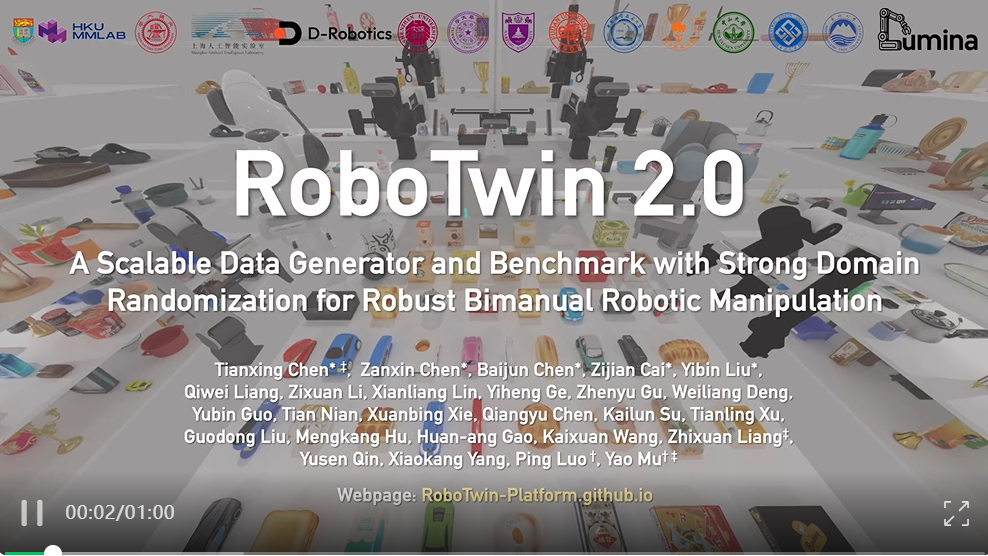
|
||||
|
||||
## Overview
|
||||
|
||||
| Property | Value |
|
||||
| ------------- | -------------------------------------------------------- |
|
||||
| Tasks | 50 dual-arm manipulation tasks |
|
||||
| Robot | Aloha-AgileX bimanual (14 DOF, 7 per arm) |
|
||||
| Action space | 14-dim joint-space, continuous in `[-1, 1]` |
|
||||
| Cameras | `head_camera`, `left_camera`, `right_camera` |
|
||||
| Simulator | SAPIEN (not MuJoCo) |
|
||||
| Eval protocol | 100 episodes/task, 50 demo_clean demonstrations |
|
||||
| Eval settings | **Easy** (`demo_clean`) and **Hard** (`demo_randomized`) |
|
||||
|
||||
## Available tasks
|
||||
|
||||
RoboTwin 2.0 ships 50 dual-arm manipulation tasks in its upstream `envs/` directory. The canonical list is the `ROBOTWIN_TASKS` tuple in `src/lerobot/envs/robotwin.py`, mirrored verbatim from the upstream repo. Example tasks:
|
||||
|
||||
| Task | CLI name | Category |
|
||||
| ------------------------ | ------------------------ | ----------------- |
|
||||
| Beat block with hammer | `beat_block_hammer` | Tool use |
|
||||
| Click bell / alarm clock | `click_bell` | Precision press |
|
||||
| Stack blocks (2 / 3) | `stack_blocks_two/three` | Stacking |
|
||||
| Stack bowls (2 / 3) | `stack_bowls_two/three` | Stacking |
|
||||
| Handover block / mic | `handover_block` | Bimanual coord. |
|
||||
| Lift pot | `lift_pot` | Bimanual lift |
|
||||
| Shake bottle | `shake_bottle` | Continuous motion |
|
||||
| Turn switch | `turn_switch` | Articulated obj |
|
||||
| Stamp seal | `stamp_seal` | Precision place |
|
||||
| Scan object | `scan_object` | Mobile manip. |
|
||||
|
||||
Pass a comma-separated list to `--env.task` to run multiple tasks in a single eval sweep.
|
||||
|
||||
<Tip warning={true}>
|
||||
`open_laptop` is currently broken upstream (its `check_success()` uses
|
||||
`self.arm_tag`, which is only set inside the scripted-expert `play_once()`
|
||||
path and therefore unavailable during normal policy eval). Avoid it until the
|
||||
upstream bug is fixed, or patch the task to default `self.arm_tag = "left"` in
|
||||
`load_actors()`.
|
||||
</Tip>
|
||||
|
||||
## Dataset
|
||||
|
||||
The RoboTwin 2.0 dataset is available in **LeRobot v3.0 format** on the Hugging Face Hub:
|
||||
|
||||
```
|
||||
lerobot/robotwin_unified
|
||||
```
|
||||
|
||||
It contains over 100,000 pre-collected trajectories across all 50 tasks (79.6 GB, Apache 2.0 license). No format conversion is needed — it is already in the correct LeRobot v3.0 schema with video observations and action labels.
|
||||
|
||||
You can load it directly with the HF Datasets library:
|
||||
|
||||
```python
|
||||
from datasets import load_dataset
|
||||
|
||||
ds = load_dataset("lerobot/robotwin_unified", split="train")
|
||||
```
|
||||
|
||||
## Installation
|
||||
|
||||
RoboTwin 2.0 requires **Linux** with an NVIDIA GPU (CUDA 12.1 recommended). Installation takes approximately 20 minutes.
|
||||
|
||||
### 1. Create a conda environment
|
||||
|
||||
```bash
|
||||
conda create -n robotwin python=3.10 -y
|
||||
conda activate robotwin
|
||||
```
|
||||
|
||||
### 2. Install LeRobot
|
||||
|
||||
```bash
|
||||
git clone https://github.com/huggingface/lerobot.git
|
||||
cd lerobot
|
||||
pip install -e "."
|
||||
```
|
||||
|
||||
### 3. Install RoboTwin 2.0
|
||||
|
||||
```bash
|
||||
git clone https://github.com/RoboTwin-Platform/RoboTwin.git
|
||||
cd RoboTwin
|
||||
bash script/_install.sh
|
||||
bash script/_download_assets.sh
|
||||
```
|
||||
|
||||
The install script handles all Python dependencies including SAPIEN, CuRobo, mplib, and pytorch3d.
|
||||
|
||||
<Tip warning={true}>
|
||||
If the automated install fails, install manually:
|
||||
|
||||
```bash
|
||||
pip install -r requirements.txt
|
||||
pip install "git+https://github.com/facebookresearch/pytorch3d.git@stable"
|
||||
cd envs && git clone https://github.com/NVlabs/curobo.git && cd curobo
|
||||
pip install -e . --no-build-isolation
|
||||
```
|
||||
|
||||
Then apply the required mplib fix: in `mplib/planner.py` line 807, remove `or collide` from the conditional.
|
||||
|
||||
</Tip>
|
||||
|
||||
### 4. Add RoboTwin to PYTHONPATH
|
||||
|
||||
The RoboTwin task modules must be importable by LeRobot. From within the `RoboTwin/` directory:
|
||||
|
||||
```bash
|
||||
export PYTHONPATH="${PYTHONPATH}:$(pwd)"
|
||||
```
|
||||
|
||||
Add this to your shell profile to make it permanent.
|
||||
|
||||
## Evaluation
|
||||
|
||||
### Standard evaluation (recommended)
|
||||
|
||||
Evaluate a policy on a single task with the official protocol (100 episodes):
|
||||
|
||||
```bash
|
||||
lerobot-eval \
|
||||
--policy.path="your-hf-policy-id" \
|
||||
--env.type=robotwin \
|
||||
--env.task=beat_block_hammer \
|
||||
--eval.batch_size=1 \
|
||||
--eval.n_episodes=100
|
||||
```
|
||||
|
||||
### Single-task quick check
|
||||
|
||||
```bash
|
||||
lerobot-eval \
|
||||
--policy.path="your-hf-policy-id" \
|
||||
--env.type=robotwin \
|
||||
--env.task=beat_block_hammer \
|
||||
--eval.batch_size=1 \
|
||||
--eval.n_episodes=5
|
||||
```
|
||||
|
||||
### Multi-task sweep
|
||||
|
||||
Evaluate on several tasks in one run:
|
||||
|
||||
```bash
|
||||
lerobot-eval \
|
||||
--policy.path="your-hf-policy-id" \
|
||||
--env.type=robotwin \
|
||||
--env.task=beat_block_hammer,click_bell,handover_block,stack_blocks_two \
|
||||
--eval.batch_size=1 \
|
||||
--eval.n_episodes=100
|
||||
```
|
||||
|
||||
### Full benchmark (all 50 tasks)
|
||||
|
||||
```bash
|
||||
lerobot-eval \
|
||||
--policy.path="your-hf-policy-id" \
|
||||
--env.type=robotwin \
|
||||
--env.task=adjust_bottle,beat_block_hammer,blocks_ranking_rgb,blocks_ranking_size,click_alarmclock,click_bell,dump_bin_bigbin,grab_roller,handover_block,handover_mic,hanging_mug,lift_pot,move_can_pot,move_pillbottle_pad,move_playingcard_away,move_stapler_pad,open_microwave,pick_diverse_bottles,pick_dual_bottles,place_a2b_left,place_a2b_right,place_bread_basket,place_bread_skillet,place_burger_fries,place_can_basket,place_cans_plasticbox,place_container_plate,place_dual_shoes,place_empty_cup,place_fan,place_mouse_pad,place_object_basket,place_object_scale,place_object_stand,place_phone_stand,place_shoe,press_stapler,put_bottles_dustbin,put_object_cabinet,rotate_qrcode,scan_object,shake_bottle,shake_bottle_horizontally,stack_blocks_three,stack_blocks_two,stack_bowls_three,stack_bowls_two,stamp_seal,turn_switch \
|
||||
--eval.batch_size=1 \
|
||||
--eval.n_episodes=100
|
||||
```
|
||||
|
||||
<Tip>
|
||||
`open_laptop` is intentionally omitted above because of the upstream
|
||||
`self.arm_tag` bug (see the **Available tasks** section). Re-add it once the
|
||||
upstream fix lands.
|
||||
</Tip>
|
||||
|
||||
## Camera configuration
|
||||
|
||||
By default, all three cameras are included:
|
||||
|
||||
| Camera key | Description |
|
||||
| -------------- | ------------------------------ |
|
||||
| `head_camera` | Torso-mounted overhead view |
|
||||
| `left_camera` | Left arm wrist-mounted camera |
|
||||
| `right_camera` | Right arm wrist-mounted camera |
|
||||
|
||||
To use a subset of cameras, override `--env.camera_names`:
|
||||
|
||||
```bash
|
||||
lerobot-eval \
|
||||
--policy.path="your-hf-policy-id" \
|
||||
--env.type=robotwin \
|
||||
--env.task=beat_block_hammer \
|
||||
--env.camera_names="head_camera,left_camera" \
|
||||
--eval.batch_size=1 \
|
||||
--eval.n_episodes=10
|
||||
```
|
||||
|
||||
## Environment config reference
|
||||
|
||||
Key parameters for `RoboTwinEnvConfig`:
|
||||
|
||||
| Parameter | Default | Description |
|
||||
| -------------------- | ---------------------------------------- | ---------------------------------- |
|
||||
| `task` | `"beat_block_hammer"` | Comma-separated task name(s) |
|
||||
| `fps` | `25` | Simulation FPS |
|
||||
| `episode_length` | `300` | Max steps per episode |
|
||||
| `obs_type` | `"pixels_agent_pos"` | `"pixels"` or `"pixels_agent_pos"` |
|
||||
| `camera_names` | `"head_camera,left_camera,right_camera"` | Comma-separated active cameras |
|
||||
| `observation_height` | `240` | Camera pixel height |
|
||||
| `observation_width` | `320` | Camera pixel width |
|
||||
|
||||
## Leaderboard submission
|
||||
|
||||
Results can be submitted to the [RoboTwin 2.0 leaderboard](https://robotwin-platform.github.io/leaderboard). The official protocol requires:
|
||||
|
||||
- Training on 50 `demo_clean` demonstrations per task
|
||||
- Evaluating 100 episodes per task
|
||||
- Reporting success rate separately for **Easy** (`demo_clean`) and **Hard** (`demo_randomized`) settings
|
||||
|
||||
For submission instructions, refer to the [RoboTwin 2.0 documentation](https://robotwin-platform.github.io/doc/).
|
||||
198
docs/source/tools.mdx
Normal file
198
docs/source/tools.mdx
Normal file
@@ -0,0 +1,198 @@
|
||||
# Tools
|
||||
|
||||
LeRobot v3.1 supports **tool calls** in policies — assistant messages can
|
||||
emit structured invocations like `say(text="OK, starting now")` that the
|
||||
runtime dispatches to a real implementation (TTS, controller, logger, …).
|
||||
|
||||
This page covers:
|
||||
|
||||
1. Where the tool catalog lives (PR 1).
|
||||
2. How the annotation pipeline produces tool-call atoms (PR 2).
|
||||
3. How to add your own tool (PR 3).
|
||||
|
||||
## Where tools are declared
|
||||
|
||||
Two layers.
|
||||
|
||||
**The catalog** — a list of OpenAI-style function schemas — lives at
|
||||
`meta/info.json["tools"]` on each dataset. Example:
|
||||
|
||||
```json
|
||||
{
|
||||
"features": { "...": "..." },
|
||||
"tools": [
|
||||
{
|
||||
"type": "function",
|
||||
"function": {
|
||||
"name": "say",
|
||||
"description": "Speak a short utterance to the user via the TTS executor.",
|
||||
"parameters": {
|
||||
"type": "object",
|
||||
"properties": {
|
||||
"text": { "type": "string", "description": "The verbatim text to speak." }
|
||||
},
|
||||
"required": ["text"]
|
||||
}
|
||||
}
|
||||
}
|
||||
]
|
||||
}
|
||||
```
|
||||
|
||||
Read it via the dataset metadata accessor:
|
||||
|
||||
```python
|
||||
from lerobot.datasets.dataset_metadata import LeRobotDatasetMetadata
|
||||
|
||||
meta = LeRobotDatasetMetadata(repo_id="pepijn/super_poulain_final_annotations")
|
||||
tools = meta.tools # list[dict] — OpenAI tool schemas
|
||||
```
|
||||
|
||||
If the dataset's `info.json` doesn't declare any tools, `meta.tools`
|
||||
returns `DEFAULT_TOOLS` from `lerobot.datasets.language` — currently a
|
||||
single-entry list with the canonical `say` schema. So unannotated
|
||||
datasets and chat-template consumers keep working without any
|
||||
configuration:
|
||||
|
||||
```python
|
||||
prompt_str = tokenizer.apply_chat_template(
|
||||
sample["messages"],
|
||||
tools=meta.tools, # works either way
|
||||
add_generation_prompt=False,
|
||||
tokenize=False,
|
||||
)
|
||||
```
|
||||
|
||||
**The implementations** — runnable Python — live under
|
||||
`src/lerobot/tools/`, one file per tool. The `say` implementation
|
||||
arrives in PR 3 and wraps Kyutai's pocket-tts model.
|
||||
|
||||
## Per-row tool *invocations*
|
||||
|
||||
The catalog above describes *what can be called*. The actual *call* — the
|
||||
function name plus the argument values — is stored per-row, on the
|
||||
assistant atoms in `language_events`:
|
||||
|
||||
```python
|
||||
{
|
||||
"role": "assistant",
|
||||
"content": null,
|
||||
"style": null,
|
||||
"timestamp": 12.4,
|
||||
"camera": null,
|
||||
"tool_calls": [
|
||||
{ "type": "function",
|
||||
"function": { "name": "say", "arguments": { "text": "On it." } } }
|
||||
]
|
||||
}
|
||||
```
|
||||
|
||||
Recipes splice these into rendered messages via `tool_calls_from`:
|
||||
|
||||
```yaml
|
||||
user_interjection_response:
|
||||
bindings:
|
||||
speech: "emitted_at(t, role=assistant, tool_name=say)"
|
||||
messages:
|
||||
- { role: user, content: "${task}", stream: high_level }
|
||||
- { role: assistant, content: "${current_plan}", stream: high_level,
|
||||
target: true, tool_calls_from: speech }
|
||||
```
|
||||
|
||||
The model's training target is one assistant turn that carries both the
|
||||
plan text *and* the `say` tool call. At inference, the runtime parses
|
||||
the generated text back into structured `tool_calls` and dispatches to
|
||||
the matching implementation.
|
||||
|
||||
## How to add your own tool
|
||||
|
||||
Three steps. Concrete example: a `record_observation` tool the policy
|
||||
can call to capture an extra observation outside the regular control
|
||||
loop.
|
||||
|
||||
### Step 1 — declare the schema
|
||||
|
||||
Add an entry under `meta/info.json["tools"]`. Either edit the file
|
||||
directly on disk *before* running the annotation pipeline (it'll be
|
||||
preserved) or hand it to `lerobot-annotate` via a config flag (PR 2 —
|
||||
exact CLI lands with the pipeline change).
|
||||
|
||||
```json
|
||||
{
|
||||
"tools": [
|
||||
{ "type": "function", "function": { "name": "say", "...": "..." } },
|
||||
{
|
||||
"type": "function",
|
||||
"function": {
|
||||
"name": "record_observation",
|
||||
"description": "Capture a high-resolution still image for the user.",
|
||||
"parameters": {
|
||||
"type": "object",
|
||||
"properties": {
|
||||
"label": { "type": "string", "description": "Short label for the saved image." }
|
||||
},
|
||||
"required": ["label"]
|
||||
}
|
||||
}
|
||||
}
|
||||
]
|
||||
}
|
||||
```
|
||||
|
||||
The schema follows OpenAI's function-calling convention exactly, so the
|
||||
chat template can render it natively.
|
||||
|
||||
### Step 2 — implement the call
|
||||
|
||||
Create `src/lerobot/tools/record_observation.py`:
|
||||
|
||||
```python
|
||||
from .base import Tool
|
||||
from typing import Any
|
||||
|
||||
RECORD_OBSERVATION_SCHEMA: dict[str, Any] = { "...": "..." } # mirrors the JSON above
|
||||
|
||||
|
||||
class RecordObservationTool:
|
||||
name = "record_observation"
|
||||
schema = RECORD_OBSERVATION_SCHEMA
|
||||
|
||||
def __init__(self, schema: dict | None = None, output_dir: str = "."):
|
||||
self.output_dir = output_dir
|
||||
|
||||
def call(self, arguments: dict) -> str:
|
||||
label = arguments["label"]
|
||||
# ... save the latest camera frame to <output_dir>/<label>.png ...
|
||||
return f"saved {label}.png"
|
||||
```
|
||||
|
||||
One file per tool keeps dependencies isolated — `record_observation`
|
||||
might pull `pillow`, while `say` (PR 3) pulls `pocket-tts`. Users
|
||||
installing only the tools they need avoid heavy transitive deps.
|
||||
|
||||
### Step 3 — register it
|
||||
|
||||
Add to `src/lerobot/tools/registry.py` (PR 3):
|
||||
|
||||
```python
|
||||
from .record_observation import RecordObservationTool
|
||||
|
||||
TOOL_REGISTRY["record_observation"] = RecordObservationTool
|
||||
```
|
||||
|
||||
That's it. At runtime `get_tools(meta)` looks up each schema in
|
||||
`meta.tools`, instantiates the matching registered class, and returns
|
||||
a name → instance dict the dispatcher can route into.
|
||||
|
||||
## Where this fits in the three-PR stack
|
||||
|
||||
| Layer | PR | What lands |
|
||||
|---|---|---|
|
||||
| Catalog storage in `meta/info.json` + `meta.tools` accessor | PR 1 | This page; `SAY_TOOL_SCHEMA`, `DEFAULT_TOOLS` constants in `lerobot.datasets.language`; `LeRobotDatasetMetadata.tools` property |
|
||||
| Annotation pipeline writes `tools` to meta after a run; honors anything users pre-populated | PR 2 | `lerobot-annotate` ensures `meta/info.json["tools"]` includes the canonical `say` and merges any user-declared tools |
|
||||
| Runnable implementations under `src/lerobot/tools/`; runtime dispatcher; `say.py` wired to Kyutai's pocket-tts | PR 3 | One file per tool; `Tool` protocol; `TOOL_REGISTRY`; optional `[tools]` extra in `pyproject.toml` |
|
||||
|
||||
If you want to use a tool *without* writing an implementation (e.g. for
|
||||
training-time chat-template formatting only), step 1 alone is enough —
|
||||
the model still learns to *generate* the call. Steps 2 and 3 are only
|
||||
needed to actually *execute* it at inference.
|
||||
176
docs/source/vlabench.mdx
Normal file
176
docs/source/vlabench.mdx
Normal file
@@ -0,0 +1,176 @@
|
||||
# VLABench
|
||||
|
||||
[VLABench](https://github.com/OpenMOSS/VLABench) is a large-scale benchmark for **language-conditioned robotic manipulation with long-horizon reasoning**. The upstream suite covers 100 task categories across 2,000+ objects and evaluates six dimensions of robot intelligence: mesh & texture understanding, spatial reasoning, world-knowledge transfer, semantic instruction comprehension, physical-law understanding, and long-horizon planning. Built on MuJoCo / dm_control with a Franka Panda 7-DOF arm. LeRobot exposes **43 of these tasks** through `--env.task` (21 primitives + 22 composites, see [Available tasks](#available-tasks) below).
|
||||
|
||||
- Paper: [VLABench: A Large-Scale Benchmark for Language-Conditioned Robotics Manipulation with Long-Horizon Reasoning](https://arxiv.org/abs/2412.18194)
|
||||
- GitHub: [OpenMOSS/VLABench](https://github.com/OpenMOSS/VLABench)
|
||||
- Project website: [vlabench.github.io](https://vlabench.github.io)
|
||||
- Pretrained policy: [`lerobot/smolvla_vlabench`](https://huggingface.co/lerobot/smolvla_vlabench)
|
||||
|
||||
<img
|
||||
src="https://huggingface.co/datasets/huggingface/documentation-images/resolve/main/lerobot/vlabench.png"
|
||||
alt="VLABench benchmark overview"
|
||||
width="85%"
|
||||
/>
|
||||
|
||||
## Available tasks
|
||||
|
||||
VLABench ships two task suites covering **43 task categories** in LeRobot's `--env.task` surface:
|
||||
|
||||
| Suite | CLI name | Tasks | Description |
|
||||
| --------- | ----------- | ----- | ---------------------------------------------------------------- |
|
||||
| Primitive | `primitive` | 21 | Single / few-skill combinations (select, insert, physics QA) |
|
||||
| Composite | `composite` | 22 | Multi-step reasoning and long-horizon planning (cook, rearrange) |
|
||||
|
||||
**Primitive tasks:** `select_fruit`, `select_toy`, `select_chemistry_tube`, `add_condiment`, `select_book`, `select_painting`, `select_drink`, `insert_flower`, `select_billiards`, `select_ingredient`, `select_mahjong`, `select_poker`, and physical-reasoning tasks (`density_qa`, `friction_qa`, `magnetism_qa`, `reflection_qa`, `simple_cuestick_usage`, `simple_seesaw_usage`, `sound_speed_qa`, `thermal_expansion_qa`, `weight_qa`).
|
||||
|
||||
**Composite tasks:** `cluster_billiards`, `cluster_book`, `cluster_drink`, `cluster_toy`, `cook_dishes`, `cool_drink`, `find_unseen_object`, `get_coffee`, `hammer_nail`, `heat_food`, `make_juice`, `play_mahjong`, `play_math_game`, `play_poker`, `play_snooker`, `rearrange_book`, `rearrange_chemistry_tube`, `set_dining_table`, `set_study_table`, `store_food`, `take_chemistry_experiment`, `use_seesaw_complex`.
|
||||
|
||||
`--env.task` accepts three forms:
|
||||
|
||||
- a single task name (`select_fruit`)
|
||||
- a comma-separated list (`select_fruit,heat_food`)
|
||||
- a suite shortcut (`primitive`, `composite`, or `primitive,composite`)
|
||||
|
||||
## Installation
|
||||
|
||||
VLABench is **not on PyPI** — its only distribution is the [OpenMOSS/VLABench](https://github.com/OpenMOSS/VLABench) GitHub repo — so LeRobot does not expose a `vlabench` extra. Install it manually as an editable clone, alongside the MuJoCo / dm_control pins VLABench needs, then fetch the mesh assets:
|
||||
|
||||
```bash
|
||||
# After following the standard LeRobot installation instructions.
|
||||
|
||||
git clone https://github.com/OpenMOSS/VLABench.git ~/VLABench
|
||||
git clone https://github.com/motion-planning/rrt-algorithms.git ~/rrt-algorithms
|
||||
pip install -e ~/VLABench -e ~/rrt-algorithms
|
||||
pip install "mujoco==3.2.2" "dm-control==1.0.22" \
|
||||
open3d colorlog scikit-learn openai gdown
|
||||
|
||||
python ~/VLABench/scripts/download_assets.py
|
||||
```
|
||||
|
||||
<Tip>
|
||||
VLABench requires Linux (`sys_platform == 'linux'`) and Python 3.10+. Set the MuJoCo rendering backend before running:
|
||||
|
||||
```bash
|
||||
export MUJOCO_GL=egl # for headless servers (HPC, cloud)
|
||||
```
|
||||
|
||||
</Tip>
|
||||
|
||||
## Evaluation
|
||||
|
||||
All eval snippets below mirror the command CI runs (see `.github/workflows/benchmark_tests.yml`). The `--rename_map` argument maps VLABench's `image` / `second_image` / `wrist_image` camera keys onto the three-camera (`camera1` / `camera2` / `camera3`) input layout the released `smolvla_vlabench` policy was trained on.
|
||||
|
||||
### Single-task evaluation (recommended for quick iteration)
|
||||
|
||||
```bash
|
||||
lerobot-eval \
|
||||
--policy.path=lerobot/smolvla_vlabench \
|
||||
--env.type=vlabench \
|
||||
--env.task=select_fruit \
|
||||
--eval.batch_size=1 \
|
||||
--eval.n_episodes=10 \
|
||||
--eval.use_async_envs=false \
|
||||
--policy.device=cuda \
|
||||
'--rename_map={"observation.images.image": "observation.images.camera1", "observation.images.second_image": "observation.images.camera2", "observation.images.wrist_image": "observation.images.camera3"}'
|
||||
```
|
||||
|
||||
### Multi-task evaluation
|
||||
|
||||
Pass a comma-separated list of tasks:
|
||||
|
||||
```bash
|
||||
lerobot-eval \
|
||||
--policy.path=lerobot/smolvla_vlabench \
|
||||
--env.type=vlabench \
|
||||
--env.task=select_fruit,select_toy,add_condiment,heat_food \
|
||||
--eval.batch_size=1 \
|
||||
--eval.n_episodes=10 \
|
||||
--eval.use_async_envs=false \
|
||||
--policy.device=cuda \
|
||||
'--rename_map={"observation.images.image": "observation.images.camera1", "observation.images.second_image": "observation.images.camera2", "observation.images.wrist_image": "observation.images.camera3"}'
|
||||
```
|
||||
|
||||
### Suite-wide evaluation
|
||||
|
||||
Run an entire suite (all 21 primitives or all 22 composites):
|
||||
|
||||
```bash
|
||||
lerobot-eval \
|
||||
--policy.path=lerobot/smolvla_vlabench \
|
||||
--env.type=vlabench \
|
||||
--env.task=primitive \
|
||||
--eval.batch_size=1 \
|
||||
--eval.n_episodes=10 \
|
||||
--eval.use_async_envs=false \
|
||||
--policy.device=cuda \
|
||||
--env.max_parallel_tasks=1 \
|
||||
'--rename_map={"observation.images.image": "observation.images.camera1", "observation.images.second_image": "observation.images.camera2", "observation.images.wrist_image": "observation.images.camera3"}'
|
||||
```
|
||||
|
||||
Or both suites:
|
||||
|
||||
```bash
|
||||
lerobot-eval \
|
||||
--policy.path=lerobot/smolvla_vlabench \
|
||||
--env.type=vlabench \
|
||||
--env.task=primitive,composite \
|
||||
--eval.batch_size=1 \
|
||||
--eval.n_episodes=10 \
|
||||
--eval.use_async_envs=false \
|
||||
--policy.device=cuda \
|
||||
--env.max_parallel_tasks=1 \
|
||||
'--rename_map={"observation.images.image": "observation.images.camera1", "observation.images.second_image": "observation.images.camera2", "observation.images.wrist_image": "observation.images.camera3"}'
|
||||
```
|
||||
|
||||
### Recommended evaluation episodes
|
||||
|
||||
**10 episodes per task** for reproducible benchmarking (210 total for the full primitive suite, 220 for composite). Matches the protocol in the VLABench paper.
|
||||
|
||||
## Policy inputs and outputs
|
||||
|
||||
**Observations:**
|
||||
|
||||
- `observation.state` — 7-dim end-effector state (position xyz + Euler xyz + gripper)
|
||||
- `observation.images.image` — front camera, 480×480 HWC uint8
|
||||
- `observation.images.second_image` — second camera, 480×480 HWC uint8
|
||||
- `observation.images.wrist_image` — wrist camera, 480×480 HWC uint8
|
||||
|
||||
**Actions:**
|
||||
|
||||
- Continuous control in `Box(-1, 1, shape=(7,))` — 3D position + 3D Euler orientation + 1D gripper.
|
||||
|
||||
## Training
|
||||
|
||||
### Datasets
|
||||
|
||||
Pre-collected VLABench datasets in LeRobot format on the Hub:
|
||||
|
||||
- [`VLABench/vlabench_primitive_ft_lerobot_video`](https://huggingface.co/datasets/VLABench/vlabench_primitive_ft_lerobot_video) — 5,000 episodes, 128 tasks, 480×480 images.
|
||||
- [`VLABench/vlabench_composite_ft_lerobot_video`](https://huggingface.co/datasets/VLABench/vlabench_composite_ft_lerobot_video) — 5,977 episodes, 167 tasks, 224×224 images.
|
||||
|
||||
### Example training command
|
||||
|
||||
Fine-tune a SmolVLA base on the primitive suite:
|
||||
|
||||
```bash
|
||||
lerobot-train \
|
||||
--policy.type=smolvla \
|
||||
--policy.repo_id=${HF_USER}/smolvla_vlabench_primitive \
|
||||
--policy.load_vlm_weights=true \
|
||||
--policy.push_to_hub=true \
|
||||
--dataset.repo_id=VLABench/vlabench_primitive_ft_lerobot_video \
|
||||
--env.type=vlabench \
|
||||
--env.task=select_fruit \
|
||||
--output_dir=./outputs/smolvla_vlabench_primitive \
|
||||
--steps=100000 \
|
||||
--batch_size=4 \
|
||||
--eval_freq=5000 \
|
||||
--eval.batch_size=1 \
|
||||
--eval.n_episodes=1 \
|
||||
--save_freq=10000
|
||||
```
|
||||
|
||||
## Reproducing published results
|
||||
|
||||
The released checkpoint [`lerobot/smolvla_vlabench`](https://huggingface.co/lerobot/smolvla_vlabench) was trained on the primitive-suite dataset above and is evaluated with the [Single-task](#single-task-evaluation-recommended-for-quick-iteration) / [Suite-wide](#suite-wide-evaluation) commands. CI runs a 10-primitive-task smoke eval (one episode each) on every PR touching the benchmark.
|
||||
@@ -95,7 +95,7 @@ dependencies = [
|
||||
|
||||
# ── Feature-scoped extras ──────────────────────────────────
|
||||
dataset = [
|
||||
"datasets>=4.0.0,<5.0.0",
|
||||
"datasets>=4.7.0,<5.0.0",
|
||||
"pandas>=2.0.0,<3.0.0", # NOTE: Transitive dependency of datasets
|
||||
"pyarrow>=21.0.0,<30.0.0", # NOTE: Transitive dependency of datasets
|
||||
"lerobot[av-dep]",
|
||||
@@ -212,6 +212,15 @@ aloha = ["lerobot[dataset]", "gym-aloha>=0.1.2,<0.2.0", "lerobot[scipy-dep]"]
|
||||
pusht = ["lerobot[dataset]", "gym-pusht>=0.1.5,<0.2.0", "pymunk>=6.6.0,<7.0.0"] # TODO: Fix pymunk version in gym-pusht instead
|
||||
libero = ["lerobot[dataset]", "lerobot[transformers-dep]", "hf-libero>=0.1.3,<0.2.0; sys_platform == 'linux'", "lerobot[scipy-dep]"]
|
||||
metaworld = ["lerobot[dataset]", "metaworld==3.0.0", "lerobot[scipy-dep]"]
|
||||
# NOTE: vlabench is NOT exposed as a `lerobot` extra. Its only distribution
|
||||
# is the OpenMOSS/VLABench GitHub repo (package name `VLABench`, no PyPI
|
||||
# release), so any `vlabench>=X` pip spec is unresolvable. Install it
|
||||
# manually alongside MuJoCo / dm-control — see docs/source/vlabench.mdx
|
||||
# for the recipe.
|
||||
# NOTE: robomme is NOT a pyproject extra — mani-skill hard-pins numpy<2
|
||||
# which conflicts with lerobot's numpy>=2 base pin, so the two trees can't
|
||||
# resolve into a single env. Install it only in the RoboMME Docker image
|
||||
# via `uv pip install --override` (see docker/Dockerfile.benchmark.robomme).
|
||||
# NOTE: robocasa is NOT exposed as a `lerobot` extra. Its setup.py pins
|
||||
# `lerobot==0.3.3` in install_requires, which cyclically shadows our own
|
||||
# workspace `lerobot` and makes the graph unsolvable under any resolver
|
||||
|
||||
@@ -31,9 +31,23 @@ from __future__ import annotations
|
||||
|
||||
import argparse
|
||||
import json
|
||||
import re
|
||||
import sys
|
||||
from pathlib import Path
|
||||
|
||||
# LIBERO-plus derives task.language by space-joining the perturbation-variant
|
||||
# filename (grab_language_from_filename in libero/libero/benchmark/__init__.py),
|
||||
# so non-_language_ variants inherit a trailing metadata blob like
|
||||
# "view 0 0 100 0 0 initstate 0 noise 45" or "add 16". Strip those tokens so
|
||||
# the description matches the base instruction used in the training dataset.
|
||||
_LIBERO_PERTURBATION_TAIL_RE = re.compile(
|
||||
r"(?:\s(?:view|initstate|noise|add|tb|table|light|level)(?:\s\d+)+)+$"
|
||||
)
|
||||
|
||||
|
||||
def _strip_libero_perturbation_tail(instruction: str) -> str:
|
||||
return _LIBERO_PERTURBATION_TAIL_RE.sub("", instruction).strip()
|
||||
|
||||
|
||||
def _libero_descriptions(task_suite: str) -> dict[str, str]:
|
||||
from libero.libero import benchmark # type: ignore[import-untyped]
|
||||
@@ -47,7 +61,10 @@ def _libero_descriptions(task_suite: str) -> dict[str, str]:
|
||||
)
|
||||
return {}
|
||||
suite = suite_dict[task_suite]()
|
||||
return {f"{task_suite}_{i}": suite.get_task(i).language for i in range(suite.n_tasks)}
|
||||
return {
|
||||
f"{task_suite}_{i}": _strip_libero_perturbation_tail(suite.get_task(i).language)
|
||||
for i in range(suite.n_tasks)
|
||||
}
|
||||
|
||||
|
||||
def _metaworld_descriptions(task_name: str) -> dict[str, str]:
|
||||
@@ -57,6 +74,24 @@ def _metaworld_descriptions(task_name: str) -> dict[str, str]:
|
||||
return {f"{task_name}_0": label}
|
||||
|
||||
|
||||
def _robotwin_descriptions(task_names: str) -> dict[str, str]:
|
||||
"""Return descriptions for each requested RoboTwin task. Reads
|
||||
`description/task_instruction/<task>.json` from the RoboTwin clone
|
||||
(cwd is /opt/robotwin in CI). Falls back to the task name if missing."""
|
||||
out: dict[str, str] = {}
|
||||
root = Path("description/task_instruction")
|
||||
for name in (t.strip() for t in task_names.split(",") if t.strip()):
|
||||
desc_file = root / f"{name}.json"
|
||||
desc = name.replace("_", " ")
|
||||
if desc_file.is_file():
|
||||
data = json.loads(desc_file.read_text())
|
||||
full = data.get("full_description") or desc
|
||||
# Strip the schema placeholders ({A}, {a}) — keep the sentence readable.
|
||||
desc = full.replace("<", "").replace(">", "")
|
||||
out[f"{name}_0"] = desc
|
||||
return out
|
||||
|
||||
|
||||
def _robocasa_descriptions(task_spec: str) -> dict[str, str]:
|
||||
"""For each task in the comma-separated list, emit a cleaned-name label.
|
||||
|
||||
@@ -74,21 +109,85 @@ def _robocasa_descriptions(task_spec: str) -> dict[str, str]:
|
||||
return out
|
||||
|
||||
|
||||
_ROBOMME_DESCRIPTIONS = {
|
||||
"BinFill": "Fill the target bin with the correct number of cubes",
|
||||
"PickXtimes": "Pick the indicated cube the specified number of times",
|
||||
"SwingXtimes": "Swing the object the specified number of times",
|
||||
"StopCube": "Grasp and stop the moving cube",
|
||||
"VideoUnmask": "Pick the cube shown in the reference video",
|
||||
"VideoUnmaskSwap": "Pick the cube matching the reference video after a swap",
|
||||
"ButtonUnmask": "Press the button indicated by the reference",
|
||||
"ButtonUnmaskSwap": "Press the correct button after objects are swapped",
|
||||
"PickHighlight": "Pick the highlighted cube",
|
||||
"VideoRepick": "Repick the cube shown in the reference video",
|
||||
"VideoPlaceButton": "Place the cube on the button shown in the video",
|
||||
"VideoPlaceOrder": "Place cubes in the order shown in the video",
|
||||
"MoveCube": "Move the cube to the target location",
|
||||
"InsertPeg": "Insert the peg into the target hole",
|
||||
"PatternLock": "Unlock the pattern by pressing buttons in sequence",
|
||||
"RouteStick": "Route the stick through the required waypoints",
|
||||
}
|
||||
|
||||
|
||||
def _robomme_descriptions(task_names: str, task_ids: list[int] | None = None) -> dict[str, str]:
|
||||
"""Return descriptions for each requested RoboMME task. Keys match the
|
||||
video filename pattern `<task>_<task_id>` used by the eval script."""
|
||||
if task_ids is None:
|
||||
task_ids = [0]
|
||||
out: dict[str, str] = {}
|
||||
for name in (t.strip() for t in task_names.split(",") if t.strip()):
|
||||
desc = _ROBOMME_DESCRIPTIONS.get(name, name)
|
||||
for tid in task_ids:
|
||||
out[f"{name}_{tid}"] = desc
|
||||
return out
|
||||
|
||||
|
||||
def _vlabench_descriptions(task_spec: str) -> dict[str, str]:
|
||||
"""For each task in the comma-separated list, emit a cleaned-name label.
|
||||
|
||||
VLABench tasks carry language instructions on their dm_control task
|
||||
object, but pulling them requires loading the full env per task
|
||||
(~seconds each). The CI smoke-eval already captures the instruction
|
||||
inside its episode info; this mapping is just enough to key
|
||||
`metrics.json` by `<task>_0`.
|
||||
"""
|
||||
out: dict[str, str] = {}
|
||||
for task in (t.strip() for t in task_spec.split(",") if t.strip()):
|
||||
out[f"{task}_0"] = task.replace("_", " ").strip()
|
||||
return out
|
||||
|
||||
|
||||
def main() -> int:
|
||||
parser = argparse.ArgumentParser(description=__doc__)
|
||||
parser.add_argument("--env", required=True, help="Environment family (libero, metaworld, ...)")
|
||||
parser.add_argument("--task", required=True, help="Task/suite name (e.g. libero_spatial)")
|
||||
parser.add_argument(
|
||||
"--task-ids",
|
||||
type=str,
|
||||
default=None,
|
||||
help="Comma-separated task IDs (e.g. '0,1,2'). Default: [0]",
|
||||
)
|
||||
parser.add_argument("--output", required=True, help="Path to write task_descriptions.json")
|
||||
args = parser.parse_args()
|
||||
|
||||
task_ids: list[int] | None = None
|
||||
if args.task_ids:
|
||||
task_ids = [int(x.strip()) for x in args.task_ids.split(",")]
|
||||
|
||||
descriptions: dict[str, str] = {}
|
||||
try:
|
||||
if args.env == "libero":
|
||||
if args.env == ("libero", "libero_plus"):
|
||||
descriptions = _libero_descriptions(args.task)
|
||||
elif args.env == "metaworld":
|
||||
descriptions = _metaworld_descriptions(args.task)
|
||||
elif args.env == "robotwin":
|
||||
descriptions = _robotwin_descriptions(args.task)
|
||||
elif args.env == "robocasa":
|
||||
descriptions = _robocasa_descriptions(args.task)
|
||||
elif args.env == "robomme":
|
||||
descriptions = _robomme_descriptions(args.task, task_ids=task_ids)
|
||||
elif args.env == "vlabench":
|
||||
descriptions = _vlabench_descriptions(args.task)
|
||||
else:
|
||||
print(
|
||||
f"[extract_task_descriptions] No description extractor for env '{args.env}'.",
|
||||
|
||||
@@ -23,6 +23,7 @@ Import them directly: ``from lerobot.configs.train import TrainPipelineConfig``
|
||||
|
||||
from .default import DatasetConfig, EvalConfig, PeftConfig, WandBConfig
|
||||
from .policies import PreTrainedConfig
|
||||
from .recipe import MessageTurn, TrainingRecipe, load_recipe
|
||||
from .types import (
|
||||
FeatureType,
|
||||
NormalizationMode,
|
||||
@@ -41,7 +42,10 @@ __all__ = [
|
||||
# Config classes
|
||||
"DatasetConfig",
|
||||
"EvalConfig",
|
||||
"MessageTurn",
|
||||
"PeftConfig",
|
||||
"PreTrainedConfig",
|
||||
"TrainingRecipe",
|
||||
"WandBConfig",
|
||||
"load_recipe",
|
||||
]
|
||||
|
||||
193
src/lerobot/configs/recipe.py
Normal file
193
src/lerobot/configs/recipe.py
Normal file
@@ -0,0 +1,193 @@
|
||||
#!/usr/bin/env python
|
||||
|
||||
# Copyright 2026 The HuggingFace Inc. team. All rights reserved.
|
||||
#
|
||||
# Licensed under the Apache License, Version 2.0 (the "License");
|
||||
# you may not use this file except in compliance with the License.
|
||||
# You may obtain a copy of the License at
|
||||
#
|
||||
# http://www.apache.org/licenses/LICENSE-2.0
|
||||
#
|
||||
# Unless required by applicable law or agreed to in writing, software
|
||||
# distributed under the License is distributed on an "AS IS" BASIS,
|
||||
# WITHOUT WARRANTIES OR CONDITIONS OF ANY KIND, either express or implied.
|
||||
# See the License for the specific language governing permissions and
|
||||
# limitations under the License.
|
||||
|
||||
from __future__ import annotations
|
||||
|
||||
import re
|
||||
from dataclasses import dataclass
|
||||
from pathlib import Path
|
||||
from typing import Any, Literal, get_args
|
||||
|
||||
MessageRole = Literal["user", "assistant", "system", "tool"]
|
||||
MessageStream = Literal["high_level", "low_level"]
|
||||
|
||||
DEFAULT_BINDINGS = {
|
||||
"subtask": "active_at(t, style=subtask)",
|
||||
"memory": "active_at(t, style=memory)",
|
||||
"plan": "active_at(t, style=plan)",
|
||||
"speech": "emitted_at(t, role=assistant, tool_name=say)",
|
||||
"interjection": "emitted_at(t, style=interjection)",
|
||||
"vqa": "emitted_at(t, style=vqa, role=assistant)",
|
||||
"vqa_query": "emitted_at(t, style=vqa, role=user)",
|
||||
}
|
||||
|
||||
_PLACEHOLDER_RE = re.compile(r"\$\{([A-Za-z_][A-Za-z0-9_]*)\}")
|
||||
_VALID_ROLES = frozenset(get_args(MessageRole))
|
||||
_VALID_STREAMS = frozenset(get_args(MessageStream))
|
||||
|
||||
|
||||
@dataclass
|
||||
class MessageTurn:
|
||||
"""A single chat-style turn in a recipe template.
|
||||
|
||||
``content`` may be a plain string, a list of HF-style multimodal blocks, or
|
||||
``None`` when ``tool_calls_from`` supplies tool-call payloads instead.
|
||||
``stream`` tags the turn for downstream filtering, ``target`` flags it as a
|
||||
training target, and ``if_present`` skips the turn when the named binding
|
||||
resolves to ``None``.
|
||||
"""
|
||||
|
||||
role: MessageRole
|
||||
content: str | list[dict[str, Any]] | None = None
|
||||
stream: MessageStream | None = None
|
||||
target: bool = False
|
||||
if_present: str | None = None
|
||||
tool_calls_from: str | None = None
|
||||
|
||||
def __post_init__(self) -> None:
|
||||
"""Validate role, stream, and content after dataclass construction."""
|
||||
if self.role not in _VALID_ROLES:
|
||||
raise ValueError(f"Unsupported message role: {self.role!r}")
|
||||
if self.stream is not None and self.stream not in _VALID_STREAMS:
|
||||
raise ValueError(f"Unsupported message stream: {self.stream!r}")
|
||||
if self.content is None and self.tool_calls_from is None:
|
||||
raise ValueError("MessageTurn.content is required unless tool_calls_from is set.")
|
||||
if self.content is not None and not isinstance(self.content, (str, list)):
|
||||
raise TypeError("MessageTurn.content must be a string, a list of HF-style blocks, or None.")
|
||||
if isinstance(self.content, list):
|
||||
for block in self.content:
|
||||
if not isinstance(block, dict) or "type" not in block:
|
||||
raise ValueError(
|
||||
"Multimodal content blocks must be HF-style dictionaries with a type key."
|
||||
)
|
||||
|
||||
@classmethod
|
||||
def from_dict(cls, data: dict[str, Any]) -> MessageTurn:
|
||||
"""Construct a :class:`MessageTurn` from a plain dictionary."""
|
||||
return cls(**data)
|
||||
|
||||
|
||||
@dataclass
|
||||
class TrainingRecipe:
|
||||
"""A recipe describing how to render training samples from language rows.
|
||||
|
||||
A recipe is either a *message recipe* (``messages`` plus optional
|
||||
``bindings``) or a *blend recipe* (``blend`` mapping names to weighted
|
||||
sub-recipes). ``weight`` is only meaningful inside a blend.
|
||||
"""
|
||||
|
||||
messages: list[MessageTurn] | None = None
|
||||
bindings: dict[str, str] | None = None
|
||||
blend: dict[str, TrainingRecipe] | None = None
|
||||
weight: float | None = None
|
||||
|
||||
def __post_init__(self) -> None:
|
||||
"""Validate that exactly one of ``messages`` or ``blend`` is set."""
|
||||
if self.messages is not None and self.blend is not None:
|
||||
raise ValueError("TrainingRecipe must set only one of messages or blend.")
|
||||
if self.messages is None and self.blend is None:
|
||||
raise ValueError("TrainingRecipe must set one of messages or blend.")
|
||||
|
||||
if self.messages is not None:
|
||||
self._validate_message_recipe()
|
||||
if self.blend is not None:
|
||||
self._validate_blend_recipe()
|
||||
|
||||
@classmethod
|
||||
def from_dict(cls, data: dict[str, Any]) -> TrainingRecipe:
|
||||
"""Construct a :class:`TrainingRecipe` from a nested dictionary."""
|
||||
data = dict(data)
|
||||
if data.get("messages") is not None:
|
||||
data["messages"] = [
|
||||
turn if isinstance(turn, MessageTurn) else MessageTurn.from_dict(turn)
|
||||
for turn in data["messages"]
|
||||
]
|
||||
if data.get("blend") is not None:
|
||||
data["blend"] = {
|
||||
name: recipe if isinstance(recipe, TrainingRecipe) else cls.from_dict(recipe)
|
||||
for name, recipe in data["blend"].items()
|
||||
}
|
||||
return cls(**data)
|
||||
|
||||
@classmethod
|
||||
def from_yaml(cls, path: str | Path) -> TrainingRecipe:
|
||||
"""Load a :class:`TrainingRecipe` from a YAML file at ``path``."""
|
||||
import yaml # type: ignore[import-untyped]
|
||||
|
||||
with open(path) as f:
|
||||
data = yaml.safe_load(f)
|
||||
if not isinstance(data, dict):
|
||||
raise ValueError(f"Recipe YAML must contain a mapping at the top level: {path}")
|
||||
return cls.from_dict(data)
|
||||
|
||||
def _validate_message_recipe(self) -> None:
|
||||
"""Ensure every templated binding is known and at least one turn is a target."""
|
||||
assert self.messages is not None
|
||||
known_bindings = set(DEFAULT_BINDINGS) | set(self.bindings or {}) | {"task"}
|
||||
|
||||
for turn in self.messages:
|
||||
missing = self._referenced_bindings(turn) - known_bindings
|
||||
if missing:
|
||||
raise ValueError(f"MessageTurn references unknown binding(s): {sorted(missing)}")
|
||||
|
||||
if not any(turn.target for turn in self.messages):
|
||||
raise ValueError("Message recipes must contain at least one target turn.")
|
||||
|
||||
def _validate_blend_recipe(self) -> None:
|
||||
"""Ensure each blend component is a non-empty, weighted message recipe."""
|
||||
assert self.blend is not None
|
||||
if not self.blend:
|
||||
raise ValueError("Blend recipes must contain at least one component.")
|
||||
|
||||
for name, recipe in self.blend.items():
|
||||
if recipe.blend is not None:
|
||||
raise ValueError(f"Blend component {name!r} cannot itself define a blend.")
|
||||
if recipe.messages is None:
|
||||
raise ValueError(f"Blend component {name!r} must define messages.")
|
||||
if recipe.weight is None:
|
||||
raise ValueError(f"Blend component {name!r} must define weight.")
|
||||
if recipe.weight <= 0:
|
||||
raise ValueError(f"Blend component {name!r} must have a positive weight.")
|
||||
|
||||
def _referenced_bindings(self, turn: MessageTurn) -> set[str]:
|
||||
"""Return the binding names that ``turn`` references via placeholders or attributes."""
|
||||
names: set[str] = set()
|
||||
if turn.if_present is not None:
|
||||
names.add(turn.if_present)
|
||||
if turn.tool_calls_from is not None:
|
||||
names.add(turn.tool_calls_from)
|
||||
names.update(_placeholders_in_content(turn.content))
|
||||
return names
|
||||
|
||||
|
||||
def _placeholders_in_content(content: str | list[dict[str, Any]] | None) -> set[str]:
|
||||
"""Return the set of ``${name}`` placeholders found anywhere in ``content``."""
|
||||
if content is None:
|
||||
return set()
|
||||
if isinstance(content, str):
|
||||
return set(_PLACEHOLDER_RE.findall(content))
|
||||
|
||||
names: set[str] = set()
|
||||
for block in content:
|
||||
for value in block.values():
|
||||
if isinstance(value, str):
|
||||
names.update(_PLACEHOLDER_RE.findall(value))
|
||||
return names
|
||||
|
||||
|
||||
def load_recipe(path: str | Path) -> TrainingRecipe:
|
||||
"""Load a :class:`TrainingRecipe` from a YAML file at ``path``."""
|
||||
return TrainingRecipe.from_yaml(path)
|
||||
74
src/lerobot/configs/recipes/pi05_hirobot.yaml
Normal file
74
src/lerobot/configs/recipes/pi05_hirobot.yaml
Normal file
@@ -0,0 +1,74 @@
|
||||
blend:
|
||||
|
||||
memory_update:
|
||||
weight: 0.10
|
||||
bindings:
|
||||
prior_memory: "nth_prev(style=memory, offset=1)"
|
||||
current_memory: "emitted_at(t, style=memory)"
|
||||
completed_subtask: "nth_prev(style=subtask, offset=1)"
|
||||
messages:
|
||||
- {role: user, content: "${task}", stream: high_level}
|
||||
- {role: assistant, content: "Previous memory: ${prior_memory}", stream: high_level, if_present: prior_memory}
|
||||
- {role: user, content: "Completed subtask: ${completed_subtask}", stream: high_level, if_present: completed_subtask}
|
||||
- {role: assistant, content: "${current_memory}", stream: high_level, target: true, if_present: current_memory}
|
||||
|
||||
user_interjection_response:
|
||||
weight: 0.16
|
||||
bindings:
|
||||
prior_plan: "nth_prev(style=plan, offset=1)"
|
||||
current_plan: "emitted_at(t, style=plan)"
|
||||
interjection: "emitted_at(t, style=interjection)"
|
||||
speech: "emitted_at(t, role=assistant, tool_name=say)"
|
||||
messages:
|
||||
- {role: user, content: "${task}", stream: high_level}
|
||||
- {role: assistant, content: "Previous plan:\n${prior_plan}", stream: high_level, if_present: prior_plan}
|
||||
- {role: user, content: "${interjection}", stream: high_level, if_present: interjection}
|
||||
- {role: assistant, content: "${current_plan}", stream: high_level, target: true, if_present: current_plan, tool_calls_from: speech}
|
||||
|
||||
high_level_subtask:
|
||||
weight: 0.15
|
||||
bindings:
|
||||
next_subtask: "nth_next(style=subtask, offset=1)"
|
||||
messages:
|
||||
- {role: user, content: "${task}\nPlan: ${plan}\nMemory: ${memory}", stream: high_level}
|
||||
- {role: user, content: "Current subtask: ${subtask}", stream: high_level, if_present: subtask}
|
||||
- {role: assistant, content: "${next_subtask}", stream: high_level, target: true}
|
||||
|
||||
low_level_execution:
|
||||
weight: 0.35
|
||||
messages:
|
||||
- {role: user, content: "${task}\nPlan: ${plan}\nMemory: ${memory}", stream: high_level}
|
||||
- {role: assistant, content: "${subtask}", stream: low_level, target: true}
|
||||
|
||||
# VQA is view-dependent: bbox / keypoint / count answers only make sense for
|
||||
# the camera they were grounded against. Each camera gets its own sub-recipe
|
||||
# so the resolver can disambiguate via `camera=...` and the user-turn carries
|
||||
# the matching image block. Adjust the camera keys (and add more sub-recipes)
|
||||
# to match the cameras present on your dataset.
|
||||
ask_vqa_top:
|
||||
weight: 0.10
|
||||
bindings:
|
||||
vqa_query: "emitted_at(t, style=vqa, role=user, camera=observation.images.top)"
|
||||
vqa: "emitted_at(t, style=vqa, role=assistant, camera=observation.images.top)"
|
||||
messages:
|
||||
- role: user
|
||||
stream: high_level
|
||||
if_present: vqa_query
|
||||
content:
|
||||
- {type: image, feature: observation.images.top}
|
||||
- {type: text, text: "${vqa_query}"}
|
||||
- {role: assistant, content: "${vqa}", stream: high_level, target: true, if_present: vqa}
|
||||
|
||||
ask_vqa_wrist:
|
||||
weight: 0.10
|
||||
bindings:
|
||||
vqa_query: "emitted_at(t, style=vqa, role=user, camera=observation.images.wrist)"
|
||||
vqa: "emitted_at(t, style=vqa, role=assistant, camera=observation.images.wrist)"
|
||||
messages:
|
||||
- role: user
|
||||
stream: high_level
|
||||
if_present: vqa_query
|
||||
content:
|
||||
- {type: image, feature: observation.images.wrist}
|
||||
- {type: text, text: "${vqa_query}"}
|
||||
- {role: assistant, content: "${vqa}", stream: high_level, target: true, if_present: vqa}
|
||||
@@ -37,6 +37,14 @@ from .dataset_tools import (
|
||||
from .factory import make_dataset, resolve_delta_timestamps
|
||||
from .image_writer import safe_stop_image_writer
|
||||
from .io_utils import load_episodes, write_stats
|
||||
from .language import (
|
||||
EVENT_ONLY_STYLES,
|
||||
LANGUAGE_EVENTS,
|
||||
LANGUAGE_PERSISTENT,
|
||||
PERSISTENT_STYLES,
|
||||
STYLE_REGISTRY,
|
||||
column_for_style,
|
||||
)
|
||||
from .lerobot_dataset import LeRobotDataset
|
||||
from .multi_dataset import MultiLeRobotDataset
|
||||
from .pipeline_features import aggregate_pipeline_dataset_features, create_initial_features
|
||||
@@ -53,10 +61,15 @@ __all__ = [
|
||||
"CODEBASE_VERSION",
|
||||
"DEFAULT_EPISODES_PATH",
|
||||
"DEFAULT_QUANTILES",
|
||||
"EVENT_ONLY_STYLES",
|
||||
"EpisodeAwareSampler",
|
||||
"LANGUAGE_EVENTS",
|
||||
"LANGUAGE_PERSISTENT",
|
||||
"LeRobotDataset",
|
||||
"LeRobotDatasetMetadata",
|
||||
"MultiLeRobotDataset",
|
||||
"PERSISTENT_STYLES",
|
||||
"STYLE_REGISTRY",
|
||||
"StreamingLeRobotDataset",
|
||||
"VideoEncodingManager",
|
||||
"add_features",
|
||||
@@ -66,6 +79,7 @@ __all__ = [
|
||||
"convert_image_to_video_dataset",
|
||||
"create_initial_features",
|
||||
"create_lerobot_dataset_card",
|
||||
"column_for_style",
|
||||
"delete_episodes",
|
||||
"get_feature_stats",
|
||||
"load_episodes",
|
||||
|
||||
@@ -512,7 +512,7 @@ def compute_episode_stats(
|
||||
|
||||
ep_stats = {}
|
||||
for key, data in episode_data.items():
|
||||
if features[key]["dtype"] == "string":
|
||||
if features[key]["dtype"] in {"string", "language"}:
|
||||
continue
|
||||
|
||||
if features[key]["dtype"] in ["image", "video"]:
|
||||
|
||||
@@ -34,7 +34,6 @@ from .io_utils import (
|
||||
load_episodes,
|
||||
load_info,
|
||||
load_stats,
|
||||
load_subtasks,
|
||||
load_tasks,
|
||||
write_info,
|
||||
write_json,
|
||||
@@ -177,7 +176,6 @@ class LeRobotDatasetMetadata:
|
||||
self.info = load_info(self.root)
|
||||
check_version_compatibility(self.repo_id, self._version, CODEBASE_VERSION)
|
||||
self.tasks = load_tasks(self.root)
|
||||
self.subtasks = load_subtasks(self.root)
|
||||
self.episodes = load_episodes(self.root)
|
||||
self.stats = load_stats(self.root)
|
||||
|
||||
@@ -320,6 +318,28 @@ class LeRobotDatasetMetadata:
|
||||
"""Keys to access visual modalities (regardless of their storage method)."""
|
||||
return [key for key, ft in self.features.items() if ft["dtype"] in ["video", "image"]]
|
||||
|
||||
@property
|
||||
def tools(self) -> list[dict]:
|
||||
"""OpenAI-style tool schemas declared by this dataset.
|
||||
|
||||
Read from ``meta/info.json["tools"]``. Returns a copy, so callers
|
||||
can mutate the result safely. Falls back to
|
||||
:data:`lerobot.datasets.language.DEFAULT_TOOLS` (the canonical
|
||||
``say`` schema) when the dataset doesn't declare any — that way
|
||||
unannotated datasets and chat-template consumers
|
||||
(``apply_chat_template(messages, tools=meta.tools)``) keep
|
||||
working out of the box.
|
||||
|
||||
Implementations live under :mod:`lerobot.tools` (one file per
|
||||
tool); see ``docs/source/tools.mdx`` for the authoring guide.
|
||||
"""
|
||||
from .language import DEFAULT_TOOLS # noqa: PLC0415 (avoid circular import)
|
||||
|
||||
declared = self.info.get("tools")
|
||||
if isinstance(declared, list) and declared:
|
||||
return [dict(t) for t in declared]
|
||||
return [dict(t) for t in DEFAULT_TOOLS]
|
||||
|
||||
@property
|
||||
def names(self) -> dict[str, list | dict]:
|
||||
"""Names of the various dimensions of vector modalities."""
|
||||
@@ -635,7 +655,6 @@ class LeRobotDatasetMetadata:
|
||||
_validate_feature_names(features)
|
||||
|
||||
obj.tasks = None
|
||||
obj.subtasks = None
|
||||
obj.episodes = None
|
||||
obj.stats = None
|
||||
obj.info = create_empty_dataset_info(
|
||||
|
||||
@@ -295,9 +295,4 @@ class DatasetReader:
|
||||
task_idx = item["task_index"].item()
|
||||
item["task"] = self._meta.tasks.iloc[task_idx].name
|
||||
|
||||
# add subtask information if available
|
||||
if "subtask_index" in self._meta.features and self._meta.subtasks is not None:
|
||||
subtask_idx = item["subtask_index"].item()
|
||||
item["subtask"] = self._meta.subtasks.iloc[subtask_idx].name
|
||||
|
||||
return item
|
||||
|
||||
@@ -22,6 +22,12 @@ from PIL import Image as PILImage
|
||||
from lerobot.utils.constants import DEFAULT_FEATURES
|
||||
from lerobot.utils.utils import is_valid_numpy_dtype_string
|
||||
|
||||
from .language import (
|
||||
LANGUAGE_PERSISTENT,
|
||||
is_language_column,
|
||||
language_events_column_feature,
|
||||
language_persistent_column_feature,
|
||||
)
|
||||
from .utils import (
|
||||
DEFAULT_CHUNK_SIZE,
|
||||
DEFAULT_DATA_FILE_SIZE_IN_MB,
|
||||
@@ -45,7 +51,13 @@ def get_hf_features_from_features(features: dict) -> datasets.Features:
|
||||
"""
|
||||
hf_features = {}
|
||||
for key, ft in features.items():
|
||||
if ft["dtype"] == "video":
|
||||
if is_language_column(key):
|
||||
hf_features[key] = (
|
||||
language_persistent_column_feature()
|
||||
if key == LANGUAGE_PERSISTENT
|
||||
else language_events_column_feature()
|
||||
)
|
||||
elif ft["dtype"] == "video":
|
||||
continue
|
||||
elif ft["dtype"] == "image":
|
||||
hf_features[key] = datasets.Image()
|
||||
@@ -242,6 +254,8 @@ def validate_feature_dtype_and_shape(
|
||||
return validate_feature_image_or_video(name, expected_shape, value)
|
||||
elif expected_dtype == "string":
|
||||
return validate_feature_string(name, value)
|
||||
elif expected_dtype == "language":
|
||||
return ""
|
||||
else:
|
||||
raise NotImplementedError(f"The feature dtype '{expected_dtype}' is not implemented yet.")
|
||||
|
||||
|
||||
@@ -34,7 +34,6 @@ from lerobot.utils.utils import SuppressProgressBars, flatten_dict, unflatten_di
|
||||
from .utils import (
|
||||
DEFAULT_DATA_FILE_SIZE_IN_MB,
|
||||
DEFAULT_EPISODES_PATH,
|
||||
DEFAULT_SUBTASKS_PATH,
|
||||
DEFAULT_TASKS_PATH,
|
||||
EPISODES_DIR,
|
||||
INFO_PATH,
|
||||
@@ -189,14 +188,6 @@ def load_tasks(local_dir: Path) -> pandas.DataFrame:
|
||||
return tasks
|
||||
|
||||
|
||||
def load_subtasks(local_dir: Path) -> pandas.DataFrame | None:
|
||||
"""Load subtasks from subtasks.parquet if it exists."""
|
||||
subtasks_path = local_dir / DEFAULT_SUBTASKS_PATH
|
||||
if subtasks_path.exists():
|
||||
return pd.read_parquet(subtasks_path)
|
||||
return None
|
||||
|
||||
|
||||
def write_episodes(episodes: Dataset, local_dir: Path) -> None:
|
||||
"""Write episode metadata to a parquet file in the LeRobot v3.0 format.
|
||||
This function writes episode-level metadata to a single parquet file.
|
||||
@@ -268,11 +259,13 @@ def hf_transform_to_torch(items_dict: dict[str, list[Any]]) -> dict[str, list[to
|
||||
dict: The batch with items converted to torch tensors.
|
||||
"""
|
||||
for key in items_dict:
|
||||
if key in {"language_persistent", "language_events"}:
|
||||
continue
|
||||
first_item = items_dict[key][0]
|
||||
if isinstance(first_item, PILImage.Image):
|
||||
to_tensor = transforms.ToTensor()
|
||||
items_dict[key] = [to_tensor(img) for img in items_dict[key]]
|
||||
elif first_item is None:
|
||||
elif first_item is None or isinstance(first_item, dict):
|
||||
pass
|
||||
else:
|
||||
items_dict[key] = [x if isinstance(x, str) else torch.tensor(x) for x in items_dict[key]]
|
||||
@@ -308,7 +301,11 @@ def item_to_torch(item: dict) -> dict:
|
||||
dict: Dictionary with all tensor-like items converted to torch.Tensor.
|
||||
"""
|
||||
for key, val in item.items():
|
||||
if isinstance(val, (np.ndarray | list)) and key not in ["task"]:
|
||||
if isinstance(val, (np.ndarray | list)) and key not in [
|
||||
"task",
|
||||
"language_persistent",
|
||||
"language_events",
|
||||
]:
|
||||
# Convert numpy arrays and lists to torch tensors
|
||||
item[key] = torch.tensor(val)
|
||||
return item
|
||||
|
||||
236
src/lerobot/datasets/language.py
Normal file
236
src/lerobot/datasets/language.py
Normal file
@@ -0,0 +1,236 @@
|
||||
#!/usr/bin/env python
|
||||
|
||||
# Copyright 2026 The HuggingFace Inc. team. All rights reserved.
|
||||
#
|
||||
# Licensed under the Apache License, Version 2.0 (the "License");
|
||||
# you may not use this file except in compliance with the License.
|
||||
# You may obtain a copy of the License at
|
||||
#
|
||||
# http://www.apache.org/licenses/LICENSE-2.0
|
||||
#
|
||||
# Unless required by applicable law or agreed to in writing, software
|
||||
# distributed under the License is distributed on an "AS IS" BASIS,
|
||||
# WITHOUT WARRANTIES OR CONDITIONS OF ANY KIND, either express or implied.
|
||||
# See the License for the specific language governing permissions and
|
||||
# limitations under the License.
|
||||
|
||||
from __future__ import annotations
|
||||
|
||||
from typing import Literal
|
||||
|
||||
import datasets
|
||||
import pyarrow as pa
|
||||
|
||||
LANGUAGE_PERSISTENT = "language_persistent"
|
||||
LANGUAGE_EVENTS = "language_events"
|
||||
LANGUAGE_COLUMNS = (LANGUAGE_PERSISTENT, LANGUAGE_EVENTS)
|
||||
PERSISTENT_ROW_FIELDS = ("role", "content", "style", "timestamp", "camera", "tool_calls")
|
||||
EVENT_ROW_FIELDS = ("role", "content", "style", "camera", "tool_calls")
|
||||
|
||||
CORE_STYLES = {
|
||||
"subtask",
|
||||
"plan",
|
||||
"memory",
|
||||
"motion",
|
||||
"interjection",
|
||||
"vqa",
|
||||
"trace",
|
||||
"task_aug",
|
||||
}
|
||||
EXTENDED_STYLES = set()
|
||||
STYLE_REGISTRY = CORE_STYLES | EXTENDED_STYLES
|
||||
|
||||
PERSISTENT_STYLES = {"subtask", "plan", "memory", "motion", "task_aug"}
|
||||
EVENT_ONLY_STYLES = {"interjection", "vqa", "trace"}
|
||||
|
||||
# Styles whose ``content`` is grounded in a specific camera view. Rows of these
|
||||
# styles MUST carry a non-null ``camera`` referencing an ``observation.images.*``
|
||||
# feature key. Rows of every other style MUST have ``camera=None``. ``motion``
|
||||
# is intentionally NOT in this set: motion primitives are described in
|
||||
# robot-frame (joint / Cartesian) terms, not pixel space, so they are
|
||||
# camera-agnostic. ``trace`` is the pixel-trajectory event style and IS
|
||||
# view-dependent. The ``camera`` field nevertheless lives on
|
||||
# ``PERSISTENT_ROW_FIELDS`` too so the schema, validator, and resolver
|
||||
# behave symmetrically across the two columns; persistent rows simply
|
||||
# always have ``camera=None`` in practice today.
|
||||
VIEW_DEPENDENT_STYLES = {"vqa", "trace"}
|
||||
|
||||
LanguageColumn = Literal["language_persistent", "language_events"]
|
||||
|
||||
|
||||
def _json_arrow_type() -> pa.DataType:
|
||||
"""Return the Arrow JSON type, falling back to ``string`` on older pyarrow."""
|
||||
return pa.json_() if hasattr(pa, "json_") else pa.string()
|
||||
|
||||
|
||||
def _json_feature() -> object:
|
||||
"""Return the HF ``datasets`` JSON feature, falling back to a string value."""
|
||||
return datasets.Json() if hasattr(datasets, "Json") else datasets.Value("string")
|
||||
|
||||
|
||||
def language_persistent_row_arrow_type() -> pa.StructType:
|
||||
"""Return the Arrow struct type for a single persistent language row.
|
||||
|
||||
Persistent rows carry their own ``timestamp`` because they represent a state
|
||||
that became active at a specific moment and remains active until superseded.
|
||||
"""
|
||||
return pa.struct(
|
||||
[
|
||||
pa.field("role", pa.string(), nullable=False),
|
||||
pa.field("content", pa.string(), nullable=True),
|
||||
pa.field("style", pa.string(), nullable=True),
|
||||
pa.field("timestamp", pa.float64(), nullable=False),
|
||||
pa.field("camera", pa.string(), nullable=True),
|
||||
pa.field("tool_calls", pa.list_(_json_arrow_type()), nullable=True),
|
||||
]
|
||||
)
|
||||
|
||||
|
||||
def language_event_row_arrow_type() -> pa.StructType:
|
||||
"""Return the Arrow struct type for a single event language row.
|
||||
|
||||
Event rows have no ``timestamp`` field: each event is stored on the dataset
|
||||
row whose frame timestamp is the event's firing time.
|
||||
"""
|
||||
return pa.struct(
|
||||
[
|
||||
pa.field("role", pa.string(), nullable=False),
|
||||
pa.field("content", pa.string(), nullable=True),
|
||||
pa.field("style", pa.string(), nullable=True),
|
||||
pa.field("camera", pa.string(), nullable=True),
|
||||
pa.field("tool_calls", pa.list_(_json_arrow_type()), nullable=True),
|
||||
]
|
||||
)
|
||||
|
||||
|
||||
def language_persistent_arrow_type() -> pa.ListType:
|
||||
"""Return the Arrow list type for the ``language_persistent`` column."""
|
||||
return pa.list_(language_persistent_row_arrow_type())
|
||||
|
||||
|
||||
def language_events_arrow_type() -> pa.ListType:
|
||||
"""Return the Arrow list type for the ``language_events`` column."""
|
||||
return pa.list_(language_event_row_arrow_type())
|
||||
|
||||
|
||||
def language_persistent_row_feature() -> dict[str, object]:
|
||||
"""Return the HF ``datasets`` feature mapping for a persistent language row."""
|
||||
return {
|
||||
"role": datasets.Value("string"),
|
||||
"content": datasets.Value("string"),
|
||||
"style": datasets.Value("string"),
|
||||
"timestamp": datasets.Value("float64"),
|
||||
"camera": datasets.Value("string"),
|
||||
"tool_calls": datasets.List(_json_feature()),
|
||||
}
|
||||
|
||||
|
||||
def language_event_row_feature() -> dict[str, object]:
|
||||
"""Return the HF ``datasets`` feature mapping for an event language row."""
|
||||
return {
|
||||
"role": datasets.Value("string"),
|
||||
"content": datasets.Value("string"),
|
||||
"style": datasets.Value("string"),
|
||||
"camera": datasets.Value("string"),
|
||||
"tool_calls": datasets.List(_json_feature()),
|
||||
}
|
||||
|
||||
|
||||
def language_persistent_column_feature() -> datasets.List:
|
||||
"""Return the HF ``datasets`` feature for the ``language_persistent`` column."""
|
||||
return datasets.List(language_persistent_row_feature())
|
||||
|
||||
|
||||
def language_events_column_feature() -> datasets.List:
|
||||
"""Return the HF ``datasets`` feature for the ``language_events`` column."""
|
||||
return datasets.List(language_event_row_feature())
|
||||
|
||||
|
||||
def language_feature_info() -> dict[str, dict]:
|
||||
"""Return the ``info["features"]`` entries for both language columns."""
|
||||
return {
|
||||
LANGUAGE_PERSISTENT: {"dtype": "language", "shape": (1,), "names": None},
|
||||
LANGUAGE_EVENTS: {"dtype": "language", "shape": (1,), "names": None},
|
||||
}
|
||||
|
||||
|
||||
def is_language_column(key: str) -> bool:
|
||||
"""Return ``True`` if ``key`` is one of the dataset's language column names."""
|
||||
return key in LANGUAGE_COLUMNS
|
||||
|
||||
|
||||
def is_view_dependent_style(style: str | None) -> bool:
|
||||
"""Return ``True`` if rows of ``style`` must be tagged with a ``camera`` key."""
|
||||
return style in VIEW_DEPENDENT_STYLES
|
||||
|
||||
|
||||
def validate_camera_field(style: str | None, camera: str | None) -> None:
|
||||
"""Enforce the ``camera`` invariant: required iff ``style`` is view-dependent.
|
||||
|
||||
Raises ``ValueError`` if a view-dependent style is missing ``camera`` or if
|
||||
a non-view-dependent style carries one. Pipeline writers and the validator
|
||||
should call this on every emitted row.
|
||||
"""
|
||||
if is_view_dependent_style(style):
|
||||
if not camera:
|
||||
raise ValueError(
|
||||
f"Rows of view-dependent style {style!r} require a non-empty 'camera' "
|
||||
f"field referencing an 'observation.images.*' feature key."
|
||||
)
|
||||
elif camera is not None:
|
||||
raise ValueError(
|
||||
f"Rows of style {style!r} must have camera=None; got camera={camera!r}."
|
||||
)
|
||||
|
||||
|
||||
# --- Tool registry --------------------------------------------------------
|
||||
# Tools declared on a dataset live in ``meta/info.json["tools"]`` as a list
|
||||
# of OpenAI-style function schemas. The runtime / training stack reads them
|
||||
# through :class:`LeRobotDatasetMetadata.tools` (with these constants as
|
||||
# fallback when the dataset doesn't declare any). Implementations live
|
||||
# under :mod:`lerobot.tools` (one file per tool); see
|
||||
# ``docs/source/tools.mdx`` for the authoring guide.
|
||||
|
||||
SAY_TOOL_SCHEMA: dict = {
|
||||
"type": "function",
|
||||
"function": {
|
||||
"name": "say",
|
||||
"description": "Speak a short utterance to the user via the TTS executor.",
|
||||
"parameters": {
|
||||
"type": "object",
|
||||
"properties": {
|
||||
"text": {
|
||||
"type": "string",
|
||||
"description": "The verbatim text to speak.",
|
||||
}
|
||||
},
|
||||
"required": ["text"],
|
||||
},
|
||||
},
|
||||
}
|
||||
"""Canonical schema for the ``say`` tool emitted by the steerable
|
||||
annotation pipeline (PR 2 Module 2). Single source of truth — PR 2's
|
||||
writer, PR 3's runtime tool registry, and the dataset visualizer all
|
||||
import this constant rather than duplicating the dict."""
|
||||
|
||||
DEFAULT_TOOLS: list[dict] = [SAY_TOOL_SCHEMA]
|
||||
"""Fallback tools list. Returned by ``LeRobotDatasetMetadata.tools``
|
||||
when ``meta/info.json["tools"]`` is unset, so unannotated datasets and
|
||||
chat-template consumers (``apply_chat_template(messages, tools=...)``)
|
||||
keep working out of the box."""
|
||||
|
||||
|
||||
def column_for_style(style: str | None) -> LanguageColumn:
|
||||
"""Map a language style to the column where rows of that style are stored.
|
||||
|
||||
Styles in :data:`PERSISTENT_STYLES` route to :data:`LANGUAGE_PERSISTENT`.
|
||||
Styles in :data:`EVENT_ONLY_STYLES` and the implicit ``None`` style route
|
||||
to :data:`LANGUAGE_EVENTS`.
|
||||
"""
|
||||
if style is None:
|
||||
return LANGUAGE_EVENTS
|
||||
if style in PERSISTENT_STYLES:
|
||||
return LANGUAGE_PERSISTENT
|
||||
if style in EVENT_ONLY_STYLES:
|
||||
return LANGUAGE_EVENTS
|
||||
raise ValueError(f"Unknown language style: {style!r}")
|
||||
593
src/lerobot/datasets/language_render.py
Normal file
593
src/lerobot/datasets/language_render.py
Normal file
@@ -0,0 +1,593 @@
|
||||
#!/usr/bin/env python
|
||||
|
||||
# Copyright 2026 The HuggingFace Inc. team. All rights reserved.
|
||||
#
|
||||
# Licensed under the Apache License, Version 2.0 (the "License");
|
||||
# you may not use this file except in compliance with the License.
|
||||
# You may obtain a copy of the License at
|
||||
#
|
||||
# http://www.apache.org/licenses/LICENSE-2.0
|
||||
#
|
||||
# Unless required by applicable law or agreed to in writing, software
|
||||
# distributed under the License is distributed on an "AS IS" BASIS,
|
||||
# WITHOUT WARRANTIES OR CONDITIONS OF ANY KIND, either express or implied.
|
||||
# See the License for the specific language governing permissions and
|
||||
# limitations under the License.
|
||||
|
||||
from __future__ import annotations
|
||||
|
||||
import copy
|
||||
import hashlib
|
||||
import re
|
||||
from collections.abc import Sequence
|
||||
from typing import Any
|
||||
|
||||
from lerobot.configs.recipe import DEFAULT_BINDINGS, TrainingRecipe
|
||||
|
||||
from .language import (
|
||||
EVENT_ONLY_STYLES,
|
||||
LANGUAGE_PERSISTENT,
|
||||
PERSISTENT_STYLES,
|
||||
column_for_style,
|
||||
)
|
||||
|
||||
LanguageRow = dict[str, Any]
|
||||
RenderedMessages = dict[str, list[Any]]
|
||||
|
||||
_RESOLVER_RE = re.compile(r"^(?P<name>[A-Za-z_][A-Za-z0-9_]*)\((?P<args>.*)\)$")
|
||||
_PLACEHOLDER_RE = re.compile(r"\$\{([A-Za-z_][A-Za-z0-9_]*)\}")
|
||||
|
||||
|
||||
def active_at(
|
||||
t: float,
|
||||
*,
|
||||
persistent: Sequence[LanguageRow],
|
||||
events: Sequence[LanguageRow] | None = None,
|
||||
style: str | None = None,
|
||||
role: str | None = None,
|
||||
tool_name: str | None = None,
|
||||
camera: str | None = None,
|
||||
) -> LanguageRow | None:
|
||||
"""Return the persistent row of ``style`` that is active at time ``t``.
|
||||
|
||||
A persistent row is "active" at ``t`` when its own ``timestamp`` is the
|
||||
most recent one ``<= t`` for the given ``style``/``role``/``tool_name``/
|
||||
``camera`` selector. ``events`` is accepted for resolver-signature
|
||||
uniformity but is not consulted: only persistent styles are valid here.
|
||||
"""
|
||||
_validate_persistent_resolver("active_at", style)
|
||||
matches = _matching_rows(
|
||||
persistent, style=style, role=role, tool_name=tool_name, camera=camera
|
||||
)
|
||||
matches = [row for row in matches if _timestamp(row) <= t]
|
||||
return _select_latest(
|
||||
matches, style=style, role=role, tool_name=tool_name, camera=camera
|
||||
)
|
||||
|
||||
|
||||
def emitted_at(
|
||||
t: float,
|
||||
*,
|
||||
persistent: Sequence[LanguageRow],
|
||||
events: Sequence[LanguageRow],
|
||||
style: str | None = None,
|
||||
role: str | None = None,
|
||||
tool_name: str | None = None,
|
||||
camera: str | None = None,
|
||||
) -> LanguageRow | None:
|
||||
"""Return the row of ``style`` emitted at exactly time ``t``.
|
||||
|
||||
For persistent styles, this matches persistent rows whose own ``timestamp``
|
||||
equals ``t``. For event styles, the ``events`` list is assumed to come from
|
||||
the dataset row at frame ``t`` (event rows carry no timestamp of their own),
|
||||
so all matching event rows are considered emitted at ``t``. ``camera``
|
||||
filters by the row's ``camera`` field — required to disambiguate when
|
||||
multiple view-dependent rows share ``(t, role)`` across cameras.
|
||||
"""
|
||||
column = column_for_style(style)
|
||||
if column == LANGUAGE_PERSISTENT:
|
||||
matches = [
|
||||
row
|
||||
for row in _matching_rows(
|
||||
persistent, style=style, role=role, tool_name=tool_name, camera=camera
|
||||
)
|
||||
if _timestamp(row) == t
|
||||
]
|
||||
return _select_one(
|
||||
matches,
|
||||
style=style,
|
||||
role=role,
|
||||
tool_name=tool_name,
|
||||
camera=camera,
|
||||
sort_key=_persistent_sort_key,
|
||||
)
|
||||
matches = _matching_rows(
|
||||
events, style=style, role=role, tool_name=tool_name, camera=camera
|
||||
)
|
||||
return _select_one(
|
||||
matches,
|
||||
style=style,
|
||||
role=role,
|
||||
tool_name=tool_name,
|
||||
camera=camera,
|
||||
sort_key=_event_sort_key,
|
||||
)
|
||||
|
||||
|
||||
def nth_prev(
|
||||
t: float,
|
||||
*,
|
||||
persistent: Sequence[LanguageRow],
|
||||
events: Sequence[LanguageRow] | None = None,
|
||||
style: str | None = None,
|
||||
offset: int = 1,
|
||||
role: str | None = None,
|
||||
tool_name: str | None = None,
|
||||
camera: str | None = None,
|
||||
) -> LanguageRow | None:
|
||||
"""Return the persistent row that was active ``offset`` steps before ``t``.
|
||||
|
||||
Walks back through chronologically sorted persistent rows of ``style``
|
||||
(filtered by optional ``role``/``tool_name``/``camera``) and returns the
|
||||
one ``offset`` positions before the row active at ``t``. Only valid for
|
||||
persistent styles.
|
||||
"""
|
||||
return _nth_relative(
|
||||
t,
|
||||
persistent=persistent,
|
||||
style=style,
|
||||
offset=-offset,
|
||||
role=role,
|
||||
tool_name=tool_name,
|
||||
camera=camera,
|
||||
resolver_name="nth_prev",
|
||||
)
|
||||
|
||||
|
||||
def nth_next(
|
||||
t: float,
|
||||
*,
|
||||
persistent: Sequence[LanguageRow],
|
||||
events: Sequence[LanguageRow] | None = None,
|
||||
style: str | None = None,
|
||||
offset: int = 1,
|
||||
role: str | None = None,
|
||||
tool_name: str | None = None,
|
||||
camera: str | None = None,
|
||||
) -> LanguageRow | None:
|
||||
"""Return the persistent row that becomes active ``offset`` steps after ``t``.
|
||||
|
||||
Walks forward through chronologically sorted persistent rows of ``style``
|
||||
(filtered by optional ``role``/``tool_name``/``camera``) and returns the
|
||||
one ``offset`` positions after the row active at ``t``. Only valid for
|
||||
persistent styles.
|
||||
"""
|
||||
return _nth_relative(
|
||||
t,
|
||||
persistent=persistent,
|
||||
style=style,
|
||||
offset=offset,
|
||||
role=role,
|
||||
tool_name=tool_name,
|
||||
camera=camera,
|
||||
resolver_name="nth_next",
|
||||
)
|
||||
|
||||
|
||||
def render_sample(
|
||||
*,
|
||||
recipe: TrainingRecipe,
|
||||
persistent: Sequence[LanguageRow] | None,
|
||||
events: Sequence[LanguageRow] | None,
|
||||
t: float,
|
||||
sample_idx: int,
|
||||
task: str | None = None,
|
||||
dataset_ctx: Any | None = None,
|
||||
) -> RenderedMessages | None:
|
||||
"""Render the chat-style messages for a single dataset sample.
|
||||
|
||||
Resolves the recipe's bindings against ``persistent`` and ``events`` rows
|
||||
at frame timestamp ``t``, then expands the recipe's message templates.
|
||||
Returns ``None`` if the resolved sample contains no target message.
|
||||
"""
|
||||
persistent_rows = _normalize_rows(persistent or [])
|
||||
event_rows = _normalize_rows(events or [])
|
||||
selected_recipe = _select_recipe(recipe, sample_idx)
|
||||
bindings = _resolve_bindings(
|
||||
selected_recipe,
|
||||
persistent=persistent_rows,
|
||||
events=event_rows,
|
||||
t=t,
|
||||
sample_idx=sample_idx,
|
||||
task=task,
|
||||
dataset_ctx=dataset_ctx,
|
||||
)
|
||||
return _render_message_recipe(selected_recipe, bindings)
|
||||
|
||||
|
||||
def _select_recipe(recipe: TrainingRecipe, sample_idx: int) -> TrainingRecipe:
|
||||
"""Pick a deterministic blend component for ``sample_idx`` (or return ``recipe``)."""
|
||||
if recipe.blend is None:
|
||||
return recipe
|
||||
|
||||
total_weight = sum(component.weight or 0.0 for component in recipe.blend.values())
|
||||
if total_weight <= 0:
|
||||
raise ValueError("Blend weights must sum to a positive value.")
|
||||
|
||||
digest = hashlib.blake2b(str(sample_idx).encode(), digest_size=8).digest()
|
||||
draw = int.from_bytes(digest, "big") / 2**64 * total_weight
|
||||
cumulative = 0.0
|
||||
last_component: TrainingRecipe | None = None
|
||||
for component in recipe.blend.values():
|
||||
last_component = component
|
||||
cumulative += component.weight or 0.0
|
||||
if draw < cumulative:
|
||||
return component
|
||||
assert last_component is not None
|
||||
return last_component
|
||||
|
||||
|
||||
def _resolve_bindings(
|
||||
recipe: TrainingRecipe,
|
||||
*,
|
||||
persistent: Sequence[LanguageRow],
|
||||
events: Sequence[LanguageRow],
|
||||
t: float,
|
||||
sample_idx: int,
|
||||
task: str | None,
|
||||
dataset_ctx: Any | None,
|
||||
) -> dict[str, LanguageRow | str | None]:
|
||||
"""Resolve every binding in ``recipe`` (plus ``task``) at time ``t``."""
|
||||
bindings: dict[str, LanguageRow | str | None] = {
|
||||
"task": _resolve_task(
|
||||
task, dataset_ctx, persistent=persistent, sample_idx=sample_idx
|
||||
),
|
||||
}
|
||||
specs = {**DEFAULT_BINDINGS, **(recipe.bindings or {})}
|
||||
for name, spec in specs.items():
|
||||
bindings[name] = _resolve_spec(spec, persistent=persistent, events=events, t=t)
|
||||
return bindings
|
||||
|
||||
|
||||
def _resolve_task(
|
||||
task: str | None,
|
||||
dataset_ctx: Any | None,
|
||||
*,
|
||||
persistent: Sequence[LanguageRow] = (),
|
||||
sample_idx: int = 0,
|
||||
) -> str | None:
|
||||
"""Return the task string for ``sample_idx``.
|
||||
|
||||
Resolution order:
|
||||
|
||||
1. Explicit ``task`` override (caller-supplied) wins.
|
||||
2. If ``persistent`` contains rows of style ``task_aug`` (role=user),
|
||||
deterministically pick one by ``sample_idx`` so each frame of an
|
||||
episode rotates through the available rephrasings across an epoch.
|
||||
This realizes Xiao 2022 / CAST-style task-prompt diversity without
|
||||
changing ``meta/tasks.parquet`` and without forcing recipes to opt
|
||||
in: ``${task}`` automatically picks a rephrasing when one exists,
|
||||
and falls back to the canonical task otherwise. Recipes that want
|
||||
the literal canonical task can override the binding.
|
||||
3. Otherwise read the canonical task from ``dataset_ctx`` (which is
|
||||
backed by ``meta/tasks.parquet``).
|
||||
"""
|
||||
if task is not None:
|
||||
return task
|
||||
|
||||
aug_rows = [
|
||||
r
|
||||
for r in persistent
|
||||
if r.get("style") == "task_aug" and r.get("role") == "user"
|
||||
]
|
||||
if aug_rows:
|
||||
# Deterministic, blake2b-based pick keyed on sample_idx so the
|
||||
# rotation is reproducible across runs (Python's built-in ``hash``
|
||||
# is process-randomized).
|
||||
digest = hashlib.blake2b(
|
||||
f"task_aug:{sample_idx}".encode(), digest_size=8
|
||||
).digest()
|
||||
idx = int.from_bytes(digest, "big") % len(aug_rows)
|
||||
chosen = aug_rows[idx].get("content")
|
||||
if chosen:
|
||||
return str(chosen)
|
||||
|
||||
if dataset_ctx is None:
|
||||
return None
|
||||
if isinstance(dataset_ctx, dict):
|
||||
return dataset_ctx.get("task")
|
||||
return getattr(dataset_ctx, "task", None)
|
||||
|
||||
|
||||
def _resolve_spec(
|
||||
spec: str,
|
||||
*,
|
||||
persistent: Sequence[LanguageRow],
|
||||
events: Sequence[LanguageRow],
|
||||
t: float,
|
||||
) -> LanguageRow | None:
|
||||
"""Parse a single binding's resolver expression and dispatch to its function."""
|
||||
match = _RESOLVER_RE.match(spec.strip())
|
||||
if match is None:
|
||||
raise ValueError(f"Invalid resolver expression: {spec!r}")
|
||||
name = match.group("name")
|
||||
kwargs = _parse_resolver_args(match.group("args"))
|
||||
kwargs.pop("t_arg", None)
|
||||
|
||||
resolvers = {
|
||||
"active_at": active_at,
|
||||
"emitted_at": emitted_at,
|
||||
"nth_prev": nth_prev,
|
||||
"nth_next": nth_next,
|
||||
}
|
||||
if name not in resolvers:
|
||||
raise ValueError(f"Unknown language resolver: {name!r}")
|
||||
return resolvers[name](t, persistent=persistent, events=events, **kwargs)
|
||||
|
||||
|
||||
def _parse_resolver_args(args: str) -> dict[str, Any]:
|
||||
"""Parse a comma-separated resolver argument list into a kwargs dict."""
|
||||
kwargs: dict[str, Any] = {}
|
||||
if not args.strip():
|
||||
return kwargs
|
||||
|
||||
parts = [part.strip() for part in args.split(",") if part.strip()]
|
||||
for part in parts:
|
||||
if part == "t":
|
||||
kwargs["t_arg"] = True
|
||||
continue
|
||||
if "=" not in part:
|
||||
raise ValueError(f"Invalid resolver argument: {part!r}")
|
||||
key, value = (item.strip() for item in part.split("=", 1))
|
||||
if key == "offset":
|
||||
kwargs[key] = int(value)
|
||||
else:
|
||||
kwargs[key] = value.strip("\"'")
|
||||
return kwargs
|
||||
|
||||
|
||||
def _render_message_recipe(
|
||||
recipe: TrainingRecipe,
|
||||
bindings: dict[str, LanguageRow | str | None],
|
||||
) -> RenderedMessages | None:
|
||||
"""Expand ``recipe.messages`` into rendered chat messages using ``bindings``."""
|
||||
assert recipe.messages is not None
|
||||
messages: list[dict[str, Any]] = []
|
||||
streams: list[str | None] = []
|
||||
target_indices: list[int] = []
|
||||
|
||||
for turn in recipe.messages:
|
||||
if turn.if_present is not None and bindings.get(turn.if_present) is None:
|
||||
continue
|
||||
|
||||
message = {"role": turn.role}
|
||||
if turn.content is not None:
|
||||
message["content"] = _render_content(turn.content, bindings)
|
||||
|
||||
if turn.tool_calls_from is not None:
|
||||
row = bindings.get(turn.tool_calls_from)
|
||||
tool_calls = row.get("tool_calls") if isinstance(row, dict) else None
|
||||
if tool_calls:
|
||||
message["tool_calls"] = copy.deepcopy(tool_calls)
|
||||
|
||||
message_idx = len(messages)
|
||||
messages.append(message)
|
||||
streams.append(turn.stream)
|
||||
if turn.target:
|
||||
target_indices.append(message_idx)
|
||||
|
||||
if not target_indices:
|
||||
return None
|
||||
|
||||
rendered = {
|
||||
"messages": messages,
|
||||
"message_streams": streams,
|
||||
"target_message_indices": target_indices,
|
||||
}
|
||||
_validate_rendered(rendered)
|
||||
return rendered
|
||||
|
||||
|
||||
def _render_content(
|
||||
content: str | list[dict[str, Any]],
|
||||
bindings: dict[str, LanguageRow | str | None],
|
||||
) -> str | list[dict[str, Any]]:
|
||||
"""Substitute bindings into a string or each string field of multimodal blocks."""
|
||||
if isinstance(content, str):
|
||||
return _substitute(content, bindings)
|
||||
|
||||
rendered_blocks = []
|
||||
for block in content:
|
||||
rendered_block = copy.deepcopy(block)
|
||||
for key, value in rendered_block.items():
|
||||
if isinstance(value, str):
|
||||
rendered_block[key] = _substitute(value, bindings)
|
||||
rendered_blocks.append(rendered_block)
|
||||
return rendered_blocks
|
||||
|
||||
|
||||
def _substitute(template: str, bindings: dict[str, LanguageRow | str | None]) -> str:
|
||||
"""Replace ``${name}`` placeholders in ``template`` with their bound values."""
|
||||
|
||||
def replace(match: re.Match[str]) -> str:
|
||||
"""Resolve a single ``${name}`` match to its bound string value."""
|
||||
name = match.group(1)
|
||||
if name not in bindings:
|
||||
raise ValueError(f"Unknown template binding: {name!r}")
|
||||
value = bindings[name]
|
||||
if value is None:
|
||||
return ""
|
||||
if isinstance(value, dict):
|
||||
content = value.get("content")
|
||||
return "" if content is None else str(content)
|
||||
return str(value)
|
||||
|
||||
return _PLACEHOLDER_RE.sub(replace, template)
|
||||
|
||||
|
||||
def _validate_rendered(rendered: RenderedMessages) -> None:
|
||||
"""Sanity-check the rendered output for stream/target alignment."""
|
||||
messages = rendered["messages"]
|
||||
streams = rendered["message_streams"]
|
||||
target_indices = rendered["target_message_indices"]
|
||||
|
||||
if len(streams) != len(messages):
|
||||
raise ValueError("message_streams must be aligned with messages.")
|
||||
if not target_indices:
|
||||
raise ValueError("Rendered samples must contain at least one target message.")
|
||||
for idx in target_indices:
|
||||
if idx < 0 or idx >= len(messages):
|
||||
raise ValueError(f"Target message index {idx} is out of bounds.")
|
||||
for idx, stream in enumerate(streams):
|
||||
if stream is None:
|
||||
raise ValueError(f"Rendered message {idx} has no stream.")
|
||||
|
||||
|
||||
def _nth_relative(
|
||||
t: float,
|
||||
*,
|
||||
persistent: Sequence[LanguageRow],
|
||||
style: str | None,
|
||||
offset: int,
|
||||
role: str | None,
|
||||
tool_name: str | None,
|
||||
camera: str | None,
|
||||
resolver_name: str,
|
||||
) -> LanguageRow | None:
|
||||
"""Shared body for ``nth_prev`` / ``nth_next`` with signed ``offset``."""
|
||||
_validate_persistent_resolver(resolver_name, style)
|
||||
if abs(offset) < 1:
|
||||
raise ValueError(f"{resolver_name} offset must be non-zero.")
|
||||
|
||||
rows = sorted(
|
||||
_matching_rows(persistent, style=style, role=role, tool_name=tool_name, camera=camera),
|
||||
key=_persistent_sort_key,
|
||||
)
|
||||
if not rows:
|
||||
return None
|
||||
|
||||
anchor_idx = None
|
||||
for idx, row in enumerate(rows):
|
||||
if _timestamp(row) <= t:
|
||||
anchor_idx = idx
|
||||
else:
|
||||
break
|
||||
|
||||
target_idx = (offset - 1 if offset > 0 else None) if anchor_idx is None else anchor_idx + offset
|
||||
|
||||
if target_idx is None or target_idx < 0 or target_idx >= len(rows):
|
||||
return None
|
||||
return rows[target_idx]
|
||||
|
||||
|
||||
def _validate_persistent_resolver(resolver_name: str, style: str | None) -> None:
|
||||
"""Reject calls with missing or event-only ``style`` for persistent resolvers."""
|
||||
if style is None:
|
||||
raise ValueError(f"{resolver_name} requires a persistent style.")
|
||||
if style in EVENT_ONLY_STYLES:
|
||||
raise ValueError(f"{resolver_name} cannot be used with event-only style {style!r}.")
|
||||
if style not in PERSISTENT_STYLES:
|
||||
column_for_style(style)
|
||||
|
||||
|
||||
def _matching_rows(
|
||||
rows: Sequence[LanguageRow],
|
||||
*,
|
||||
style: str | None,
|
||||
role: str | None,
|
||||
tool_name: str | None,
|
||||
camera: str | None,
|
||||
) -> list[LanguageRow]:
|
||||
"""Return ``rows`` filtered by optional ``style``/``role``/``tool_name``/``camera`` selectors."""
|
||||
return [
|
||||
row
|
||||
for row in rows
|
||||
if (style is None or row.get("style") == style)
|
||||
and (role is None or row.get("role") == role)
|
||||
and (tool_name is None or _row_has_tool_name(row, tool_name))
|
||||
and (camera is None or row.get("camera") == camera)
|
||||
]
|
||||
|
||||
|
||||
def _select_latest(
|
||||
rows: Sequence[LanguageRow],
|
||||
*,
|
||||
style: str | None,
|
||||
role: str | None,
|
||||
tool_name: str | None,
|
||||
camera: str | None,
|
||||
) -> LanguageRow | None:
|
||||
"""Return the row tied for the latest ``timestamp`` (disambiguated by selectors)."""
|
||||
if not rows:
|
||||
return None
|
||||
rows = sorted(rows, key=_persistent_sort_key)
|
||||
latest_ts = _timestamp(rows[-1])
|
||||
return _select_one(
|
||||
[row for row in rows if _timestamp(row) == latest_ts],
|
||||
style=style,
|
||||
role=role,
|
||||
tool_name=tool_name,
|
||||
camera=camera,
|
||||
sort_key=_persistent_sort_key,
|
||||
)
|
||||
|
||||
|
||||
def _select_one(
|
||||
rows: Sequence[LanguageRow],
|
||||
*,
|
||||
style: str | None,
|
||||
role: str | None,
|
||||
tool_name: str | None,
|
||||
camera: str | None,
|
||||
sort_key: Any,
|
||||
) -> LanguageRow | None:
|
||||
"""Return the single matching row, or raise if the selectors are ambiguous."""
|
||||
if not rows:
|
||||
return None
|
||||
if len(rows) > 1 and role is None and tool_name is None and camera is None:
|
||||
raise ValueError(
|
||||
f"Ambiguous resolver for style={style!r}; add role=..., tool_name=..., "
|
||||
f"or camera=... to disambiguate."
|
||||
)
|
||||
return sorted(rows, key=sort_key)[0]
|
||||
|
||||
|
||||
def _persistent_sort_key(row: LanguageRow) -> tuple[float, str, str]:
|
||||
"""Sort key for persistent rows: ``(timestamp, style, role)``."""
|
||||
return (_timestamp(row), row.get("style") or "", row.get("role") or "")
|
||||
|
||||
|
||||
def _event_sort_key(row: LanguageRow) -> tuple[str, str]:
|
||||
"""Sort key for event rows: ``(style, role)`` (timestamp is implicit in the frame)."""
|
||||
return (row.get("style") or "", row.get("role") or "")
|
||||
|
||||
|
||||
def _timestamp(row: LanguageRow) -> float:
|
||||
"""Extract a row's ``timestamp`` as a Python float (unwrapping numpy scalars)."""
|
||||
value = row["timestamp"]
|
||||
return float(value.item() if hasattr(value, "item") else value)
|
||||
|
||||
|
||||
def _row_has_tool_name(row: LanguageRow, tool_name: str) -> bool:
|
||||
"""Return ``True`` if any of the row's tool calls invokes ``tool_name``."""
|
||||
for tool_call in row.get("tool_calls") or []:
|
||||
if isinstance(tool_call, str):
|
||||
continue
|
||||
function = tool_call.get("function") if isinstance(tool_call, dict) else None
|
||||
if isinstance(function, dict) and function.get("name") == tool_name:
|
||||
return True
|
||||
return False
|
||||
|
||||
|
||||
def _normalize_rows(rows: Sequence[Any]) -> list[LanguageRow]:
|
||||
"""Convert pyarrow scalars / mappings into a fresh list of plain dict rows."""
|
||||
normalized = []
|
||||
for row in rows:
|
||||
if row is None:
|
||||
continue
|
||||
if hasattr(row, "as_py"):
|
||||
row = row.as_py()
|
||||
if not isinstance(row, dict):
|
||||
raise TypeError(f"Language rows must be dictionaries, got {type(row).__name__}.")
|
||||
normalized.append(dict(row))
|
||||
return normalized
|
||||
@@ -83,7 +83,6 @@ VIDEO_DIR = "videos"
|
||||
|
||||
CHUNK_FILE_PATTERN = "chunk-{chunk_index:03d}/file-{file_index:03d}"
|
||||
DEFAULT_TASKS_PATH = "meta/tasks.parquet"
|
||||
DEFAULT_SUBTASKS_PATH = "meta/subtasks.parquet"
|
||||
DEFAULT_EPISODES_PATH = EPISODES_DIR + "/" + CHUNK_FILE_PATTERN + ".parquet"
|
||||
DEFAULT_DATA_PATH = DATA_DIR + "/" + CHUNK_FILE_PATTERN + ".parquet"
|
||||
DEFAULT_VIDEO_PATH = VIDEO_DIR + "/{video_key}/" + CHUNK_FILE_PATTERN + ".mp4"
|
||||
|
||||
@@ -331,6 +331,7 @@ class LiberoEnv(EnvConfig):
|
||||
camera_name_mapping: dict[str, str] | None = None
|
||||
observation_height: int = 360
|
||||
observation_width: int = 360
|
||||
is_libero_plus: bool = False
|
||||
features: dict[str, PolicyFeature] = field(
|
||||
default_factory=lambda: {
|
||||
ACTION: PolicyFeature(type=FeatureType.ACTION, shape=(7,)),
|
||||
@@ -432,6 +433,7 @@ class LiberoEnv(EnvConfig):
|
||||
control_mode=self.control_mode,
|
||||
episode_length=self.episode_length,
|
||||
camera_name_mapping=self.camera_name_mapping,
|
||||
is_libero_plus=self.is_libero_plus,
|
||||
)
|
||||
|
||||
def get_env_processors(self):
|
||||
@@ -571,6 +573,71 @@ class RoboCasaEnv(EnvConfig):
|
||||
)
|
||||
|
||||
|
||||
@EnvConfig.register_subclass("vlabench")
|
||||
@dataclass
|
||||
class VLABenchEnv(EnvConfig):
|
||||
task: str = "select_fruit"
|
||||
fps: int = 10
|
||||
episode_length: int = 500
|
||||
obs_type: str = "pixels_agent_pos"
|
||||
render_mode: str = "rgb_array"
|
||||
render_resolution: tuple[int, int] = (480, 480)
|
||||
robot: str = "franka"
|
||||
action_mode: str = "eef"
|
||||
features: dict[str, PolicyFeature] = field(
|
||||
default_factory=lambda: {
|
||||
ACTION: PolicyFeature(type=FeatureType.ACTION, shape=(7,)),
|
||||
}
|
||||
)
|
||||
features_map: dict[str, str] = field(
|
||||
default_factory=lambda: {
|
||||
ACTION: ACTION,
|
||||
"agent_pos": OBS_STATE,
|
||||
"pixels/image": f"{OBS_IMAGES}.image",
|
||||
"pixels/second_image": f"{OBS_IMAGES}.second_image",
|
||||
"pixels/wrist_image": f"{OBS_IMAGES}.wrist_image",
|
||||
}
|
||||
)
|
||||
|
||||
def __post_init__(self):
|
||||
h, w = self.render_resolution
|
||||
if self.obs_type == "pixels":
|
||||
self.features["pixels/image"] = PolicyFeature(type=FeatureType.VISUAL, shape=(h, w, 3))
|
||||
self.features["pixels/second_image"] = PolicyFeature(type=FeatureType.VISUAL, shape=(h, w, 3))
|
||||
self.features["pixels/wrist_image"] = PolicyFeature(type=FeatureType.VISUAL, shape=(h, w, 3))
|
||||
elif self.obs_type == "pixels_agent_pos":
|
||||
self.features["pixels/image"] = PolicyFeature(type=FeatureType.VISUAL, shape=(h, w, 3))
|
||||
self.features["pixels/second_image"] = PolicyFeature(type=FeatureType.VISUAL, shape=(h, w, 3))
|
||||
self.features["pixels/wrist_image"] = PolicyFeature(type=FeatureType.VISUAL, shape=(h, w, 3))
|
||||
self.features["agent_pos"] = PolicyFeature(type=FeatureType.STATE, shape=(7,))
|
||||
else:
|
||||
raise ValueError(f"Unsupported obs_type: {self.obs_type}")
|
||||
|
||||
@property
|
||||
def gym_kwargs(self) -> dict:
|
||||
return {
|
||||
"obs_type": self.obs_type,
|
||||
"render_mode": self.render_mode,
|
||||
"render_resolution": self.render_resolution,
|
||||
"robot": self.robot,
|
||||
"max_episode_steps": self.episode_length,
|
||||
"action_mode": self.action_mode,
|
||||
}
|
||||
|
||||
def create_envs(self, n_envs: int, use_async_envs: bool = False):
|
||||
from .vlabench import create_vlabench_envs
|
||||
|
||||
if self.task is None:
|
||||
raise ValueError("VLABenchEnv requires a task to be specified")
|
||||
env_cls = _make_vec_env_cls(use_async_envs, n_envs)
|
||||
return create_vlabench_envs(
|
||||
task=self.task,
|
||||
n_envs=n_envs,
|
||||
gym_kwargs=self.gym_kwargs,
|
||||
env_cls=env_cls,
|
||||
)
|
||||
|
||||
|
||||
@EnvConfig.register_subclass("isaaclab_arena")
|
||||
@dataclass
|
||||
class IsaaclabArenaEnv(HubEnvConfig):
|
||||
@@ -649,3 +716,171 @@ class IsaaclabArenaEnv(HubEnvConfig):
|
||||
),
|
||||
PolicyProcessorPipeline(steps=[]),
|
||||
)
|
||||
|
||||
|
||||
@EnvConfig.register_subclass("libero_plus")
|
||||
@dataclass
|
||||
class LiberoPlusEnv(LiberoEnv):
|
||||
"""Config for LIBERO-plus robustness benchmark evaluation.
|
||||
|
||||
LIBERO-plus extends LIBERO with 7 perturbation dimensions (camera viewpoints,
|
||||
object layouts, robot initial states, language instructions, lighting, background
|
||||
textures, sensor noise) producing ~10k task variants.
|
||||
|
||||
The gym interface is identical to LIBERO so this class reuses ``LiberoEnv``
|
||||
entirely — only the registered name and default task suite differ.
|
||||
|
||||
Install: see docker/Dockerfile.benchmark.libero_plus — LIBERO-plus ships
|
||||
as a namespace package from a git fork and must be cloned + PYTHONPATH'd
|
||||
rather than installed as a pyproject extra.
|
||||
|
||||
See Also:
|
||||
https://github.com/sylvestf/LIBERO-plus
|
||||
"""
|
||||
|
||||
task: str = "libero_spatial"
|
||||
is_libero_plus: bool = True
|
||||
|
||||
|
||||
@EnvConfig.register_subclass("robotwin")
|
||||
@dataclass
|
||||
class RoboTwinEnvConfig(EnvConfig):
|
||||
"""Configuration for RoboTwin 2.0 benchmark environments.
|
||||
|
||||
RoboTwin 2.0 is a dual-arm manipulation benchmark with 50 tasks built on the
|
||||
SAPIEN simulator. The robot is an Aloha-AgileX bimanual platform with 14 DOF
|
||||
(7 per arm). All three cameras are enabled by default.
|
||||
|
||||
See: https://robotwin-platform.github.io
|
||||
Dataset: https://huggingface.co/datasets/lerobot/robotwin_unified
|
||||
"""
|
||||
|
||||
task: str = "beat_block_hammer" # single task or comma-separated list
|
||||
fps: int = 25
|
||||
episode_length: int = 300
|
||||
obs_type: str = "pixels_agent_pos"
|
||||
render_mode: str = "rgb_array"
|
||||
# Available cameras from RoboTwin's aloha-agilex embodiment: head_camera
|
||||
# (torso-mounted) + left_camera / right_camera (wrists).
|
||||
camera_names: str = "head_camera,left_camera,right_camera"
|
||||
# Match the D435 dims in task_config/demo_clean.yml (_camera_config.yml).
|
||||
# Gym's vector-env concatenate pre-allocates buffers of this shape, so it
|
||||
# must equal what SAPIEN actually renders.
|
||||
observation_height: int = 240
|
||||
observation_width: int = 320
|
||||
features: dict[str, PolicyFeature] = field(
|
||||
default_factory=lambda: {
|
||||
ACTION: PolicyFeature(type=FeatureType.ACTION, shape=(14,)),
|
||||
}
|
||||
)
|
||||
features_map: dict[str, str] = field(
|
||||
default_factory=lambda: {
|
||||
ACTION: ACTION,
|
||||
"pixels/head_camera": f"{OBS_IMAGES}.head_camera",
|
||||
"pixels/left_camera": f"{OBS_IMAGES}.left_camera",
|
||||
"pixels/right_camera": f"{OBS_IMAGES}.right_camera",
|
||||
"agent_pos": OBS_STATE,
|
||||
}
|
||||
)
|
||||
|
||||
def __post_init__(self):
|
||||
cam_list = [c.strip() for c in self.camera_names.split(",") if c.strip()]
|
||||
for cam in cam_list:
|
||||
self.features[f"pixels/{cam}"] = PolicyFeature(
|
||||
type=FeatureType.VISUAL,
|
||||
shape=(self.observation_height, self.observation_width, 3),
|
||||
)
|
||||
# Keep features_map entry if already set (default_factory); add if missing.
|
||||
key = f"pixels/{cam}"
|
||||
if key not in self.features_map:
|
||||
self.features_map[key] = f"{OBS_IMAGES}.{cam}"
|
||||
|
||||
if self.obs_type == "pixels_agent_pos":
|
||||
self.features["agent_pos"] = PolicyFeature(
|
||||
type=FeatureType.STATE,
|
||||
shape=(14,), # 14 DOF: 7 per arm
|
||||
)
|
||||
elif self.obs_type != "pixels":
|
||||
raise ValueError(
|
||||
f"Unsupported obs_type '{self.obs_type}'. "
|
||||
"RoboTwinEnvConfig supports 'pixels' and 'pixels_agent_pos'."
|
||||
)
|
||||
|
||||
@property
|
||||
def gym_kwargs(self) -> dict:
|
||||
return {}
|
||||
|
||||
def create_envs(self, n_envs: int, use_async_envs: bool = True):
|
||||
from lerobot.envs.robotwin import create_robotwin_envs
|
||||
|
||||
if not self.task:
|
||||
raise ValueError("RoboTwinEnvConfig requires `task` to be specified.")
|
||||
|
||||
env_cls = _make_vec_env_cls(use_async_envs, n_envs)
|
||||
cam_list = [c.strip() for c in self.camera_names.split(",") if c.strip()]
|
||||
return create_robotwin_envs(
|
||||
task=self.task,
|
||||
n_envs=n_envs,
|
||||
env_cls=env_cls,
|
||||
camera_names=cam_list,
|
||||
observation_height=self.observation_height,
|
||||
observation_width=self.observation_width,
|
||||
episode_length=self.episode_length,
|
||||
)
|
||||
|
||||
|
||||
@EnvConfig.register_subclass("robomme")
|
||||
@dataclass
|
||||
class RoboMMEEnv(EnvConfig):
|
||||
"""RoboMME memory-augmented manipulation benchmark (ManiSkill/SAPIEN).
|
||||
|
||||
16 tasks across 4 suites: Counting, Permanence, Reference, Imitation.
|
||||
Dataset: lerobot/robomme (LeRobot v3.0, 1,600 episodes).
|
||||
Benchmark: https://github.com/RoboMME/robomme_benchmark
|
||||
|
||||
Requires the `robomme` git package installed separately (Linux only);
|
||||
see docker/Dockerfile.benchmark.robomme for the canonical install.
|
||||
"""
|
||||
|
||||
task: str = "PickXtimes"
|
||||
fps: int = 10
|
||||
episode_length: int = 300
|
||||
action_space: str = "joint_angle" # or "ee_pose" (7-D)
|
||||
dataset_split: str = "test" # "train" | "val" | "test"
|
||||
task_ids: list[int] | None = None
|
||||
features: dict[str, PolicyFeature] = field(default_factory=dict)
|
||||
features_map: dict[str, str] = field(
|
||||
default_factory=lambda: {
|
||||
ACTION: ACTION,
|
||||
"pixels/image": f"{OBS_IMAGES}.image",
|
||||
"pixels/wrist_image": f"{OBS_IMAGES}.wrist_image",
|
||||
"agent_pos": OBS_STATE,
|
||||
}
|
||||
)
|
||||
|
||||
def __post_init__(self):
|
||||
action_dim = 8 if self.action_space == "joint_angle" else 7
|
||||
self.features = {
|
||||
ACTION: PolicyFeature(type=FeatureType.ACTION, shape=(action_dim,)),
|
||||
"pixels/image": PolicyFeature(type=FeatureType.VISUAL, shape=(256, 256, 3)),
|
||||
"pixels/wrist_image": PolicyFeature(type=FeatureType.VISUAL, shape=(256, 256, 3)),
|
||||
"agent_pos": PolicyFeature(type=FeatureType.STATE, shape=(8,)),
|
||||
}
|
||||
|
||||
@property
|
||||
def gym_kwargs(self) -> dict:
|
||||
return {}
|
||||
|
||||
def create_envs(self, n_envs: int, use_async_envs: bool = True):
|
||||
from lerobot.envs.robomme import create_robomme_envs
|
||||
|
||||
env_cls = _make_vec_env_cls(use_async_envs, n_envs)
|
||||
return create_robomme_envs(
|
||||
task=self.task,
|
||||
n_envs=n_envs,
|
||||
action_space_type=self.action_space,
|
||||
dataset=self.dataset_split,
|
||||
episode_length=self.episode_length,
|
||||
task_ids=self.task_ids,
|
||||
env_cls=env_cls,
|
||||
)
|
||||
|
||||
@@ -16,6 +16,7 @@
|
||||
from __future__ import annotations
|
||||
|
||||
import os
|
||||
import re
|
||||
from collections import defaultdict
|
||||
from collections.abc import Callable, Iterable, Mapping, Sequence
|
||||
from functools import partial
|
||||
@@ -56,14 +57,34 @@ def _select_task_ids(total_tasks: int, task_ids: Iterable[int] | None) -> list[i
|
||||
return ids
|
||||
|
||||
|
||||
def get_task_init_states(task_suite: Any, i: int) -> np.ndarray:
|
||||
init_states_path = (
|
||||
Path(get_libero_path("init_states"))
|
||||
/ task_suite.tasks[i].problem_folder
|
||||
/ task_suite.tasks[i].init_states_file
|
||||
)
|
||||
init_states = torch.load(init_states_path, weights_only=False) # nosec B614
|
||||
return init_states
|
||||
# LIBERO-plus perturbation variants encode the perturbation in the filename
|
||||
# but on disk only the base `.pruned_init` exists — strip the suffix to match
|
||||
# LIBERO-plus's own suite.get_task_init_states() (we reimplement it here so we
|
||||
# can pass weights_only=False for PyTorch 2.6+ numpy pickles).
|
||||
_LIBERO_PERTURBATION_SUFFIX_RE = re.compile(r"_(?:language|view|light)_[^.]*|_(?:table|tb)_\d+")
|
||||
|
||||
|
||||
def get_task_init_states(task_suite: Any, i: int, is_libero_plus: bool = False) -> np.ndarray:
|
||||
task = task_suite.tasks[i]
|
||||
filename = Path(task.init_states_file)
|
||||
root = Path(get_libero_path("init_states"))
|
||||
|
||||
if not is_libero_plus:
|
||||
init_states_path = root / task.problem_folder / filename.name
|
||||
return torch.load(init_states_path, weights_only=False) # nosec B614
|
||||
|
||||
# LIBERO-plus: `_add_` / `_level` variants store extra-object layouts under
|
||||
# libero_newobj/ as a flat array that must be reshaped to (1, -1).
|
||||
if "_add_" in filename.name or "_level" in filename.name:
|
||||
init_states_path = root / "libero_newobj" / task.problem_folder / filename.name
|
||||
init_states = torch.load(init_states_path, weights_only=False) # nosec B614
|
||||
return init_states.reshape(1, -1)
|
||||
|
||||
# LIBERO-plus perturbation variants encode the perturbation in the filename
|
||||
# but on disk only the base `.pruned_init` exists — strip the suffix to match.
|
||||
stripped = _LIBERO_PERTURBATION_SUFFIX_RE.sub("", filename.stem) + filename.suffix
|
||||
init_states_path = root / task.problem_folder / stripped
|
||||
return torch.load(init_states_path, weights_only=False) # nosec B614
|
||||
|
||||
|
||||
def get_libero_dummy_action():
|
||||
@@ -105,9 +126,11 @@ class LiberoEnv(gym.Env):
|
||||
camera_name_mapping: dict[str, str] | None = None,
|
||||
num_steps_wait: int = 10,
|
||||
control_mode: str = "relative",
|
||||
is_libero_plus: bool = False,
|
||||
):
|
||||
super().__init__()
|
||||
self.task_id = task_id
|
||||
self.is_libero_plus = is_libero_plus
|
||||
self.obs_type = obs_type
|
||||
self.render_mode = render_mode
|
||||
self.observation_width = observation_width
|
||||
@@ -134,7 +157,11 @@ class LiberoEnv(gym.Env):
|
||||
self.episode_index = episode_index
|
||||
self.episode_length = episode_length
|
||||
# Load once and keep
|
||||
self._init_states = get_task_init_states(task_suite, self.task_id) if self.init_states else None
|
||||
self._init_states = (
|
||||
get_task_init_states(task_suite, self.task_id, is_libero_plus=self.is_libero_plus)
|
||||
if self.init_states
|
||||
else None
|
||||
)
|
||||
self._reset_stride = n_envs # when performing a reset, append `_reset_stride` to `init_state_id`.
|
||||
|
||||
self.init_state_id = self.episode_index # tie each sub-env to a fixed init state
|
||||
@@ -367,6 +394,7 @@ def _make_env_fns(
|
||||
gym_kwargs: Mapping[str, Any],
|
||||
control_mode: str,
|
||||
camera_name_mapping: dict[str, str] | None = None,
|
||||
is_libero_plus: bool = False,
|
||||
) -> list[Callable[[], LiberoEnv]]:
|
||||
"""Build n_envs factory callables for a single (suite, task_id)."""
|
||||
|
||||
@@ -383,6 +411,7 @@ def _make_env_fns(
|
||||
n_envs=n_envs,
|
||||
control_mode=control_mode,
|
||||
camera_name_mapping=camera_name_mapping,
|
||||
is_libero_plus=is_libero_plus,
|
||||
**local_kwargs,
|
||||
)
|
||||
|
||||
@@ -405,6 +434,7 @@ def create_libero_envs(
|
||||
control_mode: str = "relative",
|
||||
episode_length: int | None = None,
|
||||
camera_name_mapping: dict[str, str] | None = None,
|
||||
is_libero_plus: bool = False,
|
||||
) -> dict[str, dict[int, Any]]:
|
||||
"""
|
||||
Create vectorized LIBERO environments with a consistent return shape.
|
||||
@@ -463,6 +493,7 @@ def create_libero_envs(
|
||||
gym_kwargs=gym_kwargs,
|
||||
control_mode=control_mode,
|
||||
camera_name_mapping=camera_name_mapping,
|
||||
is_libero_plus=is_libero_plus,
|
||||
)
|
||||
if is_async:
|
||||
lazy = _LazyAsyncVectorEnv(fns, cached_obs_space, cached_act_space, cached_metadata)
|
||||
|
||||
245
src/lerobot/envs/robomme.py
Normal file
245
src/lerobot/envs/robomme.py
Normal file
@@ -0,0 +1,245 @@
|
||||
"""RoboMME environment wrapper for LeRobot evaluation.
|
||||
|
||||
Wraps the RoboMME ``BenchmarkEnvBuilder`` into a Gymnasium-compatible
|
||||
``VectorEnv`` suitable for ``lerobot_eval``.
|
||||
|
||||
RoboMME tasks:
|
||||
Counting: BinFill, PickXtimes, SwingXtimes, StopCube
|
||||
Permanence: VideoUnmask, VideoUnmaskSwap, ButtonUnmask, ButtonUnmaskSwap
|
||||
Reference: PickHighlight, VideoRepick, VideoPlaceButton, VideoPlaceOrder
|
||||
Imitation: MoveCube, InsertPeg, PatternLock, RouteStick
|
||||
|
||||
Dataset: lerobot/robomme (LeRobot v3.0, 1,600 episodes)
|
||||
Install: see docker/Dockerfile.benchmark.robomme (Linux only — mani-skill vs numpy pin conflict)
|
||||
Benchmark: https://github.com/RoboMME/robomme_benchmark
|
||||
"""
|
||||
|
||||
from __future__ import annotations
|
||||
|
||||
from collections.abc import Callable, Sequence
|
||||
from functools import partial
|
||||
from typing import Any
|
||||
|
||||
import gymnasium as gym
|
||||
import numpy as np
|
||||
from gymnasium import spaces
|
||||
|
||||
from .utils import _LazyAsyncVectorEnv
|
||||
|
||||
ROBOMME_TASKS = [
|
||||
"BinFill",
|
||||
"PickXtimes",
|
||||
"SwingXtimes",
|
||||
"StopCube",
|
||||
"VideoUnmask",
|
||||
"VideoUnmaskSwap",
|
||||
"ButtonUnmask",
|
||||
"ButtonUnmaskSwap",
|
||||
"PickHighlight",
|
||||
"VideoRepick",
|
||||
"VideoPlaceButton",
|
||||
"VideoPlaceOrder",
|
||||
"MoveCube",
|
||||
"InsertPeg",
|
||||
"PatternLock",
|
||||
"RouteStick",
|
||||
]
|
||||
|
||||
|
||||
class RoboMMEGymEnv(gym.Env):
|
||||
"""Thin Gymnasium wrapper around a single RoboMME episode env."""
|
||||
|
||||
metadata = {"render_modes": ["rgb_array"], "render_fps": 10}
|
||||
|
||||
def __init__(
|
||||
self,
|
||||
task: str = "PickXtimes",
|
||||
action_space_type: str = "joint_angle",
|
||||
dataset: str = "test",
|
||||
episode_idx: int = 0,
|
||||
max_steps: int = 300,
|
||||
):
|
||||
super().__init__()
|
||||
from robomme.env_record_wrapper import BenchmarkEnvBuilder
|
||||
|
||||
self._task = task
|
||||
self._action_space_type = action_space_type
|
||||
self._dataset = dataset
|
||||
self._episode_idx = episode_idx
|
||||
self._max_steps = max_steps
|
||||
self._max_episode_steps = max_steps
|
||||
|
||||
self._builder = BenchmarkEnvBuilder(
|
||||
env_id=task,
|
||||
dataset=dataset,
|
||||
action_space=action_space_type,
|
||||
gui_render=False,
|
||||
max_steps=max_steps,
|
||||
)
|
||||
self._env = None
|
||||
self._last_raw_obs: dict | None = None
|
||||
|
||||
action_dim = 8 if action_space_type == "joint_angle" else 7
|
||||
self.action_space = spaces.Box(low=-1.0, high=1.0, shape=(action_dim,), dtype=np.float32)
|
||||
# `pixels` must be a nested Dict so `preprocess_observation()` in
|
||||
# envs/utils.py picks it up and maps each camera to
|
||||
# `observation.images.<cam>`. A flat layout (`pixels/image`,
|
||||
# `pixels/wrist_image`) silently drops every image from the batch.
|
||||
self.observation_space = spaces.Dict(
|
||||
{
|
||||
"pixels": spaces.Dict(
|
||||
{
|
||||
"image": spaces.Box(0, 255, shape=(256, 256, 3), dtype=np.uint8),
|
||||
"wrist_image": spaces.Box(0, 255, shape=(256, 256, 3), dtype=np.uint8),
|
||||
}
|
||||
),
|
||||
"agent_pos": spaces.Box(-np.inf, np.inf, shape=(8,), dtype=np.float32),
|
||||
}
|
||||
)
|
||||
|
||||
def reset(self, *, seed=None, options=None):
|
||||
super().reset(seed=seed)
|
||||
self._env = self._builder.make_env_for_episode(
|
||||
episode_idx=self._episode_idx,
|
||||
max_steps=self._max_steps,
|
||||
)
|
||||
obs, info = self._env.reset()
|
||||
self._last_raw_obs = obs
|
||||
return self._convert_obs(obs), self._convert_info(info)
|
||||
|
||||
def step(self, action):
|
||||
obs, reward, terminated, truncated, info = self._env.step(action)
|
||||
self._last_raw_obs = obs
|
||||
|
||||
terminated_bool = bool(terminated.item()) if hasattr(terminated, "item") else bool(terminated)
|
||||
truncated_bool = bool(truncated.item()) if hasattr(truncated, "item") else bool(truncated)
|
||||
|
||||
status = info.get("status", "ongoing")
|
||||
is_success = status == "success"
|
||||
conv_info = self._convert_info(info)
|
||||
conv_info["is_success"] = is_success
|
||||
|
||||
return self._convert_obs(obs), float(reward), terminated_bool, truncated_bool, conv_info
|
||||
|
||||
def render(self) -> np.ndarray | None:
|
||||
"""Return the front camera image from the last observation for video recording."""
|
||||
if self._last_raw_obs is None:
|
||||
return np.zeros((256, 256, 3), dtype=np.uint8)
|
||||
front = self._last_raw_obs.get("front_rgb_list")
|
||||
if front is None:
|
||||
return np.zeros((256, 256, 3), dtype=np.uint8)
|
||||
frame = front[-1] if isinstance(front, list) else front
|
||||
return np.asarray(frame, dtype=np.uint8)
|
||||
|
||||
def _convert_obs(self, obs: dict) -> dict:
|
||||
front_rgb = (
|
||||
obs["front_rgb_list"][-1] if isinstance(obs["front_rgb_list"], list) else obs["front_rgb_list"]
|
||||
)
|
||||
wrist_rgb = (
|
||||
obs["wrist_rgb_list"][-1] if isinstance(obs["wrist_rgb_list"], list) else obs["wrist_rgb_list"]
|
||||
)
|
||||
joint_state = (
|
||||
obs["joint_state_list"][-1]
|
||||
if isinstance(obs["joint_state_list"], list)
|
||||
else obs["joint_state_list"]
|
||||
)
|
||||
gripper_state = (
|
||||
obs["gripper_state_list"][-1]
|
||||
if isinstance(obs["gripper_state_list"], list)
|
||||
else obs["gripper_state_list"]
|
||||
)
|
||||
|
||||
front_rgb = np.asarray(front_rgb, dtype=np.uint8)
|
||||
wrist_rgb = np.asarray(wrist_rgb, dtype=np.uint8)
|
||||
joint = np.asarray(joint_state, dtype=np.float32).flatten()[:7]
|
||||
gripper = np.asarray(gripper_state, dtype=np.float32).flatten()[:1]
|
||||
state = np.concatenate([joint, gripper])
|
||||
|
||||
return {
|
||||
"pixels": {"image": front_rgb, "wrist_image": wrist_rgb},
|
||||
"agent_pos": state,
|
||||
}
|
||||
|
||||
def _convert_info(self, info: dict) -> dict:
|
||||
return {
|
||||
"status": info.get("status", "ongoing"),
|
||||
"task_goal": info.get("task_goal", ""),
|
||||
}
|
||||
|
||||
|
||||
def _make_env_fns(
|
||||
*,
|
||||
task: str,
|
||||
n_envs: int,
|
||||
action_space_type: str,
|
||||
dataset: str,
|
||||
episode_length: int,
|
||||
task_id: int,
|
||||
) -> list[Callable[[], RoboMMEGymEnv]]:
|
||||
"""Build n_envs factory callables for one RoboMME task id."""
|
||||
|
||||
def _make_one(episode_index: int) -> RoboMMEGymEnv:
|
||||
return RoboMMEGymEnv(
|
||||
task=task,
|
||||
action_space_type=action_space_type,
|
||||
dataset=dataset,
|
||||
episode_idx=episode_index,
|
||||
max_steps=episode_length,
|
||||
)
|
||||
|
||||
return [partial(_make_one, task_id + i) for i in range(n_envs)]
|
||||
|
||||
|
||||
def create_robomme_envs(
|
||||
task: str,
|
||||
n_envs: int = 1,
|
||||
action_space_type: str = "joint_angle",
|
||||
dataset: str = "test",
|
||||
episode_length: int = 300,
|
||||
task_ids: list[int] | None = None,
|
||||
env_cls: Callable[[Sequence[Callable[[], Any]]], Any] | None = None,
|
||||
) -> dict[str, dict[int, gym.vector.VectorEnv]]:
|
||||
"""Create vectorized RoboMME environments for evaluation.
|
||||
|
||||
`task` may be a single RoboMME task name (e.g. "PickXtimes") or a
|
||||
comma-separated list (e.g. "PickXtimes,BinFill,StopCube"). Each task
|
||||
becomes its own suite in the returned mapping.
|
||||
|
||||
Returns {suite_name: {task_id: VectorEnv}} matching lerobot's expected format.
|
||||
"""
|
||||
if env_cls is None or not callable(env_cls):
|
||||
raise ValueError("env_cls must be a callable that wraps a list of env factory callables.")
|
||||
if not isinstance(n_envs, int) or n_envs <= 0:
|
||||
raise ValueError(f"n_envs must be a positive int; got {n_envs}.")
|
||||
|
||||
if task_ids is None:
|
||||
task_ids = [0]
|
||||
|
||||
task_names = [t.strip() for t in task.split(",") if t.strip()]
|
||||
is_async = env_cls is gym.vector.AsyncVectorEnv
|
||||
cached_obs_space: spaces.Space | None = None
|
||||
cached_act_space: spaces.Space | None = None
|
||||
cached_metadata: dict[str, Any] | None = None
|
||||
out: dict[str, dict[int, gym.vector.VectorEnv]] = {}
|
||||
for task_name in task_names:
|
||||
envs_by_task: dict[int, gym.vector.VectorEnv] = {}
|
||||
for task_id in task_ids:
|
||||
fns = _make_env_fns(
|
||||
task=task_name,
|
||||
n_envs=n_envs,
|
||||
action_space_type=action_space_type,
|
||||
dataset=dataset,
|
||||
episode_length=episode_length,
|
||||
task_id=task_id,
|
||||
)
|
||||
if is_async:
|
||||
lazy = _LazyAsyncVectorEnv(fns, cached_obs_space, cached_act_space, cached_metadata)
|
||||
if cached_obs_space is None:
|
||||
cached_obs_space = lazy.observation_space
|
||||
cached_act_space = lazy.action_space
|
||||
cached_metadata = lazy.metadata
|
||||
envs_by_task[task_id] = lazy
|
||||
else:
|
||||
envs_by_task[task_id] = env_cls(fns)
|
||||
out[task_name] = envs_by_task
|
||||
return out
|
||||
488
src/lerobot/envs/robotwin.py
Normal file
488
src/lerobot/envs/robotwin.py
Normal file
@@ -0,0 +1,488 @@
|
||||
#!/usr/bin/env python
|
||||
|
||||
# Copyright 2025 The HuggingFace Inc. team. All rights reserved.
|
||||
#
|
||||
# Licensed under the Apache License, Version 2.0 (the "License");
|
||||
# you may not use this file except in compliance with the License.
|
||||
# You may obtain a copy of the License at
|
||||
#
|
||||
# http://www.apache.org/licenses/LICENSE-2.0
|
||||
#
|
||||
# Unless required by applicable law or agreed to in writing, software
|
||||
# distributed under the License is distributed on an "AS IS" BASIS,
|
||||
# WITHOUT WARRANTIES OR CONDITIONS OF ANY KIND, either express or implied.
|
||||
# See the License for the specific language governing permissions and
|
||||
# limitations under the License.
|
||||
from __future__ import annotations
|
||||
|
||||
import importlib
|
||||
import logging
|
||||
from collections import defaultdict
|
||||
from collections.abc import Callable, Sequence
|
||||
from functools import partial
|
||||
from typing import Any
|
||||
|
||||
import gymnasium as gym
|
||||
import numpy as np
|
||||
import torch
|
||||
from gymnasium import spaces
|
||||
|
||||
from lerobot.types import RobotObservation
|
||||
|
||||
from .utils import _LazyAsyncVectorEnv
|
||||
|
||||
logger = logging.getLogger(__name__)
|
||||
|
||||
# Camera names as used by RoboTwin 2.0. The wrapper appends "_rgb" when looking
|
||||
# up keys in get_obs() output (e.g. "head_camera" → "head_camera_rgb").
|
||||
ROBOTWIN_CAMERA_NAMES: tuple[str, ...] = (
|
||||
"head_camera",
|
||||
"left_camera",
|
||||
"right_camera",
|
||||
)
|
||||
|
||||
ACTION_DIM = 14 # 7 DOF × 2 arms
|
||||
ACTION_LOW = -1.0
|
||||
ACTION_HIGH = 1.0
|
||||
DEFAULT_EPISODE_LENGTH = 300
|
||||
# D435 dims from task_config/_camera_config.yml (what demo_clean.yml selects).
|
||||
DEFAULT_CAMERA_H = 240
|
||||
DEFAULT_CAMERA_W = 320
|
||||
|
||||
# Task list from RoboTwin 2.0's `envs/` directory — mirrors upstream exactly
|
||||
# (50 tasks as of main; earlier revisions had 60 with a different split).
|
||||
# Keep this in sync with:
|
||||
# gh api /repos/RoboTwin-Platform/RoboTwin/contents/envs --paginate \
|
||||
# | jq -r '.[].name' | grep -E '\.py$' | grep -v '^_' | sed 's/\.py$//'
|
||||
ROBOTWIN_TASKS: tuple[str, ...] = (
|
||||
"adjust_bottle",
|
||||
"beat_block_hammer",
|
||||
"blocks_ranking_rgb",
|
||||
"blocks_ranking_size",
|
||||
"click_alarmclock",
|
||||
"click_bell",
|
||||
"dump_bin_bigbin",
|
||||
"grab_roller",
|
||||
"handover_block",
|
||||
"handover_mic",
|
||||
"hanging_mug",
|
||||
"lift_pot",
|
||||
"move_can_pot",
|
||||
"move_pillbottle_pad",
|
||||
"move_playingcard_away",
|
||||
"move_stapler_pad",
|
||||
"open_laptop",
|
||||
"open_microwave",
|
||||
"pick_diverse_bottles",
|
||||
"pick_dual_bottles",
|
||||
"place_a2b_left",
|
||||
"place_a2b_right",
|
||||
"place_bread_basket",
|
||||
"place_bread_skillet",
|
||||
"place_burger_fries",
|
||||
"place_can_basket",
|
||||
"place_cans_plasticbox",
|
||||
"place_container_plate",
|
||||
"place_dual_shoes",
|
||||
"place_empty_cup",
|
||||
"place_fan",
|
||||
"place_mouse_pad",
|
||||
"place_object_basket",
|
||||
"place_object_scale",
|
||||
"place_object_stand",
|
||||
"place_phone_stand",
|
||||
"place_shoe",
|
||||
"press_stapler",
|
||||
"put_bottles_dustbin",
|
||||
"put_object_cabinet",
|
||||
"rotate_qrcode",
|
||||
"scan_object",
|
||||
"shake_bottle",
|
||||
"shake_bottle_horizontally",
|
||||
"stack_blocks_three",
|
||||
"stack_blocks_two",
|
||||
"stack_bowls_three",
|
||||
"stack_bowls_two",
|
||||
"stamp_seal",
|
||||
"turn_switch",
|
||||
)
|
||||
|
||||
|
||||
_ROBOTWIN_SETUP_CACHE: dict[str, dict[str, Any]] = {}
|
||||
|
||||
|
||||
def _load_robotwin_setup_kwargs(task_name: str) -> dict[str, Any]:
|
||||
"""Build the kwargs dict RoboTwin's setup_demo expects.
|
||||
|
||||
Mirrors the config loading done by RoboTwin's ``script/eval_policy.py``:
|
||||
reads ``task_config/demo_clean.yml``, resolves the embodiment file from
|
||||
``_embodiment_config.yml``, loads the robot's own ``config.yml``, and
|
||||
reads camera dimensions from ``_camera_config.yml``.
|
||||
|
||||
Uses ``aloha-agilex`` single-robot dual-arm by default (the only embodiment
|
||||
used by beat_block_hammer and most smoke-test tasks).
|
||||
"""
|
||||
if task_name in _ROBOTWIN_SETUP_CACHE:
|
||||
return dict(_ROBOTWIN_SETUP_CACHE[task_name])
|
||||
|
||||
import os
|
||||
|
||||
import yaml # type: ignore[import-untyped]
|
||||
from envs import CONFIGS_PATH # type: ignore[import-not-found]
|
||||
|
||||
task_config = "demo_clean"
|
||||
with open(os.path.join(CONFIGS_PATH, f"{task_config}.yml"), encoding="utf-8") as f:
|
||||
args = yaml.safe_load(f)
|
||||
|
||||
# Resolve embodiment — demo_clean.yml uses [aloha-agilex] (dual-arm single robot)
|
||||
with open(os.path.join(CONFIGS_PATH, "_embodiment_config.yml"), encoding="utf-8") as f:
|
||||
embodiment_types = yaml.safe_load(f)
|
||||
embodiment = args.get("embodiment", ["aloha-agilex"])
|
||||
if len(embodiment) == 1:
|
||||
robot_file = embodiment_types[embodiment[0]]["file_path"]
|
||||
args["left_robot_file"] = robot_file
|
||||
args["right_robot_file"] = robot_file
|
||||
args["dual_arm_embodied"] = True
|
||||
elif len(embodiment) == 3:
|
||||
args["left_robot_file"] = embodiment_types[embodiment[0]]["file_path"]
|
||||
args["right_robot_file"] = embodiment_types[embodiment[1]]["file_path"]
|
||||
args["embodiment_dis"] = embodiment[2]
|
||||
args["dual_arm_embodied"] = False
|
||||
else:
|
||||
raise ValueError(f"embodiment must have 1 or 3 items, got {len(embodiment)}")
|
||||
|
||||
with open(os.path.join(args["left_robot_file"], "config.yml"), encoding="utf-8") as f:
|
||||
args["left_embodiment_config"] = yaml.safe_load(f)
|
||||
with open(os.path.join(args["right_robot_file"], "config.yml"), encoding="utf-8") as f:
|
||||
args["right_embodiment_config"] = yaml.safe_load(f)
|
||||
|
||||
# Camera dimensions
|
||||
with open(os.path.join(CONFIGS_PATH, "_camera_config.yml"), encoding="utf-8") as f:
|
||||
camera_config = yaml.safe_load(f)
|
||||
head_cam = args["camera"]["head_camera_type"]
|
||||
args["head_camera_h"] = camera_config[head_cam]["h"]
|
||||
args["head_camera_w"] = camera_config[head_cam]["w"]
|
||||
|
||||
# Headless overrides
|
||||
args["render_freq"] = 0
|
||||
args["task_name"] = task_name
|
||||
args["task_config"] = task_config
|
||||
|
||||
_ROBOTWIN_SETUP_CACHE[task_name] = args
|
||||
return dict(args)
|
||||
|
||||
|
||||
def _load_robotwin_task(task_name: str) -> type:
|
||||
"""Dynamically import and return a RoboTwin 2.0 task class.
|
||||
|
||||
RoboTwin tasks live in ``envs/<task_name>.py`` relative to the repository
|
||||
root and are expected to be on ``sys.path`` after installation.
|
||||
"""
|
||||
try:
|
||||
module = importlib.import_module(f"envs.{task_name}")
|
||||
except ModuleNotFoundError as e:
|
||||
raise ModuleNotFoundError(
|
||||
f"Could not import RoboTwin task '{task_name}'. "
|
||||
"Ensure RoboTwin 2.0 is installed and its 'envs/' directory is on PYTHONPATH. "
|
||||
"See the RoboTwin installation guide: https://robotwin-platform.github.io/doc/usage/robotwin-install.html"
|
||||
) from e
|
||||
task_cls = getattr(module, task_name, None)
|
||||
if task_cls is None:
|
||||
raise AttributeError(f"Task class '{task_name}' not found in envs/{task_name}.py")
|
||||
return task_cls
|
||||
|
||||
|
||||
class RoboTwinEnv(gym.Env):
|
||||
"""Gymnasium wrapper around a single RoboTwin 2.0 task.
|
||||
|
||||
RoboTwin uses a custom SAPIEN-based API (``setup_demo`` / ``get_obs`` /
|
||||
``take_action`` / ``check_success``) rather than the standard gym interface.
|
||||
This class bridges that API to Gymnasium so that ``lerobot-eval`` can drive
|
||||
RoboTwin exactly like LIBERO or Meta-World.
|
||||
|
||||
The underlying SAPIEN environment is created lazily on the first ``reset()``
|
||||
call *inside the worker process*. This is required for
|
||||
``gym.vector.AsyncVectorEnv`` compatibility: SAPIEN allocates EGL/GPU
|
||||
contexts that must not be forked from the parent process.
|
||||
|
||||
Observations
|
||||
------------
|
||||
The ``pixels`` dict uses the raw RoboTwin camera names as keys (e.g.
|
||||
``"head_camera"``, ``"left_camera"``). ``preprocess_observation`` in
|
||||
``envs/utils.py`` then converts these to ``observation.images.<cam>``.
|
||||
|
||||
Actions
|
||||
-------
|
||||
14-dim float32 array in ``[-1, 1]`` (joint-space, 7 DOF per arm).
|
||||
|
||||
Autograd
|
||||
--------
|
||||
``setup_demo`` and ``take_action`` drive CuRobo's Newton trajectory
|
||||
optimizer, which calls ``cost.backward()`` internally. lerobot_eval wraps
|
||||
the rollout in ``torch.no_grad()``, so both call sites re-enable grad.
|
||||
"""
|
||||
|
||||
metadata = {"render_modes": ["rgb_array"], "render_fps": 25}
|
||||
|
||||
def __init__(
|
||||
self,
|
||||
task_name: str,
|
||||
episode_index: int = 0,
|
||||
n_envs: int = 1,
|
||||
camera_names: Sequence[str] = ROBOTWIN_CAMERA_NAMES,
|
||||
observation_height: int | None = None,
|
||||
observation_width: int | None = None,
|
||||
episode_length: int = DEFAULT_EPISODE_LENGTH,
|
||||
render_mode: str = "rgb_array",
|
||||
):
|
||||
super().__init__()
|
||||
self.task_name = task_name
|
||||
self.task = task_name # used by add_envs_task() in utils.py
|
||||
self.task_description = task_name.replace("_", " ")
|
||||
self.episode_index = episode_index
|
||||
self._reset_stride = n_envs
|
||||
self.camera_names = list(camera_names)
|
||||
# Default to D435 dims (the camera type baked into task_config/demo_clean.yml).
|
||||
# The YAML-driven lookup is deferred to reset() so construction doesn't
|
||||
# import RoboTwin's `envs` module — fast-tests run without RoboTwin installed.
|
||||
self.observation_height = observation_height or DEFAULT_CAMERA_H
|
||||
self.observation_width = observation_width or DEFAULT_CAMERA_W
|
||||
self.episode_length = episode_length
|
||||
self._max_episode_steps = episode_length # lerobot_eval.rollout reads this
|
||||
self.render_mode = render_mode
|
||||
|
||||
self._env: Any | None = None # deferred — created on first reset() inside worker
|
||||
self._step_count: int = 0
|
||||
self._black_frame = np.zeros((self.observation_height, self.observation_width, 3), dtype=np.uint8)
|
||||
|
||||
image_spaces = {
|
||||
cam: spaces.Box(
|
||||
low=0,
|
||||
high=255,
|
||||
shape=(self.observation_height, self.observation_width, 3),
|
||||
dtype=np.uint8,
|
||||
)
|
||||
for cam in self.camera_names
|
||||
}
|
||||
self.observation_space = spaces.Dict(
|
||||
{
|
||||
"pixels": spaces.Dict(image_spaces),
|
||||
"agent_pos": spaces.Box(low=-np.inf, high=np.inf, shape=(ACTION_DIM,), dtype=np.float32),
|
||||
}
|
||||
)
|
||||
self.action_space = spaces.Box(
|
||||
low=ACTION_LOW, high=ACTION_HIGH, shape=(ACTION_DIM,), dtype=np.float32
|
||||
)
|
||||
|
||||
def _ensure_env(self) -> None:
|
||||
"""Create the SAPIEN environment on first use.
|
||||
|
||||
Called inside the worker subprocess after fork(), so each worker gets
|
||||
its own EGL/GPU context rather than inheriting a stale one from the
|
||||
parent process (which causes crashes with AsyncVectorEnv).
|
||||
"""
|
||||
if self._env is not None:
|
||||
return
|
||||
task_cls = _load_robotwin_task(self.task_name)
|
||||
self._env = task_cls()
|
||||
|
||||
def _get_obs(self) -> RobotObservation:
|
||||
assert self._env is not None, "_get_obs called before _ensure_env()"
|
||||
raw = self._env.get_obs()
|
||||
cameras_raw = raw.get("observation", {})
|
||||
|
||||
images: dict[str, np.ndarray] = {}
|
||||
for cam in self.camera_names:
|
||||
cam_data = cameras_raw.get(cam)
|
||||
img = cam_data.get("rgb") if cam_data else None
|
||||
if img is None:
|
||||
images[cam] = self._black_frame
|
||||
continue
|
||||
img = np.asarray(img, dtype=np.uint8)
|
||||
if img.ndim == 2:
|
||||
img = np.stack([img, img, img], axis=-1)
|
||||
elif img.shape[-1] != 3:
|
||||
img = img[..., :3]
|
||||
images[cam] = img
|
||||
|
||||
ja = raw.get("joint_action") or {}
|
||||
vec = ja.get("vector")
|
||||
if vec is not None:
|
||||
arr = np.asarray(vec, dtype=np.float32).ravel()
|
||||
joint_state = (
|
||||
arr[:ACTION_DIM] if arr.size >= ACTION_DIM else np.zeros(ACTION_DIM, dtype=np.float32)
|
||||
)
|
||||
else:
|
||||
joint_state = np.zeros(ACTION_DIM, dtype=np.float32)
|
||||
|
||||
return {"pixels": images, "agent_pos": joint_state}
|
||||
|
||||
def reset(self, seed: int | None = None, **kwargs) -> tuple[RobotObservation, dict]:
|
||||
self._ensure_env()
|
||||
super().reset(seed=seed)
|
||||
assert self._env is not None # set by _ensure_env() above
|
||||
|
||||
actual_seed = self.episode_index if seed is None else seed
|
||||
setup_kwargs = _load_robotwin_setup_kwargs(self.task_name)
|
||||
setup_kwargs.update(seed=actual_seed, is_test=True)
|
||||
with torch.enable_grad():
|
||||
self._env.setup_demo(**setup_kwargs)
|
||||
self.episode_index += self._reset_stride
|
||||
self._step_count = 0
|
||||
|
||||
obs = self._get_obs()
|
||||
return obs, {"is_success": False, "task": self.task_name}
|
||||
|
||||
def step(self, action: np.ndarray) -> tuple[RobotObservation, float, bool, bool, dict[str, Any]]:
|
||||
assert self._env is not None, "step() called before reset()"
|
||||
if action.ndim != 1 or action.shape[0] != ACTION_DIM:
|
||||
raise ValueError(f"Expected 1-D action of shape ({ACTION_DIM},), got {action.shape}")
|
||||
|
||||
with torch.enable_grad():
|
||||
if hasattr(self._env, "take_action"):
|
||||
self._env.take_action(action)
|
||||
else:
|
||||
self._env.step(action)
|
||||
|
||||
self._step_count += 1
|
||||
|
||||
is_success = bool(getattr(self._env, "eval_success", False))
|
||||
if not is_success and hasattr(self._env, "check_success"):
|
||||
is_success = bool(self._env.check_success())
|
||||
|
||||
obs = self._get_obs()
|
||||
reward = float(is_success)
|
||||
terminated = is_success
|
||||
truncated = self._step_count >= self.episode_length
|
||||
|
||||
info: dict[str, Any] = {
|
||||
"task": self.task_name,
|
||||
"is_success": is_success,
|
||||
"step": self._step_count,
|
||||
}
|
||||
if terminated or truncated:
|
||||
info["final_info"] = {
|
||||
"task": self.task_name,
|
||||
"is_success": is_success,
|
||||
}
|
||||
self.reset()
|
||||
|
||||
return obs, reward, terminated, truncated, info
|
||||
|
||||
def render(self) -> np.ndarray:
|
||||
self._ensure_env()
|
||||
obs = self._get_obs()
|
||||
# Prefer head camera for rendering; fall back to first available.
|
||||
if "head_camera" in obs["pixels"]:
|
||||
return obs["pixels"]["head_camera"]
|
||||
return next(iter(obs["pixels"].values()))
|
||||
|
||||
def close(self) -> None:
|
||||
if self._env is not None:
|
||||
if hasattr(self._env, "close_env"):
|
||||
import contextlib
|
||||
|
||||
with contextlib.suppress(TypeError):
|
||||
self._env.close_env()
|
||||
self._env = None
|
||||
|
||||
|
||||
# ---- Multi-task factory --------------------------------------------------------
|
||||
|
||||
|
||||
def _make_env_fns(
|
||||
*,
|
||||
task_name: str,
|
||||
n_envs: int,
|
||||
camera_names: list[str],
|
||||
observation_height: int,
|
||||
observation_width: int,
|
||||
episode_length: int,
|
||||
) -> list[Callable[[], RoboTwinEnv]]:
|
||||
"""Return n_envs factory callables for a single task."""
|
||||
|
||||
def _make_one(episode_index: int) -> RoboTwinEnv:
|
||||
return RoboTwinEnv(
|
||||
task_name=task_name,
|
||||
episode_index=episode_index,
|
||||
n_envs=n_envs,
|
||||
camera_names=camera_names,
|
||||
observation_height=observation_height,
|
||||
observation_width=observation_width,
|
||||
episode_length=episode_length,
|
||||
)
|
||||
|
||||
return [partial(_make_one, i) for i in range(n_envs)]
|
||||
|
||||
|
||||
def create_robotwin_envs(
|
||||
task: str,
|
||||
n_envs: int,
|
||||
env_cls: Callable[[Sequence[Callable[[], Any]]], Any] | None = None,
|
||||
camera_names: Sequence[str] = ROBOTWIN_CAMERA_NAMES,
|
||||
observation_height: int = DEFAULT_CAMERA_H,
|
||||
observation_width: int = DEFAULT_CAMERA_W,
|
||||
episode_length: int = DEFAULT_EPISODE_LENGTH,
|
||||
) -> dict[str, dict[int, Any]]:
|
||||
"""Create vectorized RoboTwin 2.0 environments.
|
||||
|
||||
Returns:
|
||||
``dict[task_name][0] -> VectorEnv`` — one entry per task, each wrapping
|
||||
``n_envs`` parallel rollouts.
|
||||
|
||||
Args:
|
||||
task: Comma-separated list of task names (e.g. ``"beat_block_hammer"``
|
||||
or ``"beat_block_hammer,click_bell"``).
|
||||
n_envs: Number of parallel rollouts per task.
|
||||
env_cls: Vector env constructor (e.g. ``gym.vector.AsyncVectorEnv``).
|
||||
camera_names: Cameras to include in observations.
|
||||
observation_height: Pixel height for all cameras.
|
||||
observation_width: Pixel width for all cameras.
|
||||
episode_length: Max steps before truncation.
|
||||
"""
|
||||
if env_cls is None or not callable(env_cls):
|
||||
raise ValueError("env_cls must be callable (e.g. gym.vector.AsyncVectorEnv).")
|
||||
if not isinstance(n_envs, int) or n_envs <= 0:
|
||||
raise ValueError(f"n_envs must be a positive int; got {n_envs}.")
|
||||
|
||||
task_names = [t.strip() for t in str(task).split(",") if t.strip()]
|
||||
if not task_names:
|
||||
raise ValueError("`task` must contain at least one RoboTwin task name.")
|
||||
|
||||
unknown = [t for t in task_names if t not in ROBOTWIN_TASKS]
|
||||
if unknown:
|
||||
raise ValueError(f"Unknown RoboTwin tasks: {unknown}. Available tasks: {sorted(ROBOTWIN_TASKS)}")
|
||||
|
||||
logger.info(
|
||||
"Creating RoboTwin envs | tasks=%s | n_envs(per task)=%d",
|
||||
task_names,
|
||||
n_envs,
|
||||
)
|
||||
|
||||
is_async = env_cls is gym.vector.AsyncVectorEnv
|
||||
cached_obs_space: spaces.Space | None = None
|
||||
cached_act_space: spaces.Space | None = None
|
||||
cached_metadata: dict[str, Any] | None = None
|
||||
|
||||
out: dict[str, dict[int, Any]] = defaultdict(dict)
|
||||
for task_name in task_names:
|
||||
fns = _make_env_fns(
|
||||
task_name=task_name,
|
||||
n_envs=n_envs,
|
||||
camera_names=list(camera_names),
|
||||
observation_height=observation_height,
|
||||
observation_width=observation_width,
|
||||
episode_length=episode_length,
|
||||
)
|
||||
if is_async:
|
||||
lazy = _LazyAsyncVectorEnv(fns, cached_obs_space, cached_act_space, cached_metadata)
|
||||
if cached_obs_space is None:
|
||||
cached_obs_space = lazy.observation_space
|
||||
cached_act_space = lazy.action_space
|
||||
cached_metadata = lazy.metadata
|
||||
out[task_name][0] = lazy
|
||||
else:
|
||||
out[task_name][0] = env_cls(fns)
|
||||
logger.info("Built vec env | task=%s | n_envs=%d", task_name, n_envs)
|
||||
|
||||
return {k: dict(v) for k, v in out.items()}
|
||||
589
src/lerobot/envs/vlabench.py
Normal file
589
src/lerobot/envs/vlabench.py
Normal file
@@ -0,0 +1,589 @@
|
||||
#!/usr/bin/env python
|
||||
|
||||
# Copyright 2025 The HuggingFace Inc. team. All rights reserved.
|
||||
#
|
||||
# Licensed under the Apache License, Version 2.0 (the "License");
|
||||
# you may not use this file except in compliance with the License.
|
||||
# You may obtain a copy of the License at
|
||||
#
|
||||
# http://www.apache.org/licenses/LICENSE-2.0
|
||||
#
|
||||
# Unless required by applicable law or agreed to in writing, software
|
||||
# distributed under the License is distributed on an "AS IS" BASIS,
|
||||
# WITHOUT WARRANTIES OR CONDITIONS OF ANY KIND, either express or implied.
|
||||
# See the License for the specific language governing permissions and
|
||||
# limitations under the License.
|
||||
"""VLABench environment wrapper for LeRobot.
|
||||
|
||||
VLABench is a large-scale benchmark for language-conditioned robotic manipulation
|
||||
with long-horizon reasoning, built on MuJoCo/dm_control.
|
||||
|
||||
- Paper: https://arxiv.org/abs/2412.18194
|
||||
- GitHub: https://github.com/OpenMOSS/VLABench
|
||||
- Website: https://vlabench.github.io
|
||||
"""
|
||||
|
||||
from __future__ import annotations
|
||||
|
||||
import contextlib
|
||||
import logging
|
||||
from collections import defaultdict
|
||||
from collections.abc import Callable, Sequence
|
||||
from typing import Any
|
||||
|
||||
import cv2
|
||||
import gymnasium as gym
|
||||
import numpy as np
|
||||
from gymnasium import spaces
|
||||
from scipy.spatial.transform import Rotation
|
||||
|
||||
from lerobot.types import RobotObservation
|
||||
|
||||
from .utils import _LazyAsyncVectorEnv
|
||||
|
||||
logger = logging.getLogger(__name__)
|
||||
|
||||
ACTION_DIM = 7 # pos(3) + euler(3) + gripper(1)
|
||||
ACTION_LOW = np.array([-1.0, -1.0, -1.0, -1.0, -1.0, -1.0, 0.0], dtype=np.float32)
|
||||
ACTION_HIGH = np.array([1.0, 1.0, 1.0, 1.0, 1.0, 1.0, 1.0], dtype=np.float32)
|
||||
|
||||
# Default max episode steps per task type
|
||||
DEFAULT_MAX_EPISODE_STEPS = 500
|
||||
|
||||
# VLABench task suites
|
||||
PRIMITIVE_TASKS = [
|
||||
"select_fruit",
|
||||
"select_toy",
|
||||
"select_chemistry_tube",
|
||||
"add_condiment",
|
||||
"select_book",
|
||||
"select_painting",
|
||||
"select_drink",
|
||||
"insert_flower",
|
||||
"select_billiards",
|
||||
"select_ingredient",
|
||||
"select_mahjong",
|
||||
"select_poker",
|
||||
# Physical series
|
||||
"density_qa",
|
||||
"friction_qa",
|
||||
"magnetism_qa",
|
||||
"reflection_qa",
|
||||
"simple_cuestick_usage",
|
||||
"simple_seesaw_usage",
|
||||
"sound_speed_qa",
|
||||
"thermal_expansion_qa",
|
||||
"weight_qa",
|
||||
]
|
||||
|
||||
COMPOSITE_TASKS = [
|
||||
"cluster_billiards",
|
||||
"cluster_book",
|
||||
"cluster_drink",
|
||||
"cluster_toy",
|
||||
"cook_dishes",
|
||||
"cool_drink",
|
||||
"find_unseen_object",
|
||||
"get_coffee",
|
||||
"hammer_nail",
|
||||
"heat_food",
|
||||
"make_juice",
|
||||
"play_mahjong",
|
||||
"play_math_game",
|
||||
"play_poker",
|
||||
"play_snooker",
|
||||
"rearrange_book",
|
||||
"rearrange_chemistry_tube",
|
||||
"set_dining_table",
|
||||
"set_study_table",
|
||||
"store_food",
|
||||
"take_chemistry_experiment",
|
||||
"use_seesaw_complex",
|
||||
]
|
||||
|
||||
SUITE_TASKS: dict[str, list[str]] = {
|
||||
"primitive": PRIMITIVE_TASKS,
|
||||
"composite": COMPOSITE_TASKS,
|
||||
}
|
||||
|
||||
|
||||
class VLABenchEnv(gym.Env):
|
||||
"""Gymnasium wrapper for VLABench environments.
|
||||
|
||||
Wraps the dm_control-based VLABench simulator behind a standard gym.Env interface.
|
||||
Supports multiple cameras (front, second, wrist) and end-effector control.
|
||||
"""
|
||||
|
||||
metadata = {"render_modes": ["rgb_array"], "render_fps": 10}
|
||||
|
||||
def __init__(
|
||||
self,
|
||||
task: str = "select_fruit",
|
||||
obs_type: str = "pixels_agent_pos",
|
||||
render_mode: str = "rgb_array",
|
||||
render_resolution: tuple[int, int] = (480, 480),
|
||||
robot: str = "franka",
|
||||
max_episode_steps: int = DEFAULT_MAX_EPISODE_STEPS,
|
||||
action_mode: str = "eef",
|
||||
):
|
||||
super().__init__()
|
||||
self.task = task
|
||||
self.obs_type = obs_type
|
||||
self.render_mode = render_mode
|
||||
self.render_resolution = render_resolution
|
||||
self.robot = robot
|
||||
self._max_episode_steps = max_episode_steps
|
||||
self.action_mode = action_mode
|
||||
|
||||
# Deferred — created on first reset() inside worker subprocess to avoid
|
||||
# inheriting stale GPU/EGL contexts when AsyncVectorEnv spawns workers.
|
||||
# We never cache `env.physics`: dm_control exposes it as a weakref
|
||||
# proxy that goes stale across resets (rebuilds the sim), so we always
|
||||
# refetch it via `self._env.physics` at the call site.
|
||||
self._env = None
|
||||
self.task_description = "" # populated on first reset
|
||||
# Cached world-frame XYZ of the robot base link. The VLABench datasets
|
||||
# log both `observation.state` positions and `actions` positions in
|
||||
# robot-base frame (see VLABench/scripts/convert_to_lerobot.py which
|
||||
# subtracts `robot_frame_pos` from ee_pos). The robot is attached at a
|
||||
# fixed offset per task so this is safe to cache once per env build.
|
||||
self._robot_base_xyz: np.ndarray | None = None
|
||||
|
||||
h, w = self.render_resolution
|
||||
|
||||
if self.obs_type == "state":
|
||||
raise NotImplementedError(
|
||||
"The 'state' observation type is not supported in VLABenchEnv. "
|
||||
"Please use 'pixels' or 'pixels_agent_pos'."
|
||||
)
|
||||
elif self.obs_type == "pixels":
|
||||
self.observation_space = spaces.Dict(
|
||||
{
|
||||
"pixels": spaces.Dict(
|
||||
{
|
||||
"image": spaces.Box(low=0, high=255, shape=(h, w, 3), dtype=np.uint8),
|
||||
"second_image": spaces.Box(low=0, high=255, shape=(h, w, 3), dtype=np.uint8),
|
||||
"wrist_image": spaces.Box(low=0, high=255, shape=(h, w, 3), dtype=np.uint8),
|
||||
}
|
||||
),
|
||||
}
|
||||
)
|
||||
elif self.obs_type == "pixels_agent_pos":
|
||||
self.observation_space = spaces.Dict(
|
||||
{
|
||||
"pixels": spaces.Dict(
|
||||
{
|
||||
"image": spaces.Box(low=0, high=255, shape=(h, w, 3), dtype=np.uint8),
|
||||
"second_image": spaces.Box(low=0, high=255, shape=(h, w, 3), dtype=np.uint8),
|
||||
"wrist_image": spaces.Box(low=0, high=255, shape=(h, w, 3), dtype=np.uint8),
|
||||
}
|
||||
),
|
||||
"agent_pos": spaces.Box(low=-np.inf, high=np.inf, shape=(7,), dtype=np.float64),
|
||||
}
|
||||
)
|
||||
else:
|
||||
raise ValueError(f"Unsupported obs_type: {self.obs_type}")
|
||||
|
||||
self.action_space = spaces.Box(low=ACTION_LOW, high=ACTION_HIGH, dtype=np.float32)
|
||||
|
||||
# Max attempts to rebuild the underlying env when MuJoCo throws
|
||||
# `PhysicsError` (e.g. mjWARN_BADQACC) during VLABench's 20-step
|
||||
# reset warm-up. Some random task/layout samples land in unstable
|
||||
# initial configurations; re-sampling the layout almost always
|
||||
# gives a stable one. A handful of upstream tasks (notably
|
||||
# `select_mahjong`) have layout samplers that diverge often enough
|
||||
# to need >>5 retries, so we pick a generous ceiling.
|
||||
_ENSURE_ENV_MAX_ATTEMPTS = 20
|
||||
|
||||
def _ensure_env(self) -> None:
|
||||
"""Create the underlying VLABench env on first use.
|
||||
|
||||
Called inside the worker subprocess after fork(), so each worker gets
|
||||
its own clean rendering context rather than inheriting a stale one from
|
||||
the parent process (which causes crashes with AsyncVectorEnv).
|
||||
|
||||
Retries on `PhysicsError`: VLABench's `LM4ManipDMEnv.reset()` runs 20
|
||||
warm-up `step()` calls while toggling gravity/fluids to let the scene
|
||||
settle; for some random layouts MuJoCo's integrator diverges and
|
||||
raises `mjWARN_BADQACC`. Re-sampling the layout almost always yields
|
||||
a stable one, so we retry a number of times before giving up. Between
|
||||
attempts we reseed NumPy's global RNG from OS entropy so the upstream
|
||||
task sampler explores fresh initial states — without this, retries
|
||||
can replay the same diverging configuration when the sampler is
|
||||
deterministic given the current RNG state.
|
||||
"""
|
||||
if self._env is not None:
|
||||
return
|
||||
|
||||
import VLABench.robots # noqa: F401 # type: ignore[import-untyped]
|
||||
import VLABench.tasks # noqa: F401 # type: ignore[import-untyped]
|
||||
from dm_control.rl.control import PhysicsError # type: ignore[import-untyped]
|
||||
from VLABench.envs import load_env # type: ignore[import-untyped]
|
||||
|
||||
h, w = self.render_resolution
|
||||
last_exc: PhysicsError | None = None
|
||||
for attempt in range(1, self._ENSURE_ENV_MAX_ATTEMPTS + 1):
|
||||
try:
|
||||
env = load_env(task=self.task, robot=self.robot, render_resolution=(h, w))
|
||||
self._env = env
|
||||
break
|
||||
except PhysicsError as exc:
|
||||
last_exc = exc
|
||||
logger.warning(
|
||||
"PhysicsError on attempt %d/%d while building task '%s': %s. Retrying with fresh layout…",
|
||||
attempt,
|
||||
self._ENSURE_ENV_MAX_ATTEMPTS,
|
||||
self.task,
|
||||
exc,
|
||||
)
|
||||
np.random.seed(None)
|
||||
if self._env is None:
|
||||
assert last_exc is not None
|
||||
raise RuntimeError(
|
||||
f"VLABench task '{self.task}' failed to produce a stable "
|
||||
f"initial layout after {self._ENSURE_ENV_MAX_ATTEMPTS} "
|
||||
f"attempts. This task's upstream sampler diverges too "
|
||||
f"often for the configured robot; consider removing it "
|
||||
f"from the eval set. Last physics error: {last_exc}"
|
||||
) from last_exc
|
||||
|
||||
# Extract task description from the dm_control task
|
||||
task_obj = self._env.task
|
||||
if hasattr(task_obj, "task_description"):
|
||||
self.task_description = task_obj.task_description
|
||||
elif hasattr(task_obj, "language_instruction"):
|
||||
self.task_description = task_obj.language_instruction
|
||||
else:
|
||||
self.task_description = self.task
|
||||
|
||||
# Cache robot base world position so `_build_ctrl_from_action` and
|
||||
# `_get_obs` can translate between robot-frame (dataset) and
|
||||
# world-frame (dm_control) without hitting physics every call.
|
||||
try:
|
||||
self._robot_base_xyz = np.asarray(self._env.get_robot_frame_position(), dtype=np.float64).reshape(
|
||||
3
|
||||
)
|
||||
except Exception:
|
||||
# Fallback to VLABench's default Franka base position.
|
||||
self._robot_base_xyz = np.array([0.0, -0.4, 0.78], dtype=np.float64)
|
||||
|
||||
def _get_obs(self) -> dict:
|
||||
"""Get current observation from the environment."""
|
||||
assert self._env is not None
|
||||
|
||||
obs = self._env.get_observation()
|
||||
h, w = self.render_resolution
|
||||
|
||||
def _to_hwc3(arr: np.ndarray) -> np.ndarray:
|
||||
"""Coerce any camera array to the declared (h, w, 3) uint8 shape."""
|
||||
a = np.asarray(arr)
|
||||
# Drop a leading singleton batch dim if present.
|
||||
while a.ndim > 3 and a.shape[0] == 1:
|
||||
a = a[0]
|
||||
if a.ndim == 3 and a.shape[0] in (1, 3, 4) and a.shape[-1] not in (1, 3, 4):
|
||||
# CHW → HWC
|
||||
a = np.transpose(a, (1, 2, 0))
|
||||
if a.ndim == 2:
|
||||
a = np.stack([a] * 3, axis=-1)
|
||||
if a.ndim != 3:
|
||||
return np.zeros((h, w, 3), dtype=np.uint8)
|
||||
# Force 3 channels.
|
||||
if a.shape[-1] == 1:
|
||||
a = np.repeat(a, 3, axis=-1)
|
||||
elif a.shape[-1] == 4:
|
||||
a = a[..., :3]
|
||||
elif a.shape[-1] != 3:
|
||||
return np.zeros((h, w, 3), dtype=np.uint8)
|
||||
if a.shape[:2] != (h, w):
|
||||
a = cv2.resize(a, (w, h), interpolation=cv2.INTER_AREA)
|
||||
return a.astype(np.uint8)
|
||||
|
||||
# Extract camera images — VLABench returns (n_cameras, C, H, W) or individual arrays
|
||||
raw_frames: list[np.ndarray] = []
|
||||
if "rgb" in obs:
|
||||
rgb = obs["rgb"]
|
||||
if isinstance(rgb, np.ndarray):
|
||||
if rgb.ndim == 4:
|
||||
raw_frames = [rgb[i] for i in range(rgb.shape[0])]
|
||||
elif rgb.ndim == 3:
|
||||
raw_frames = [rgb]
|
||||
|
||||
image_keys = ["image", "second_image", "wrist_image"]
|
||||
images: dict[str, np.ndarray] = {}
|
||||
for i, key in enumerate(image_keys):
|
||||
if i < len(raw_frames):
|
||||
images[key] = _to_hwc3(raw_frames[i])
|
||||
else:
|
||||
images[key] = np.zeros((h, w, 3), dtype=np.uint8)
|
||||
|
||||
# Convert VLABench's raw ee_state `[pos_world(3), quat_wxyz(4), open(1)]`
|
||||
# to the dataset's observation.state layout `[pos_robot(3), euler_xyz(3),
|
||||
# gripper(1)]`. See VLABench/scripts/convert_to_lerobot.py — positions
|
||||
# are stored in robot-base frame and orientations as scipy extrinsic
|
||||
# 'xyz' euler angles.
|
||||
raw = np.asarray(obs.get("ee_state", np.zeros(8)), dtype=np.float64).ravel()
|
||||
pos_world = raw[:3] if raw.size >= 3 else np.zeros(3, dtype=np.float64)
|
||||
quat_wxyz = raw[3:7] if raw.size >= 7 else np.array([1.0, 0.0, 0.0, 0.0], dtype=np.float64)
|
||||
gripper = float(raw[7]) if raw.size >= 8 else 0.0
|
||||
|
||||
base = self._robot_base_xyz if self._robot_base_xyz is not None else np.zeros(3, dtype=np.float64)
|
||||
pos_robot = pos_world - base
|
||||
euler_xyz = Rotation.from_quat([quat_wxyz[1], quat_wxyz[2], quat_wxyz[3], quat_wxyz[0]]).as_euler(
|
||||
"xyz", degrees=False
|
||||
)
|
||||
|
||||
ee_state = np.concatenate([pos_robot, euler_xyz, [gripper]]).astype(np.float64)
|
||||
|
||||
if self.obs_type == "pixels":
|
||||
return {"pixels": images}
|
||||
elif self.obs_type == "pixels_agent_pos":
|
||||
return {
|
||||
"pixels": images,
|
||||
"agent_pos": ee_state.astype(np.float64),
|
||||
}
|
||||
else:
|
||||
raise ValueError(f"Unknown obs_type: {self.obs_type}")
|
||||
|
||||
# ---- Action adaptation (EEF → joint ctrl) --------------------------------
|
||||
#
|
||||
# The HF vlabench datasets log 7D actions
|
||||
# `[x, y, z (robot frame), rx, ry, rz (scipy extrinsic xyz), gripper]`,
|
||||
# exactly matching VLABench's own eval pipeline (evaluator.base):
|
||||
# pos, euler, g = policy(...)
|
||||
# quat = euler_to_quaternion(*euler) # extrinsic xyz -> wxyz
|
||||
# _, qpos = robot.get_qpos_from_ee_pos(physics, pos=pos + base, quat=quat)
|
||||
# env.step(np.concatenate([qpos, [g, g]]))
|
||||
#
|
||||
# VLABench's dm_control task writes `data.ctrl[:] = action` directly — for
|
||||
# Franka that's 9 entries (7 arm joints + 2 gripper fingers). We mirror the
|
||||
# above conversion so the policy's EEF commands actually drive the robot.
|
||||
|
||||
_FRANKA_FINGER_OPEN = 0.04 # qpos when gripper fully open
|
||||
|
||||
def _build_ctrl_from_action(self, action: np.ndarray, ctrl_dim: int) -> np.ndarray:
|
||||
"""Convert a 7D EEF action into the `ctrl_dim`-sized joint command vector.
|
||||
|
||||
For the Franka default (ctrl_dim=9): 7 arm joint qposes (via IK) +
|
||||
2 gripper finger qposes (open/closed based on the gripper scalar).
|
||||
If the action is already joint-space (shape matches ctrl_dim), pass
|
||||
through.
|
||||
"""
|
||||
if action.shape[0] == ctrl_dim:
|
||||
return action.astype(np.float64, copy=False)
|
||||
|
||||
if action.shape[0] != 7:
|
||||
# Unknown layout — fall back to zero-pad so the sim doesn't crash.
|
||||
padded = np.zeros(ctrl_dim, dtype=np.float64)
|
||||
padded[: min(action.shape[0], ctrl_dim)] = action[:ctrl_dim]
|
||||
return padded
|
||||
|
||||
from dm_control.utils.inverse_kinematics import qpos_from_site_pose
|
||||
|
||||
# Action position is in robot-base frame (see convert_to_lerobot.py);
|
||||
# dm_control's IK expects a world-frame target.
|
||||
base = self._robot_base_xyz if self._robot_base_xyz is not None else np.zeros(3, dtype=np.float64)
|
||||
pos_world = np.asarray(action[:3], dtype=np.float64) + base
|
||||
rx, ry, rz = float(action[3]), float(action[4]), float(action[5])
|
||||
gripper = float(np.clip(action[6], 0.0, 1.0))
|
||||
|
||||
# Dataset euler is scipy extrinsic 'xyz' (same as VLABench's
|
||||
# `euler_to_quaternion`). scipy emits `[x, y, z, w]`; dm_control's IK
|
||||
# and MuJoCo use `[w, x, y, z]`, so reorder.
|
||||
qxyzw = Rotation.from_euler("xyz", [rx, ry, rz], degrees=False).as_quat()
|
||||
quat = np.array([qxyzw[3], qxyzw[0], qxyzw[1], qxyzw[2]], dtype=np.float64)
|
||||
|
||||
assert self._env is not None
|
||||
robot = self._env.task.robot
|
||||
site_name = robot.end_effector_site.full_identifier
|
||||
|
||||
# inplace=False so IK doesn't mutate physics state mid-step — we only
|
||||
# want the solved qpos. Fetch a fresh physics handle — caching it can
|
||||
# yield a stale weakref after a reset.
|
||||
ik_result = qpos_from_site_pose(
|
||||
self._env.physics,
|
||||
site_name=site_name,
|
||||
target_pos=pos_world,
|
||||
target_quat=quat,
|
||||
inplace=False,
|
||||
max_steps=100,
|
||||
)
|
||||
n_dof = robot.n_dof # 7 for Franka
|
||||
arm_qpos = ik_result.qpos[:n_dof]
|
||||
|
||||
# Dataset gripper convention: 1 = open (finger qpos = 0.04),
|
||||
# 0 = closed (finger qpos = 0.0). See VLABench/scripts/convert_to_lerobot.py
|
||||
# where `trajectory[i][-1] > 0.03` is encoded as `1`.
|
||||
finger_qpos = gripper * self._FRANKA_FINGER_OPEN
|
||||
|
||||
ctrl = np.zeros(ctrl_dim, dtype=np.float64)
|
||||
ctrl[:n_dof] = arm_qpos
|
||||
# Remaining entries are gripper fingers (usually 2 for Franka).
|
||||
ctrl[n_dof:] = finger_qpos
|
||||
return ctrl
|
||||
|
||||
def reset(self, seed=None, **kwargs) -> tuple[RobotObservation, dict[str, Any]]:
|
||||
self._ensure_env()
|
||||
assert self._env is not None
|
||||
super().reset(seed=seed)
|
||||
|
||||
if seed is not None:
|
||||
self._seed_inner_env(int(self.np_random.integers(0, 2**31 - 1)))
|
||||
|
||||
self._env.reset()
|
||||
|
||||
observation = self._get_obs()
|
||||
info = {"is_success": False}
|
||||
return observation, info
|
||||
|
||||
def _seed_inner_env(self, seed: int) -> None:
|
||||
"""Propagate `seed` to the inner dm_control env. `Environment.reset()`
|
||||
doesn't accept a seed, so we re-seed the task and environment
|
||||
`RandomState`s directly. Best-effort: silently skipped when the
|
||||
expected attributes are absent on a given VLABench version.
|
||||
"""
|
||||
for owner_attr, rng_attr in (("task", "random"), (None, "_random_state")):
|
||||
owner = getattr(self._env, owner_attr) if owner_attr else self._env
|
||||
rng = getattr(owner, rng_attr, None)
|
||||
rng_seed = getattr(rng, "seed", None)
|
||||
if callable(rng_seed):
|
||||
rng_seed(seed)
|
||||
|
||||
def step(self, action: np.ndarray) -> tuple[RobotObservation, float, bool, bool, dict[str, Any]]:
|
||||
from dm_control.rl.control import PhysicsError # type: ignore[import-untyped]
|
||||
|
||||
self._ensure_env()
|
||||
assert self._env is not None
|
||||
|
||||
if action.ndim != 1:
|
||||
raise ValueError(
|
||||
f"Expected action to be 1-D (shape (action_dim,)), "
|
||||
f"but got shape {action.shape} with ndim={action.ndim}"
|
||||
)
|
||||
|
||||
if self.action_mode not in ("eef", "joint", "delta_eef"):
|
||||
raise ValueError(f"Unknown action_mode: {self.action_mode}")
|
||||
|
||||
# Always refetch physics — dm_control returns a weakref proxy that can
|
||||
# go stale across resets.
|
||||
physics = self._env.physics
|
||||
ctrl_dim = int(physics.data.ctrl.shape[0])
|
||||
ctrl = self._build_ctrl_from_action(action, ctrl_dim)
|
||||
try:
|
||||
timestep = self._env.step(ctrl)
|
||||
except PhysicsError as exc:
|
||||
# Physics integrator diverged (e.g. mjWARN_BADQACC). Treat it as
|
||||
# a graceful failed termination rather than a hard crash — the
|
||||
# rest of the multi-task eval should still run.
|
||||
logger.warning(
|
||||
"PhysicsError during step on task '%s': %s. Terminating episode.",
|
||||
self.task,
|
||||
exc,
|
||||
)
|
||||
observation = self._get_obs()
|
||||
info = {"task": self.task, "is_success": False, "physics_error": True}
|
||||
# Drop the stale env so the next reset() rebuilds it cleanly.
|
||||
with contextlib.suppress(Exception):
|
||||
self._env.close()
|
||||
self._env = None
|
||||
return observation, 0.0, True, False, info
|
||||
|
||||
# Extract reward from dm_control timestep
|
||||
reward = float(timestep.reward) if timestep.reward is not None else 0.0
|
||||
|
||||
# Check success via the task's termination condition
|
||||
is_success = False
|
||||
if hasattr(self._env, "task") and hasattr(self._env.task, "should_terminate_episode"):
|
||||
is_success = bool(self._env.task.should_terminate_episode(self._env.physics))
|
||||
|
||||
terminated = is_success
|
||||
truncated = False
|
||||
info = {
|
||||
"task": self.task,
|
||||
"is_success": is_success,
|
||||
}
|
||||
|
||||
observation = self._get_obs()
|
||||
|
||||
if terminated:
|
||||
self.reset()
|
||||
|
||||
return observation, reward, terminated, truncated, info
|
||||
|
||||
def render(self) -> np.ndarray:
|
||||
self._ensure_env()
|
||||
obs = self._get_obs()
|
||||
return obs["pixels"]["image"]
|
||||
|
||||
def close(self):
|
||||
if self._env is not None:
|
||||
self._env.close()
|
||||
self._env = None
|
||||
|
||||
|
||||
# ---- Main API ----------------------------------------------------------------
|
||||
|
||||
|
||||
def create_vlabench_envs(
|
||||
task: str,
|
||||
n_envs: int,
|
||||
gym_kwargs: dict[str, Any] | None = None,
|
||||
env_cls: Callable[[Sequence[Callable[[], Any]]], Any] | None = None,
|
||||
) -> dict[str, dict[int, Any]]:
|
||||
"""
|
||||
Create vectorized VLABench environments with a consistent return shape.
|
||||
|
||||
Returns:
|
||||
dict[suite_name][task_id] -> vec_env (env_cls([...]) with exactly n_envs factories)
|
||||
|
||||
Notes:
|
||||
- n_envs is the number of rollouts *per task*.
|
||||
- `task` can be a suite name ("primitive", "composite"), a comma-separated list of
|
||||
suite names, or individual task names (e.g. "select_fruit,heat_food").
|
||||
"""
|
||||
if env_cls is None or not callable(env_cls):
|
||||
raise ValueError("env_cls must be a callable that wraps a list of environment factory callables.")
|
||||
if not isinstance(n_envs, int) or n_envs <= 0:
|
||||
raise ValueError(f"n_envs must be a positive int; got {n_envs}.")
|
||||
|
||||
gym_kwargs = dict(gym_kwargs or {})
|
||||
task_groups = [t.strip() for t in task.split(",") if t.strip()]
|
||||
if not task_groups:
|
||||
raise ValueError("`task` must contain at least one VLABench task or suite name.")
|
||||
|
||||
logger.info(
|
||||
"Creating VLABench envs | task_groups=%s | n_envs(per task)=%d",
|
||||
task_groups,
|
||||
n_envs,
|
||||
)
|
||||
|
||||
is_async = env_cls is gym.vector.AsyncVectorEnv
|
||||
cached_obs_space = None
|
||||
cached_act_space = None
|
||||
cached_metadata = None
|
||||
out: dict[str, dict[int, Any]] = defaultdict(dict)
|
||||
|
||||
for group in task_groups:
|
||||
# Check if it's a suite name, otherwise treat as individual task
|
||||
tasks = SUITE_TASKS.get(group, [group])
|
||||
|
||||
for tid, task_name in enumerate(tasks):
|
||||
logger.info(
|
||||
"Building vec env | group=%s | task_id=%d | task=%s",
|
||||
group,
|
||||
tid,
|
||||
task_name,
|
||||
)
|
||||
|
||||
fns = [(lambda tn=task_name: VLABenchEnv(task=tn, **gym_kwargs)) for _ in range(n_envs)]
|
||||
|
||||
if is_async:
|
||||
lazy = _LazyAsyncVectorEnv(fns, cached_obs_space, cached_act_space, cached_metadata)
|
||||
if cached_obs_space is None:
|
||||
cached_obs_space = lazy.observation_space
|
||||
cached_act_space = lazy.action_space
|
||||
cached_metadata = lazy.metadata
|
||||
out[group][tid] = lazy
|
||||
else:
|
||||
out[group][tid] = env_cls(fns)
|
||||
|
||||
return {group: dict(task_map) for group, task_map in out.items()}
|
||||
@@ -93,6 +93,7 @@ from .relative_action_processor import (
|
||||
to_relative_actions,
|
||||
)
|
||||
from .rename_processor import RenameObservationsProcessorStep, rename_stats
|
||||
from .render_messages_processor import RenderMessagesStep
|
||||
from .tokenizer_processor import ActionTokenizerProcessorStep, TokenizerProcessorStep
|
||||
|
||||
__all__ = [
|
||||
@@ -128,6 +129,7 @@ __all__ = [
|
||||
"make_default_robot_observation_processor",
|
||||
"AbsoluteActionsProcessorStep",
|
||||
"RelativeActionsProcessorStep",
|
||||
"RenderMessagesStep",
|
||||
"MapDeltaActionToRobotActionStep",
|
||||
"MapTensorToDeltaActionDictStep",
|
||||
"NewLineTaskProcessorStep",
|
||||
|
||||
@@ -174,6 +174,24 @@ class AddBatchDimensionComplementaryDataStep(ComplementaryDataProcessorStep):
|
||||
task_index_value = complementary_data["task_index"]
|
||||
if isinstance(task_index_value, Tensor) and task_index_value.dim() == 0:
|
||||
complementary_data["task_index"] = task_index_value.unsqueeze(0)
|
||||
|
||||
complementary_data.pop("language_persistent", None)
|
||||
complementary_data.pop("language_events", None)
|
||||
|
||||
if "messages" in complementary_data:
|
||||
messages = complementary_data["messages"]
|
||||
if isinstance(messages, list) and (not messages or isinstance(messages[0], dict)):
|
||||
complementary_data["messages"] = [messages]
|
||||
|
||||
if "message_streams" in complementary_data:
|
||||
streams = complementary_data["message_streams"]
|
||||
if isinstance(streams, list) and (not streams or isinstance(streams[0], str)):
|
||||
complementary_data["message_streams"] = [streams]
|
||||
|
||||
if "target_message_indices" in complementary_data:
|
||||
indices = complementary_data["target_message_indices"]
|
||||
if isinstance(indices, list) and (not indices or isinstance(indices[0], int)):
|
||||
complementary_data["target_message_indices"] = [indices]
|
||||
return complementary_data
|
||||
|
||||
def transform_features(
|
||||
|
||||
@@ -167,12 +167,35 @@ def _extract_complementary_data(batch: dict[str, Any]) -> dict[str, Any]:
|
||||
"""
|
||||
pad_keys = {k: v for k, v in batch.items() if "_is_pad" in k}
|
||||
task_key = {"task": batch["task"]} if "task" in batch else {}
|
||||
subtask_key = {"subtask": batch["subtask"]} if "subtask" in batch else {}
|
||||
index_key = {"index": batch["index"]} if "index" in batch else {}
|
||||
task_index_key = {"task_index": batch["task_index"]} if "task_index" in batch else {}
|
||||
episode_index_key = {"episode_index": batch["episode_index"]} if "episode_index" in batch else {}
|
||||
timestamp_key = {"timestamp": batch["timestamp"]} if "timestamp" in batch else {}
|
||||
language_persistent_key = (
|
||||
{"language_persistent": batch["language_persistent"]} if "language_persistent" in batch else {}
|
||||
)
|
||||
language_events_key = {"language_events": batch["language_events"]} if "language_events" in batch else {}
|
||||
messages_key = {"messages": batch["messages"]} if "messages" in batch else {}
|
||||
message_streams_key = {"message_streams": batch["message_streams"]} if "message_streams" in batch else {}
|
||||
target_message_indices_key = (
|
||||
{"target_message_indices": batch["target_message_indices"]}
|
||||
if "target_message_indices" in batch
|
||||
else {}
|
||||
)
|
||||
|
||||
return {**pad_keys, **task_key, **subtask_key, **index_key, **task_index_key, **episode_index_key}
|
||||
return {
|
||||
**pad_keys,
|
||||
**task_key,
|
||||
**index_key,
|
||||
**task_index_key,
|
||||
**episode_index_key,
|
||||
**timestamp_key,
|
||||
**language_persistent_key,
|
||||
**language_events_key,
|
||||
**messages_key,
|
||||
**message_streams_key,
|
||||
**target_message_indices_key,
|
||||
}
|
||||
|
||||
|
||||
def create_transition(
|
||||
|
||||
92
src/lerobot/processor/render_messages_processor.py
Normal file
92
src/lerobot/processor/render_messages_processor.py
Normal file
@@ -0,0 +1,92 @@
|
||||
#!/usr/bin/env python
|
||||
|
||||
# Copyright 2026 The HuggingFace Inc. team. All rights reserved.
|
||||
#
|
||||
# Licensed under the Apache License, Version 2.0 (the "License");
|
||||
# you may not use this file except in compliance with the License.
|
||||
# You may obtain a copy of the License at
|
||||
#
|
||||
# http://www.apache.org/licenses/LICENSE-2.0
|
||||
#
|
||||
# Unless required by applicable law or agreed to in writing, software
|
||||
# distributed under the License is distributed on an "AS IS" BASIS,
|
||||
# WITHOUT WARRANTIES OR CONDITIONS OF ANY KIND, either express or implied.
|
||||
# See the License for the specific language governing permissions and
|
||||
# limitations under the License.
|
||||
|
||||
from __future__ import annotations
|
||||
|
||||
from dataclasses import dataclass
|
||||
from typing import Any
|
||||
|
||||
from lerobot.configs import PipelineFeatureType, PolicyFeature
|
||||
from lerobot.configs.recipe import TrainingRecipe
|
||||
from lerobot.datasets.language import LANGUAGE_EVENTS, LANGUAGE_PERSISTENT
|
||||
from lerobot.datasets.language_render import render_sample
|
||||
from lerobot.types import EnvTransition, TransitionKey
|
||||
|
||||
from .pipeline import ProcessorStep, ProcessorStepRegistry
|
||||
|
||||
|
||||
@dataclass
|
||||
@ProcessorStepRegistry.register(name="render_messages_processor")
|
||||
class RenderMessagesStep(ProcessorStep):
|
||||
"""Processor step that turns raw language columns into rendered chat messages.
|
||||
|
||||
Reads ``language_persistent`` and ``language_events`` from the transition's
|
||||
complementary data, renders them through ``recipe`` at the sample timestamp,
|
||||
and replaces the raw columns with the resulting ``messages`` /
|
||||
``message_streams`` / ``target_message_indices`` keys.
|
||||
"""
|
||||
|
||||
recipe: TrainingRecipe
|
||||
dataset_ctx: Any | None = None
|
||||
|
||||
def __call__(self, transition: EnvTransition) -> EnvTransition | None:
|
||||
"""Render messages for a single transition; return ``None`` to drop it."""
|
||||
complementary_data = transition.get(TransitionKey.COMPLEMENTARY_DATA) or {}
|
||||
persistent = complementary_data.get(LANGUAGE_PERSISTENT) or []
|
||||
events = complementary_data.get(LANGUAGE_EVENTS) or []
|
||||
|
||||
if not persistent and not events:
|
||||
return transition
|
||||
|
||||
timestamp = complementary_data.get("timestamp")
|
||||
if timestamp is None:
|
||||
raise KeyError("RenderMessagesStep requires sample timestamp in complementary data.")
|
||||
|
||||
sample_idx = complementary_data.get("index", 0)
|
||||
rendered = render_sample(
|
||||
recipe=self.recipe,
|
||||
persistent=persistent,
|
||||
events=events,
|
||||
t=_scalar(timestamp),
|
||||
sample_idx=int(_scalar(sample_idx)),
|
||||
task=complementary_data.get("task"),
|
||||
dataset_ctx=self.dataset_ctx,
|
||||
)
|
||||
if rendered is None:
|
||||
return None
|
||||
|
||||
new_transition = transition.copy()
|
||||
new_complementary_data = dict(complementary_data)
|
||||
new_complementary_data.pop(LANGUAGE_PERSISTENT, None)
|
||||
new_complementary_data.pop(LANGUAGE_EVENTS, None)
|
||||
new_complementary_data.update(rendered)
|
||||
new_transition[TransitionKey.COMPLEMENTARY_DATA] = new_complementary_data
|
||||
return new_transition
|
||||
|
||||
def transform_features(
|
||||
self, features: dict[PipelineFeatureType, dict[str, PolicyFeature]]
|
||||
) -> dict[PipelineFeatureType, dict[str, PolicyFeature]]:
|
||||
"""Pass features through unchanged; rendering only touches complementary data."""
|
||||
return features
|
||||
|
||||
|
||||
def _scalar(value: Any) -> float | int:
|
||||
"""Unwrap a tensor/array/single-element list into a Python scalar."""
|
||||
if hasattr(value, "item"):
|
||||
return value.item()
|
||||
if isinstance(value, list) and len(value) == 1:
|
||||
return _scalar(value[0])
|
||||
return value
|
||||
@@ -47,6 +47,7 @@ from lerobot.datasets import EpisodeAwareSampler, make_dataset
|
||||
from lerobot.envs import close_envs, make_env, make_env_pre_post_processors
|
||||
from lerobot.optim.factory import make_optimizer_and_scheduler
|
||||
from lerobot.policies import PreTrainedPolicy, make_policy, make_pre_post_processors
|
||||
from lerobot.utils.collate import lerobot_collate_fn
|
||||
from lerobot.utils.import_utils import register_third_party_plugins
|
||||
from lerobot.utils.logging_utils import AverageMeter, MetricsTracker
|
||||
from lerobot.utils.random_utils import set_seed
|
||||
@@ -386,6 +387,7 @@ def train(cfg: TrainPipelineConfig, accelerator: "Accelerator | None" = None):
|
||||
sampler=sampler,
|
||||
pin_memory=device.type == "cuda",
|
||||
drop_last=False,
|
||||
collate_fn=lerobot_collate_fn,
|
||||
prefetch_factor=cfg.prefetch_factor if cfg.num_workers > 0 else None,
|
||||
persistent_workers=cfg.persistent_workers and cfg.num_workers > 0,
|
||||
)
|
||||
|
||||
54
src/lerobot/utils/collate.py
Normal file
54
src/lerobot/utils/collate.py
Normal file
@@ -0,0 +1,54 @@
|
||||
#!/usr/bin/env python
|
||||
|
||||
# Copyright 2026 The HuggingFace Inc. team. All rights reserved.
|
||||
#
|
||||
# Licensed under the Apache License, Version 2.0 (the "License");
|
||||
# you may not use this file except in compliance with the License.
|
||||
# You may obtain a copy of the License at
|
||||
#
|
||||
# http://www.apache.org/licenses/LICENSE-2.0
|
||||
#
|
||||
# Unless required by applicable law or agreed to in writing, software
|
||||
# distributed under the License is distributed on an "AS IS" BASIS,
|
||||
# WITHOUT WARRANTIES OR CONDITIONS OF ANY KIND, either express or implied.
|
||||
# See the License for the specific language governing permissions and
|
||||
# limitations under the License.
|
||||
|
||||
from __future__ import annotations
|
||||
|
||||
from typing import Any
|
||||
|
||||
from torch.utils.data._utils.collate import default_collate
|
||||
|
||||
from lerobot.datasets.language import LANGUAGE_COLUMNS
|
||||
|
||||
_PYTHON_LIST_KEYS = {"messages", "message_streams", "target_message_indices"}
|
||||
|
||||
|
||||
def lerobot_collate_fn(batch: list[dict[str, Any] | None]) -> dict[str, Any] | None:
|
||||
"""Collate function that preserves Python-list and language fields as lists.
|
||||
|
||||
Drops ``None`` samples (e.g. recipes that yielded no target message), keeps
|
||||
rendered-message and language fields as plain Python lists, and delegates
|
||||
every other key to PyTorch's ``default_collate``.
|
||||
"""
|
||||
batch = [sample for sample in batch if sample is not None]
|
||||
if not batch:
|
||||
return None
|
||||
|
||||
preserved = {
|
||||
key: [sample[key] for sample in batch if key in sample]
|
||||
for key in _PYTHON_LIST_KEYS
|
||||
if any(key in sample for sample in batch)
|
||||
}
|
||||
tensorizable = [
|
||||
{
|
||||
key: value
|
||||
for key, value in sample.items()
|
||||
if key not in _PYTHON_LIST_KEYS and key not in LANGUAGE_COLUMNS
|
||||
}
|
||||
for sample in batch
|
||||
]
|
||||
collated = default_collate(tensorizable)
|
||||
collated.update(preserved)
|
||||
return collated
|
||||
32
tests/configs/test_recipe.py
Normal file
32
tests/configs/test_recipe.py
Normal file
@@ -0,0 +1,32 @@
|
||||
#!/usr/bin/env python
|
||||
|
||||
from pathlib import Path
|
||||
|
||||
import pytest
|
||||
|
||||
from lerobot.configs.recipe import MessageTurn, TrainingRecipe
|
||||
|
||||
|
||||
def test_message_recipe_validates_unknown_binding():
|
||||
with pytest.raises(ValueError, match="unknown binding"):
|
||||
TrainingRecipe(
|
||||
messages=[
|
||||
MessageTurn(role="user", content="${missing}", stream="high_level"),
|
||||
MessageTurn(role="assistant", content="ok", stream="high_level", target=True),
|
||||
]
|
||||
)
|
||||
|
||||
|
||||
def test_canonical_recipe_loads():
|
||||
recipe = TrainingRecipe.from_yaml(Path("src/lerobot/configs/recipes/pi05_hirobot.yaml"))
|
||||
|
||||
assert recipe.blend is not None
|
||||
assert set(recipe.blend) == {
|
||||
"memory_update",
|
||||
"user_interjection_response",
|
||||
"high_level_subtask",
|
||||
"low_level_execution",
|
||||
"ask_vqa_top",
|
||||
"ask_vqa_wrist",
|
||||
}
|
||||
assert sum(component.weight for component in recipe.blend.values()) == pytest.approx(0.96)
|
||||
152
tests/datasets/test_language.py
Normal file
152
tests/datasets/test_language.py
Normal file
@@ -0,0 +1,152 @@
|
||||
#!/usr/bin/env python
|
||||
|
||||
import numpy as np
|
||||
import pandas as pd
|
||||
import pyarrow as pa
|
||||
import pytest
|
||||
|
||||
from lerobot.datasets import LeRobotDataset
|
||||
from lerobot.datasets.io_utils import write_info
|
||||
from lerobot.datasets.language import (
|
||||
EVENT_ONLY_STYLES,
|
||||
LANGUAGE_EVENTS,
|
||||
LANGUAGE_PERSISTENT,
|
||||
PERSISTENT_STYLES,
|
||||
STYLE_REGISTRY,
|
||||
VIEW_DEPENDENT_STYLES,
|
||||
column_for_style,
|
||||
is_view_dependent_style,
|
||||
language_events_arrow_type,
|
||||
language_feature_info,
|
||||
language_persistent_arrow_type,
|
||||
validate_camera_field,
|
||||
)
|
||||
from lerobot.datasets.utils import DEFAULT_DATA_PATH
|
||||
|
||||
|
||||
def test_language_arrow_schema_has_expected_fields():
|
||||
persistent_row_type = language_persistent_arrow_type().value_type
|
||||
event_row_type = language_events_arrow_type().value_type
|
||||
|
||||
assert isinstance(persistent_row_type, pa.StructType)
|
||||
assert persistent_row_type.names == [
|
||||
"role",
|
||||
"content",
|
||||
"style",
|
||||
"timestamp",
|
||||
"camera",
|
||||
"tool_calls",
|
||||
]
|
||||
|
||||
assert isinstance(event_row_type, pa.StructType)
|
||||
assert event_row_type.names == ["role", "content", "style", "camera", "tool_calls"]
|
||||
|
||||
|
||||
def test_style_registry_routes_columns():
|
||||
assert {"subtask", "plan", "memory", "motion", "task_aug"} == PERSISTENT_STYLES
|
||||
assert {"interjection", "vqa", "trace"} == EVENT_ONLY_STYLES
|
||||
assert PERSISTENT_STYLES | EVENT_ONLY_STYLES <= STYLE_REGISTRY
|
||||
|
||||
assert column_for_style("subtask") == LANGUAGE_PERSISTENT
|
||||
assert column_for_style("plan") == LANGUAGE_PERSISTENT
|
||||
assert column_for_style("memory") == LANGUAGE_PERSISTENT
|
||||
assert column_for_style("motion") == LANGUAGE_PERSISTENT
|
||||
assert column_for_style("task_aug") == LANGUAGE_PERSISTENT
|
||||
assert column_for_style("interjection") == LANGUAGE_EVENTS
|
||||
assert column_for_style("vqa") == LANGUAGE_EVENTS
|
||||
assert column_for_style("trace") == LANGUAGE_EVENTS
|
||||
assert column_for_style(None) == LANGUAGE_EVENTS
|
||||
|
||||
|
||||
def test_view_dependent_styles():
|
||||
# motion lives in PERSISTENT_STYLES and is described in robot-frame
|
||||
# (joint / Cartesian) terms, so it is NOT view-dependent. Only vqa
|
||||
# (event) and trace (event, pixel-trajectory) carry a camera tag.
|
||||
assert {"vqa", "trace"} == VIEW_DEPENDENT_STYLES
|
||||
assert is_view_dependent_style("vqa")
|
||||
assert is_view_dependent_style("trace")
|
||||
assert not is_view_dependent_style("motion")
|
||||
assert not is_view_dependent_style("subtask")
|
||||
assert not is_view_dependent_style("plan")
|
||||
assert not is_view_dependent_style("interjection")
|
||||
assert not is_view_dependent_style(None)
|
||||
|
||||
|
||||
def test_validate_camera_field_requires_camera_for_view_dependent_styles():
|
||||
validate_camera_field("vqa", "observation.images.top")
|
||||
validate_camera_field("trace", "observation.images.front")
|
||||
with pytest.raises(ValueError, match="view-dependent"):
|
||||
validate_camera_field("vqa", None)
|
||||
with pytest.raises(ValueError, match="view-dependent"):
|
||||
validate_camera_field("trace", "")
|
||||
|
||||
|
||||
def test_validate_camera_field_rejects_camera_on_non_view_dependent_styles():
|
||||
validate_camera_field("subtask", None)
|
||||
validate_camera_field("plan", None)
|
||||
validate_camera_field("memory", None)
|
||||
validate_camera_field("motion", None)
|
||||
validate_camera_field("interjection", None)
|
||||
validate_camera_field(None, None)
|
||||
with pytest.raises(ValueError, match="must have camera=None"):
|
||||
validate_camera_field("subtask", "observation.images.top")
|
||||
with pytest.raises(ValueError, match="must have camera=None"):
|
||||
validate_camera_field("motion", "observation.images.top")
|
||||
with pytest.raises(ValueError, match="must have camera=None"):
|
||||
validate_camera_field("interjection", "observation.images.top")
|
||||
with pytest.raises(ValueError, match="must have camera=None"):
|
||||
validate_camera_field(None, "observation.images.top")
|
||||
|
||||
|
||||
def test_unknown_style_rejected():
|
||||
with pytest.raises(ValueError, match="Unknown language style"):
|
||||
column_for_style("surprise")
|
||||
|
||||
|
||||
def test_lerobot_dataset_passes_language_columns_through(tmp_path, empty_lerobot_dataset_factory):
|
||||
root = tmp_path / "language_dataset"
|
||||
dataset = empty_lerobot_dataset_factory(
|
||||
root=root,
|
||||
features={"state": {"dtype": "float32", "shape": (2,), "names": None}},
|
||||
use_videos=False,
|
||||
)
|
||||
dataset.add_frame({"state": np.array([0.0, 1.0], dtype=np.float32), "task": "tidy"})
|
||||
dataset.add_frame({"state": np.array([1.0, 2.0], dtype=np.float32), "task": "tidy"})
|
||||
dataset.save_episode()
|
||||
dataset.finalize()
|
||||
|
||||
persistent = [
|
||||
{
|
||||
"role": "assistant",
|
||||
"content": "reach for the cup",
|
||||
"style": "subtask",
|
||||
"timestamp": 0.0,
|
||||
"camera": None,
|
||||
"tool_calls": None,
|
||||
}
|
||||
]
|
||||
event = {
|
||||
"role": "user",
|
||||
"content": "what is visible?",
|
||||
"style": "vqa",
|
||||
"camera": "observation.images.top",
|
||||
"tool_calls": None,
|
||||
}
|
||||
data_path = root / DEFAULT_DATA_PATH.format(chunk_index=0, file_index=0)
|
||||
df = pd.read_parquet(data_path)
|
||||
df[LANGUAGE_PERSISTENT] = [persistent, persistent]
|
||||
df[LANGUAGE_EVENTS] = [[event], []]
|
||||
df.to_parquet(data_path)
|
||||
|
||||
info = dataset.meta.info
|
||||
info["features"].update(language_feature_info())
|
||||
write_info(info, root)
|
||||
|
||||
reloaded = LeRobotDataset(repo_id=dataset.repo_id, root=root)
|
||||
|
||||
first = reloaded[0]
|
||||
second = reloaded[1]
|
||||
assert first[LANGUAGE_PERSISTENT] == persistent
|
||||
assert first[LANGUAGE_EVENTS] == [event]
|
||||
assert second[LANGUAGE_PERSISTENT] == persistent
|
||||
assert second[LANGUAGE_EVENTS] == []
|
||||
388
tests/datasets/test_language_render.py
Normal file
388
tests/datasets/test_language_render.py
Normal file
@@ -0,0 +1,388 @@
|
||||
#!/usr/bin/env python
|
||||
|
||||
from pathlib import Path
|
||||
|
||||
import pytest
|
||||
|
||||
from lerobot.configs.recipe import MessageTurn, TrainingRecipe
|
||||
from lerobot.datasets.language_render import active_at, emitted_at, nth_next, nth_prev, render_sample
|
||||
|
||||
|
||||
def persistent_row(role, content, style, timestamp, tool_calls=None, camera=None):
|
||||
return {
|
||||
"role": role,
|
||||
"content": content,
|
||||
"style": style,
|
||||
"timestamp": timestamp,
|
||||
"camera": camera,
|
||||
"tool_calls": tool_calls,
|
||||
}
|
||||
|
||||
|
||||
def event_row(role, content, style, tool_calls=None, camera=None):
|
||||
return {
|
||||
"role": role,
|
||||
"content": content,
|
||||
"style": style,
|
||||
"camera": camera,
|
||||
"tool_calls": tool_calls,
|
||||
}
|
||||
|
||||
|
||||
PERSISTENT = [
|
||||
persistent_row("assistant", "plan 0", "plan", 0.0),
|
||||
persistent_row("assistant", "memory 0", "memory", 0.0),
|
||||
persistent_row("assistant", "subtask 0", "subtask", 0.0),
|
||||
persistent_row("assistant", "memory 1", "memory", 1.0),
|
||||
persistent_row("assistant", "subtask 1", "subtask", 1.0),
|
||||
]
|
||||
EVENTS_AT_1 = [
|
||||
event_row("user", "what is visible?", "vqa", camera="observation.images.top"),
|
||||
event_row("assistant", '{"count": 2}', "vqa", camera="observation.images.top"),
|
||||
]
|
||||
EVENTS_AT_2 = [
|
||||
event_row("user", "skip wiping", "interjection"),
|
||||
event_row(
|
||||
"assistant",
|
||||
None,
|
||||
None,
|
||||
[{"type": "function", "function": {"name": "say", "arguments": {"text": "Skipping wiping."}}}],
|
||||
),
|
||||
]
|
||||
# Same emission tick, two cameras: triggers per-camera disambiguation in
|
||||
# resolvers, mirroring how Module 3 of the annotation pipeline writes one
|
||||
# (vqa, user) + (vqa, assistant) pair per camera.
|
||||
EVENTS_AT_3_TWO_CAMERAS = [
|
||||
event_row("user", "how many cups (top)?", "vqa", camera="observation.images.top"),
|
||||
event_row("assistant", '{"count": 3}', "vqa", camera="observation.images.top"),
|
||||
event_row("user", "how many cups (wrist)?", "vqa", camera="observation.images.wrist"),
|
||||
event_row("assistant", '{"count": 1}', "vqa", camera="observation.images.wrist"),
|
||||
]
|
||||
|
||||
|
||||
def test_resolver_temporal_semantics():
|
||||
assert active_at(0.5, persistent=PERSISTENT, style="subtask")["content"] == "subtask 0"
|
||||
assert active_at(1.0, persistent=PERSISTENT, style="subtask")["content"] == "subtask 1"
|
||||
assert emitted_at(0.5, persistent=PERSISTENT, events=[], style="vqa", role="assistant") is None
|
||||
assert (
|
||||
emitted_at(1.0, persistent=PERSISTENT, events=EVENTS_AT_1, style="vqa", role="assistant")["content"]
|
||||
== '{"count": 2}'
|
||||
)
|
||||
|
||||
|
||||
def test_persistent_relative_resolvers_reject_event_styles():
|
||||
with pytest.raises(ValueError, match="event-only"):
|
||||
active_at(1.0, persistent=PERSISTENT, style="vqa")
|
||||
with pytest.raises(ValueError, match="event-only"):
|
||||
nth_prev(1.0, persistent=PERSISTENT, style="interjection")
|
||||
|
||||
|
||||
def test_nth_prev_and_next():
|
||||
assert nth_prev(1.0, persistent=PERSISTENT, style="subtask", offset=1)["content"] == "subtask 0"
|
||||
assert nth_next(0.0, persistent=PERSISTENT, style="subtask", offset=1)["content"] == "subtask 1"
|
||||
|
||||
|
||||
def test_substitution_if_present_multimodal_and_tool_calls():
|
||||
recipe = TrainingRecipe(
|
||||
messages=[
|
||||
MessageTurn(
|
||||
role="user",
|
||||
content=[
|
||||
{"type": "image", "feature": "observation.images.top"},
|
||||
{"type": "text", "text": "${task}: ${interjection}"},
|
||||
],
|
||||
stream="high_level",
|
||||
if_present="interjection",
|
||||
),
|
||||
MessageTurn(
|
||||
role="assistant",
|
||||
content="${plan}",
|
||||
stream="high_level",
|
||||
target=True,
|
||||
tool_calls_from="speech",
|
||||
),
|
||||
],
|
||||
bindings={"plan": "active_at(t, style=plan)"},
|
||||
)
|
||||
|
||||
rendered = render_sample(
|
||||
recipe=recipe,
|
||||
persistent=PERSISTENT,
|
||||
events=EVENTS_AT_2,
|
||||
t=2.0,
|
||||
sample_idx=0,
|
||||
task="clean kitchen",
|
||||
)
|
||||
|
||||
assert rendered["messages"][0]["content"][1]["text"] == "clean kitchen: skip wiping"
|
||||
assert rendered["messages"][1]["content"] == "plan 0"
|
||||
assert rendered["messages"][1]["tool_calls"][0]["function"]["name"] == "say"
|
||||
assert rendered["message_streams"] == ["high_level", "high_level"]
|
||||
assert rendered["target_message_indices"] == [1]
|
||||
|
||||
|
||||
def test_exact_event_miss_returns_none_when_target_skips():
|
||||
recipe = TrainingRecipe(
|
||||
messages=[
|
||||
MessageTurn(role="user", content="${vqa_query}", stream="high_level", if_present="vqa_query"),
|
||||
MessageTurn(
|
||||
role="assistant",
|
||||
content="${vqa}",
|
||||
stream="high_level",
|
||||
target=True,
|
||||
if_present="vqa",
|
||||
),
|
||||
]
|
||||
)
|
||||
|
||||
assert (
|
||||
render_sample(recipe=recipe, persistent=PERSISTENT, events=EVENTS_AT_2, t=0.0, sample_idx=0) is None
|
||||
)
|
||||
|
||||
|
||||
def test_deterministic_blend_sampling():
|
||||
recipe = TrainingRecipe(
|
||||
blend={
|
||||
"a": TrainingRecipe(
|
||||
weight=1.0,
|
||||
messages=[
|
||||
MessageTurn(role="user", content="${task}", stream="high_level"),
|
||||
MessageTurn(role="assistant", content="a", stream="high_level", target=True),
|
||||
],
|
||||
),
|
||||
"b": TrainingRecipe(
|
||||
weight=1.0,
|
||||
messages=[
|
||||
MessageTurn(role="user", content="${task}", stream="high_level"),
|
||||
MessageTurn(role="assistant", content="b", stream="high_level", target=True),
|
||||
],
|
||||
),
|
||||
}
|
||||
)
|
||||
|
||||
first = render_sample(
|
||||
recipe=recipe, persistent=PERSISTENT, events=EVENTS_AT_2, t=0.0, sample_idx=123, task="x"
|
||||
)
|
||||
second = render_sample(
|
||||
recipe=recipe, persistent=PERSISTENT, events=EVENTS_AT_2, t=0.0, sample_idx=123, task="x"
|
||||
)
|
||||
assert first == second
|
||||
|
||||
|
||||
def test_emitted_at_filters_vqa_by_camera():
|
||||
top = emitted_at(
|
||||
3.0,
|
||||
persistent=PERSISTENT,
|
||||
events=EVENTS_AT_3_TWO_CAMERAS,
|
||||
style="vqa",
|
||||
role="assistant",
|
||||
camera="observation.images.top",
|
||||
)
|
||||
wrist = emitted_at(
|
||||
3.0,
|
||||
persistent=PERSISTENT,
|
||||
events=EVENTS_AT_3_TWO_CAMERAS,
|
||||
style="vqa",
|
||||
role="assistant",
|
||||
camera="observation.images.wrist",
|
||||
)
|
||||
assert top["content"] == '{"count": 3}'
|
||||
assert wrist["content"] == '{"count": 1}'
|
||||
|
||||
|
||||
def test_emitted_at_raises_on_ambiguous_per_camera_vqa():
|
||||
with pytest.raises(ValueError, match="Ambiguous resolver"):
|
||||
emitted_at(
|
||||
3.0,
|
||||
persistent=PERSISTENT,
|
||||
events=EVENTS_AT_3_TWO_CAMERAS,
|
||||
style="vqa",
|
||||
role="assistant",
|
||||
)
|
||||
|
||||
|
||||
def test_per_camera_blend_renders_both_views():
|
||||
recipe = TrainingRecipe(
|
||||
blend={
|
||||
"top": TrainingRecipe(
|
||||
weight=1.0,
|
||||
bindings={
|
||||
"vqa_query": (
|
||||
"emitted_at(t, style=vqa, role=user, camera=observation.images.top)"
|
||||
),
|
||||
"vqa": (
|
||||
"emitted_at(t, style=vqa, role=assistant, camera=observation.images.top)"
|
||||
),
|
||||
},
|
||||
messages=[
|
||||
MessageTurn(
|
||||
role="user",
|
||||
content=[
|
||||
{"type": "image", "feature": "observation.images.top"},
|
||||
{"type": "text", "text": "${vqa_query}"},
|
||||
],
|
||||
stream="high_level",
|
||||
if_present="vqa_query",
|
||||
),
|
||||
MessageTurn(
|
||||
role="assistant",
|
||||
content="${vqa}",
|
||||
stream="high_level",
|
||||
target=True,
|
||||
if_present="vqa",
|
||||
),
|
||||
],
|
||||
),
|
||||
"wrist": TrainingRecipe(
|
||||
weight=1.0,
|
||||
bindings={
|
||||
"vqa_query": (
|
||||
"emitted_at(t, style=vqa, role=user, camera=observation.images.wrist)"
|
||||
),
|
||||
"vqa": (
|
||||
"emitted_at(t, style=vqa, role=assistant, camera=observation.images.wrist)"
|
||||
),
|
||||
},
|
||||
messages=[
|
||||
MessageTurn(
|
||||
role="user",
|
||||
content=[
|
||||
{"type": "image", "feature": "observation.images.wrist"},
|
||||
{"type": "text", "text": "${vqa_query}"},
|
||||
],
|
||||
stream="high_level",
|
||||
if_present="vqa_query",
|
||||
),
|
||||
MessageTurn(
|
||||
role="assistant",
|
||||
content="${vqa}",
|
||||
stream="high_level",
|
||||
target=True,
|
||||
if_present="vqa",
|
||||
),
|
||||
],
|
||||
),
|
||||
}
|
||||
)
|
||||
|
||||
rendered_top = render_sample(
|
||||
recipe=recipe.blend["top"],
|
||||
persistent=PERSISTENT,
|
||||
events=EVENTS_AT_3_TWO_CAMERAS,
|
||||
t=3.0,
|
||||
sample_idx=0,
|
||||
)
|
||||
rendered_wrist = render_sample(
|
||||
recipe=recipe.blend["wrist"],
|
||||
persistent=PERSISTENT,
|
||||
events=EVENTS_AT_3_TWO_CAMERAS,
|
||||
t=3.0,
|
||||
sample_idx=0,
|
||||
)
|
||||
|
||||
assert rendered_top["messages"][0]["content"][0]["feature"] == "observation.images.top"
|
||||
assert rendered_top["messages"][0]["content"][1]["text"] == "how many cups (top)?"
|
||||
assert rendered_top["messages"][1]["content"] == '{"count": 3}'
|
||||
|
||||
assert rendered_wrist["messages"][0]["content"][0]["feature"] == "observation.images.wrist"
|
||||
assert rendered_wrist["messages"][0]["content"][1]["text"] == "how many cups (wrist)?"
|
||||
assert rendered_wrist["messages"][1]["content"] == '{"count": 1}'
|
||||
|
||||
|
||||
def test_resolve_task_picks_rephrasing_deterministically_per_sample():
|
||||
rephrasings = [
|
||||
persistent_row("user", "tidy the kitchen", "task_aug", 0.0),
|
||||
persistent_row("user", "please clean up the kitchen", "task_aug", 0.0),
|
||||
persistent_row("user", "kitchen needs tidying", "task_aug", 0.0),
|
||||
persistent_row("user", "make the kitchen clean", "task_aug", 0.0),
|
||||
]
|
||||
recipe = TrainingRecipe(
|
||||
messages=[
|
||||
MessageTurn(role="user", content="${task}", stream="high_level"),
|
||||
MessageTurn(role="assistant", content="ok", stream="high_level", target=True),
|
||||
]
|
||||
)
|
||||
|
||||
# No explicit task override → resolver consults persistent rows.
|
||||
seen: set[str] = set()
|
||||
for sample_idx in range(64):
|
||||
rendered = render_sample(
|
||||
recipe=recipe,
|
||||
persistent=rephrasings,
|
||||
events=[],
|
||||
t=0.0,
|
||||
sample_idx=sample_idx,
|
||||
dataset_ctx={"task": "canonical kitchen task"},
|
||||
)
|
||||
seen.add(rendered["messages"][0]["content"])
|
||||
# Every rephrasing should be reachable across enough samples.
|
||||
assert seen == {r["content"] for r in rephrasings}
|
||||
# Same sample_idx → same pick (determinism).
|
||||
a = render_sample(
|
||||
recipe=recipe, persistent=rephrasings, events=[], t=0.0, sample_idx=42,
|
||||
dataset_ctx={"task": "canonical"},
|
||||
)
|
||||
b = render_sample(
|
||||
recipe=recipe, persistent=rephrasings, events=[], t=0.0, sample_idx=42,
|
||||
dataset_ctx={"task": "canonical"},
|
||||
)
|
||||
assert a["messages"][0]["content"] == b["messages"][0]["content"]
|
||||
|
||||
|
||||
def test_resolve_task_falls_back_to_canonical_without_rephrasings():
|
||||
recipe = TrainingRecipe(
|
||||
messages=[
|
||||
MessageTurn(role="user", content="${task}", stream="high_level"),
|
||||
MessageTurn(role="assistant", content="ok", stream="high_level", target=True),
|
||||
]
|
||||
)
|
||||
rendered = render_sample(
|
||||
recipe=recipe,
|
||||
persistent=PERSISTENT, # no task_aug rows
|
||||
events=[],
|
||||
t=0.0,
|
||||
sample_idx=0,
|
||||
dataset_ctx={"task": "clean the kitchen"},
|
||||
)
|
||||
assert rendered["messages"][0]["content"] == "clean the kitchen"
|
||||
|
||||
|
||||
def test_resolve_task_explicit_override_beats_rephrasings():
|
||||
rephrasings = [
|
||||
persistent_row("user", "rephrased one", "task_aug", 0.0),
|
||||
persistent_row("user", "rephrased two", "task_aug", 0.0),
|
||||
]
|
||||
recipe = TrainingRecipe(
|
||||
messages=[
|
||||
MessageTurn(role="user", content="${task}", stream="high_level"),
|
||||
MessageTurn(role="assistant", content="ok", stream="high_level", target=True),
|
||||
]
|
||||
)
|
||||
rendered = render_sample(
|
||||
recipe=recipe,
|
||||
persistent=rephrasings,
|
||||
events=[],
|
||||
t=0.0,
|
||||
sample_idx=0,
|
||||
task="explicit override wins",
|
||||
dataset_ctx={"task": "canonical"},
|
||||
)
|
||||
assert rendered["messages"][0]["content"] == "explicit override wins"
|
||||
|
||||
|
||||
def test_canonical_recipe_can_render_low_level_branch():
|
||||
recipe = TrainingRecipe.from_yaml(Path("src/lerobot/configs/recipes/pi05_hirobot.yaml"))
|
||||
low_level = TrainingRecipe(blend={"low": recipe.blend["low_level_execution"]})
|
||||
|
||||
rendered = render_sample(
|
||||
recipe=low_level,
|
||||
persistent=PERSISTENT,
|
||||
events=[],
|
||||
t=0.5,
|
||||
sample_idx=0,
|
||||
task="clean kitchen",
|
||||
)
|
||||
|
||||
assert rendered["messages"][-1] == {"role": "assistant", "content": "subtask 0"}
|
||||
assert rendered["message_streams"][-1] == "low_level"
|
||||
assert rendered["target_message_indices"] == [1]
|
||||
@@ -1,193 +0,0 @@
|
||||
#!/usr/bin/env python
|
||||
|
||||
# Copyright 2026 The HuggingFace Inc. team. All rights reserved.
|
||||
#
|
||||
# Licensed under the Apache License, Version 2.0 (the "License");
|
||||
# you may not use this file except in compliance with the License.
|
||||
# You may obtain a copy of the License at
|
||||
#
|
||||
# http://www.apache.org/licenses/LICENSE-2.0
|
||||
#
|
||||
# Unless required by applicable law or agreed to in writing, software
|
||||
# distributed under the License is distributed on an "AS IS" BASIS,
|
||||
# WITHOUT WARRANTIES OR CONDITIONS OF ANY KIND, either express or implied.
|
||||
# See the License for the specific language governing permissions and
|
||||
# limitations under the License.
|
||||
|
||||
"""
|
||||
Tests for subtask functionality in LeRobotDataset.
|
||||
|
||||
These tests verify that:
|
||||
- Subtask information is correctly loaded from datasets that have subtask data
|
||||
- The __getitem__ method correctly adds subtask strings to returned items
|
||||
- Subtask handling gracefully handles missing data
|
||||
"""
|
||||
|
||||
import pytest
|
||||
|
||||
pytest.importorskip("pandas", reason="pandas is required (install lerobot[dataset])")
|
||||
|
||||
import pandas as pd # noqa: E402
|
||||
import torch
|
||||
|
||||
from lerobot.datasets.lerobot_dataset import LeRobotDataset
|
||||
|
||||
|
||||
class TestSubtaskDataset:
|
||||
"""Tests for subtask handling in LeRobotDataset."""
|
||||
|
||||
@pytest.fixture
|
||||
def subtask_dataset(self):
|
||||
"""Load the test subtask dataset from the hub."""
|
||||
# Use lerobot/pusht-subtask dataset with episode 1
|
||||
return LeRobotDataset(
|
||||
repo_id="lerobot/pusht-subtask",
|
||||
episodes=[1, 2, 3, 4, 5, 6, 7, 8, 9, 10, 11],
|
||||
)
|
||||
|
||||
def test_subtask_dataset_loads(self, subtask_dataset):
|
||||
"""Test that the subtask dataset loads successfully."""
|
||||
assert subtask_dataset is not None
|
||||
assert len(subtask_dataset) > 0
|
||||
|
||||
def test_subtask_metadata_loaded(self, subtask_dataset):
|
||||
"""Test that subtask metadata is loaded when present in dataset."""
|
||||
# The dataset should have subtasks metadata loaded
|
||||
assert subtask_dataset.meta.subtasks is not None
|
||||
assert isinstance(subtask_dataset.meta.subtasks, pd.DataFrame)
|
||||
|
||||
def test_subtask_index_in_features(self, subtask_dataset):
|
||||
"""Test that subtask_index is a feature when dataset has subtasks."""
|
||||
assert "subtask_index" in subtask_dataset.features
|
||||
|
||||
def test_getitem_returns_subtask_string(self, subtask_dataset):
|
||||
"""Test that __getitem__ correctly adds subtask string to returned item."""
|
||||
item = subtask_dataset[0]
|
||||
|
||||
# Subtask should be present in the returned item
|
||||
assert "subtask" in item
|
||||
assert isinstance(item["subtask"], str)
|
||||
assert len(item["subtask"]) > 0 # Should not be empty
|
||||
|
||||
def test_getitem_has_subtask_index(self, subtask_dataset):
|
||||
"""Test that __getitem__ includes subtask_index."""
|
||||
item = subtask_dataset[0]
|
||||
|
||||
assert "subtask_index" in item
|
||||
assert isinstance(item["subtask_index"], torch.Tensor)
|
||||
|
||||
def test_subtask_index_maps_to_valid_subtask(self, subtask_dataset):
|
||||
"""Test that subtask_index correctly maps to a subtask in metadata."""
|
||||
item = subtask_dataset[0]
|
||||
|
||||
subtask_idx = item["subtask_index"].item()
|
||||
subtask_from_metadata = subtask_dataset.meta.subtasks.iloc[subtask_idx].name
|
||||
|
||||
assert item["subtask"] == subtask_from_metadata
|
||||
|
||||
def test_all_items_have_subtask(self, subtask_dataset):
|
||||
"""Test that all items in the dataset have subtask information."""
|
||||
for i in range(min(len(subtask_dataset), 5)): # Check first 5 items
|
||||
item = subtask_dataset[i]
|
||||
assert "subtask" in item
|
||||
assert isinstance(item["subtask"], str)
|
||||
|
||||
def test_task_and_subtask_coexist(self, subtask_dataset):
|
||||
"""Test that both task and subtask are present in returned items."""
|
||||
item = subtask_dataset[0]
|
||||
|
||||
# Both task and subtask should be present
|
||||
assert "task" in item
|
||||
assert "subtask" in item
|
||||
assert isinstance(item["task"], str)
|
||||
assert isinstance(item["subtask"], str)
|
||||
|
||||
|
||||
class TestSubtaskDatasetMissing:
|
||||
"""Tests for graceful handling when subtask data is missing."""
|
||||
|
||||
@pytest.fixture
|
||||
def dataset_without_subtasks(self, tmp_path, empty_lerobot_dataset_factory):
|
||||
"""Create a dataset without subtask information."""
|
||||
features = {"state": {"dtype": "float32", "shape": (2,), "names": None}}
|
||||
dataset = empty_lerobot_dataset_factory(root=tmp_path / "no_subtask", features=features)
|
||||
|
||||
# Add some frames and save
|
||||
for _ in range(5):
|
||||
dataset.add_frame({"state": torch.randn(2), "task": "Test task"})
|
||||
dataset.save_episode()
|
||||
dataset.finalize()
|
||||
|
||||
# Reload the dataset
|
||||
return LeRobotDataset(dataset.repo_id, root=dataset.root)
|
||||
|
||||
def test_no_subtask_in_features(self, dataset_without_subtasks):
|
||||
"""Test that subtask_index is not in features when not provided."""
|
||||
assert "subtask_index" not in dataset_without_subtasks.features
|
||||
|
||||
def test_getitem_without_subtask(self, dataset_without_subtasks):
|
||||
"""Test that __getitem__ works when subtask is not present."""
|
||||
item = dataset_without_subtasks[0]
|
||||
|
||||
# Item should still be retrievable
|
||||
assert item is not None
|
||||
assert "state" in item
|
||||
assert "task" in item
|
||||
|
||||
# Subtask should NOT be present
|
||||
assert "subtask" not in item
|
||||
|
||||
def test_subtasks_metadata_is_none(self, dataset_without_subtasks):
|
||||
"""Test that subtasks metadata is None when not present."""
|
||||
assert dataset_without_subtasks.meta.subtasks is None
|
||||
|
||||
|
||||
class TestSubtaskEdgeCases:
|
||||
"""Edge case tests for subtask handling."""
|
||||
|
||||
def test_subtask_with_multiple_episodes(self):
|
||||
"""Test subtask handling with multiple episodes if available."""
|
||||
try:
|
||||
dataset = LeRobotDataset(
|
||||
repo_id="lerobot/pusht-subtask",
|
||||
episodes=[1, 2, 3, 4, 5, 6, 7, 8, 9, 10, 11],
|
||||
)
|
||||
except Exception:
|
||||
pytest.skip("Could not load test-subtask dataset")
|
||||
|
||||
# Check first and last items have valid subtasks
|
||||
first_item = dataset[0]
|
||||
last_item = dataset[len(dataset) - 1]
|
||||
|
||||
assert "subtask" in first_item
|
||||
assert "subtask" in last_item
|
||||
assert isinstance(first_item["subtask"], str)
|
||||
assert isinstance(last_item["subtask"], str)
|
||||
|
||||
def test_subtask_index_consistency(self):
|
||||
"""Test that same subtask_index returns same subtask string."""
|
||||
try:
|
||||
dataset = LeRobotDataset(
|
||||
repo_id="lerobot/pusht-subtask",
|
||||
episodes=[1, 2, 3, 4, 5, 6, 7, 8, 9, 10, 11],
|
||||
)
|
||||
except Exception:
|
||||
pytest.skip("Could not load test-subtask dataset")
|
||||
|
||||
if len(dataset) < 2:
|
||||
pytest.skip("Dataset too small for this test")
|
||||
|
||||
# Collect subtask_index to subtask mappings
|
||||
subtask_map = {}
|
||||
for i in range(min(len(dataset), 10)):
|
||||
item = dataset[i]
|
||||
idx = item["subtask_index"].item()
|
||||
subtask = item["subtask"]
|
||||
|
||||
if idx in subtask_map:
|
||||
# Same index should always return same subtask
|
||||
assert subtask_map[idx] == subtask, (
|
||||
f"Inconsistent subtask for index {idx}: '{subtask_map[idx]}' vs '{subtask}'"
|
||||
)
|
||||
else:
|
||||
subtask_map[idx] = subtask
|
||||
282
tests/envs/test_robotwin.py
Normal file
282
tests/envs/test_robotwin.py
Normal file
@@ -0,0 +1,282 @@
|
||||
#!/usr/bin/env python
|
||||
|
||||
# Copyright 2025 The HuggingFace Inc. team. All rights reserved.
|
||||
#
|
||||
# Licensed under the Apache License, Version 2.0 (the "License");
|
||||
# you may not use this file except in compliance with the License.
|
||||
# You may obtain a copy of the License at
|
||||
#
|
||||
# http://www.apache.org/licenses/LICENSE-2.0
|
||||
#
|
||||
# Unless required by applicable law or agreed to in writing, software
|
||||
# distributed under the License is distributed on an "AS IS" BASIS,
|
||||
# WITHOUT WARRANTIES OR CONDITIONS OF ANY KIND, either express or implied.
|
||||
# See the License for the specific language governing permissions and
|
||||
# limitations under the License.
|
||||
"""Unit tests for the RoboTwin 2.0 Gymnasium wrapper.
|
||||
|
||||
These tests mock out the SAPIEN-based RoboTwin runtime (task modules +
|
||||
YAML config loader) so they run without the full RoboTwin installation
|
||||
(SAPIEN, CuRobo, mplib, asset downloads, etc.).
|
||||
"""
|
||||
|
||||
from __future__ import annotations
|
||||
|
||||
from contextlib import contextmanager
|
||||
from unittest.mock import MagicMock, patch
|
||||
|
||||
import gymnasium as gym
|
||||
import numpy as np
|
||||
import pytest
|
||||
|
||||
from lerobot.envs.robotwin import (
|
||||
ACTION_DIM,
|
||||
ROBOTWIN_CAMERA_NAMES,
|
||||
ROBOTWIN_TASKS,
|
||||
RoboTwinEnv,
|
||||
create_robotwin_envs,
|
||||
)
|
||||
|
||||
# ---------------------------------------------------------------------------
|
||||
# Fixtures / helpers
|
||||
# ---------------------------------------------------------------------------
|
||||
|
||||
|
||||
def _make_mock_task_env(
|
||||
height: int = 240,
|
||||
width: int = 320,
|
||||
cameras: tuple[str, ...] = ROBOTWIN_CAMERA_NAMES,
|
||||
) -> MagicMock:
|
||||
"""Return a mock that mimics the RoboTwin task class API.
|
||||
|
||||
RoboTwin's real get_obs returns
|
||||
{"observation": {cam: {"rgb": img}}, "joint_action": {"vector": np.ndarray}, ...}
|
||||
so the mock follows the same nested shape.
|
||||
"""
|
||||
obs_dict = {
|
||||
"observation": {cam: {"rgb": np.zeros((height, width, 3), dtype=np.uint8)} for cam in cameras},
|
||||
"joint_action": {"vector": np.zeros(ACTION_DIM, dtype=np.float32)},
|
||||
"endpose": {},
|
||||
}
|
||||
|
||||
mock = MagicMock()
|
||||
mock.get_obs.return_value = obs_dict
|
||||
mock.setup_demo.return_value = None
|
||||
mock.take_action.return_value = None
|
||||
mock.eval_success = False
|
||||
mock.check_success.return_value = False
|
||||
mock.close_env.return_value = None
|
||||
return mock
|
||||
|
||||
|
||||
@contextmanager
|
||||
def _patch_runtime(mock_task_instance: MagicMock):
|
||||
"""Patch both the task-class loader and the YAML config loader so the
|
||||
env can construct + reset without a real RoboTwin install."""
|
||||
task_cls = MagicMock(return_value=mock_task_instance)
|
||||
fake_setup = {
|
||||
"head_camera_h": 240,
|
||||
"head_camera_w": 320,
|
||||
"left_embodiment_config": {},
|
||||
"right_embodiment_config": {},
|
||||
"left_robot_file": "",
|
||||
"right_robot_file": "",
|
||||
"dual_arm_embodied": True,
|
||||
"render_freq": 0,
|
||||
"task_name": "beat_block_hammer",
|
||||
"task_config": "demo_clean",
|
||||
}
|
||||
with (
|
||||
patch("lerobot.envs.robotwin._load_robotwin_task", return_value=task_cls),
|
||||
patch("lerobot.envs.robotwin._load_robotwin_setup_kwargs", return_value=fake_setup),
|
||||
):
|
||||
yield
|
||||
|
||||
|
||||
# ---------------------------------------------------------------------------
|
||||
# RoboTwinEnv unit tests
|
||||
# ---------------------------------------------------------------------------
|
||||
|
||||
|
||||
class TestRoboTwinEnv:
|
||||
def test_observation_space_shape(self):
|
||||
"""observation_space should have the configured h×w×3 for every camera."""
|
||||
h, w = 240, 320
|
||||
env = RoboTwinEnv(
|
||||
task_name="beat_block_hammer",
|
||||
observation_height=h,
|
||||
observation_width=w,
|
||||
camera_names=["head_camera", "left_camera"],
|
||||
)
|
||||
pixels_space = env.observation_space["pixels"]
|
||||
assert pixels_space["head_camera"].shape == (h, w, 3)
|
||||
assert pixels_space["left_camera"].shape == (h, w, 3)
|
||||
assert "right_camera" not in pixels_space
|
||||
|
||||
def test_action_space(self):
|
||||
env = RoboTwinEnv(task_name="beat_block_hammer")
|
||||
assert env.action_space.shape == (ACTION_DIM,)
|
||||
assert env.action_space.dtype == np.float32
|
||||
|
||||
def test_reset_returns_correct_obs_keys(self):
|
||||
mock_task = _make_mock_task_env()
|
||||
env = RoboTwinEnv(task_name="beat_block_hammer")
|
||||
with _patch_runtime(mock_task):
|
||||
obs, info = env.reset()
|
||||
|
||||
assert "pixels" in obs
|
||||
for cam in ROBOTWIN_CAMERA_NAMES:
|
||||
assert cam in obs["pixels"], f"Missing camera '{cam}' in obs"
|
||||
assert "agent_pos" in obs
|
||||
assert obs["agent_pos"].shape == (ACTION_DIM,)
|
||||
assert info["is_success"] is False
|
||||
|
||||
def test_reset_calls_setup_demo(self):
|
||||
mock_task = _make_mock_task_env()
|
||||
env = RoboTwinEnv(task_name="beat_block_hammer")
|
||||
with _patch_runtime(mock_task):
|
||||
env.reset(seed=42)
|
||||
# setup_demo receives the full YAML-derived kwargs plus seed + is_test;
|
||||
# we only assert the caller-provided bits.
|
||||
assert mock_task.setup_demo.call_count == 1
|
||||
call_kwargs = mock_task.setup_demo.call_args.kwargs
|
||||
assert call_kwargs["seed"] == 42
|
||||
assert call_kwargs["is_test"] is True
|
||||
|
||||
def test_step_returns_correct_types(self):
|
||||
mock_task = _make_mock_task_env()
|
||||
env = RoboTwinEnv(task_name="beat_block_hammer")
|
||||
action = np.zeros(ACTION_DIM, dtype=np.float32)
|
||||
with _patch_runtime(mock_task):
|
||||
env.reset()
|
||||
obs, reward, terminated, truncated, info = env.step(action)
|
||||
|
||||
assert isinstance(obs, dict)
|
||||
assert isinstance(reward, float)
|
||||
assert isinstance(terminated, bool)
|
||||
assert isinstance(truncated, bool)
|
||||
assert isinstance(info, dict)
|
||||
|
||||
def test_step_wrong_action_shape_raises(self):
|
||||
mock_task = _make_mock_task_env()
|
||||
env = RoboTwinEnv(task_name="beat_block_hammer")
|
||||
bad_action = np.zeros(7, dtype=np.float32) # wrong dim
|
||||
with _patch_runtime(mock_task):
|
||||
env.reset()
|
||||
with pytest.raises(ValueError, match="Expected 1-D action"):
|
||||
env.step(bad_action)
|
||||
|
||||
def test_success_terminates_episode(self):
|
||||
mock_task = _make_mock_task_env()
|
||||
mock_task.check_success.return_value = True
|
||||
env = RoboTwinEnv(task_name="beat_block_hammer")
|
||||
action = np.zeros(ACTION_DIM, dtype=np.float32)
|
||||
with _patch_runtime(mock_task):
|
||||
env.reset()
|
||||
_, _, terminated, _, info = env.step(action)
|
||||
assert terminated is True
|
||||
assert info["is_success"] is True
|
||||
|
||||
def test_truncation_after_episode_length(self):
|
||||
mock_task = _make_mock_task_env()
|
||||
env = RoboTwinEnv(task_name="beat_block_hammer", episode_length=2)
|
||||
action = np.zeros(ACTION_DIM, dtype=np.float32)
|
||||
with _patch_runtime(mock_task):
|
||||
env.reset()
|
||||
env.step(action) # step 1
|
||||
_, _, _, truncated, _ = env.step(action) # step 2 → truncated
|
||||
assert truncated is True
|
||||
|
||||
def test_close_calls_close_env(self):
|
||||
mock_task = _make_mock_task_env()
|
||||
env = RoboTwinEnv(task_name="beat_block_hammer")
|
||||
with _patch_runtime(mock_task):
|
||||
env.reset()
|
||||
env.close()
|
||||
mock_task.close_env.assert_called_once()
|
||||
|
||||
def test_black_frame_for_missing_camera(self):
|
||||
"""If a camera key is absent from get_obs(), a black frame is returned."""
|
||||
# Mock exposes only head_camera; we ask for both head_camera + left_camera.
|
||||
mock_task = _make_mock_task_env(height=10, width=10, cameras=("head_camera",))
|
||||
env = RoboTwinEnv(
|
||||
task_name="beat_block_hammer",
|
||||
camera_names=["head_camera", "left_camera"],
|
||||
observation_height=10,
|
||||
observation_width=10,
|
||||
)
|
||||
with _patch_runtime(mock_task):
|
||||
obs, _ = env.reset()
|
||||
assert obs["pixels"]["left_camera"].shape == (10, 10, 3)
|
||||
assert obs["pixels"]["left_camera"].sum() == 0
|
||||
|
||||
def test_task_and_task_description_attributes(self):
|
||||
env = RoboTwinEnv(task_name="beat_block_hammer")
|
||||
assert env.task == "beat_block_hammer"
|
||||
assert isinstance(env.task_description, str)
|
||||
|
||||
def test_deferred_init_env_is_none_before_reset(self):
|
||||
env = RoboTwinEnv(task_name="beat_block_hammer")
|
||||
assert env._env is None # noqa: SLF001 (testing internal state)
|
||||
|
||||
|
||||
# ---------------------------------------------------------------------------
|
||||
# create_robotwin_envs tests
|
||||
# ---------------------------------------------------------------------------
|
||||
|
||||
|
||||
class TestCreateRoboTwinEnvs:
|
||||
def test_returns_correct_structure(self):
|
||||
mock_task = _make_mock_task_env()
|
||||
with _patch_runtime(mock_task):
|
||||
envs = create_robotwin_envs(
|
||||
task="beat_block_hammer",
|
||||
n_envs=1,
|
||||
env_cls=gym.vector.SyncVectorEnv,
|
||||
)
|
||||
assert "beat_block_hammer" in envs
|
||||
assert 0 in envs["beat_block_hammer"]
|
||||
assert isinstance(envs["beat_block_hammer"][0], gym.vector.SyncVectorEnv)
|
||||
|
||||
def test_multi_task(self):
|
||||
mock_task = _make_mock_task_env()
|
||||
with _patch_runtime(mock_task):
|
||||
envs = create_robotwin_envs(
|
||||
task="beat_block_hammer,click_bell",
|
||||
n_envs=1,
|
||||
env_cls=gym.vector.SyncVectorEnv,
|
||||
)
|
||||
assert set(envs.keys()) == {"beat_block_hammer", "click_bell"}
|
||||
|
||||
def test_unknown_task_raises(self):
|
||||
with pytest.raises(ValueError, match="Unknown RoboTwin tasks"):
|
||||
create_robotwin_envs(
|
||||
task="not_a_real_task",
|
||||
n_envs=1,
|
||||
env_cls=gym.vector.SyncVectorEnv,
|
||||
)
|
||||
|
||||
def test_invalid_n_envs_raises(self):
|
||||
with pytest.raises(ValueError, match="n_envs must be a positive int"):
|
||||
create_robotwin_envs(
|
||||
task="beat_block_hammer",
|
||||
n_envs=0,
|
||||
env_cls=gym.vector.SyncVectorEnv,
|
||||
)
|
||||
|
||||
|
||||
# ---------------------------------------------------------------------------
|
||||
# ROBOTWIN_TASKS list
|
||||
# ---------------------------------------------------------------------------
|
||||
|
||||
|
||||
def test_task_list_not_empty():
|
||||
assert len(ROBOTWIN_TASKS) >= 50
|
||||
|
||||
|
||||
def test_all_tasks_are_strings():
|
||||
assert all(isinstance(t, str) and t for t in ROBOTWIN_TASKS)
|
||||
|
||||
|
||||
def test_no_duplicate_tasks():
|
||||
assert len(ROBOTWIN_TASKS) == len(set(ROBOTWIN_TASKS))
|
||||
56
tests/processor/test_render_messages_processor.py
Normal file
56
tests/processor/test_render_messages_processor.py
Normal file
@@ -0,0 +1,56 @@
|
||||
#!/usr/bin/env python
|
||||
|
||||
import torch
|
||||
|
||||
from lerobot.configs.recipe import MessageTurn, TrainingRecipe
|
||||
from lerobot.processor.converters import create_transition
|
||||
from lerobot.processor.render_messages_processor import RenderMessagesStep
|
||||
from lerobot.types import TransitionKey
|
||||
|
||||
|
||||
def test_render_messages_step_noops_without_language_columns():
|
||||
recipe = TrainingRecipe(
|
||||
messages=[
|
||||
MessageTurn(role="user", content="${task}", stream="high_level"),
|
||||
MessageTurn(role="assistant", content="${subtask}", stream="low_level", target=True),
|
||||
]
|
||||
)
|
||||
transition = create_transition(complementary_data={"task": "do it"})
|
||||
|
||||
assert RenderMessagesStep(recipe)(transition) == transition
|
||||
|
||||
|
||||
def test_render_messages_step_renders_and_drops_raw_language():
|
||||
recipe = TrainingRecipe(
|
||||
messages=[
|
||||
MessageTurn(role="user", content="${task}", stream="high_level"),
|
||||
MessageTurn(role="assistant", content="${subtask}", stream="low_level", target=True),
|
||||
]
|
||||
)
|
||||
transition = create_transition(
|
||||
complementary_data={
|
||||
"task": "do it",
|
||||
"timestamp": torch.tensor(0.0),
|
||||
"index": torch.tensor(7),
|
||||
"language_persistent": [
|
||||
{
|
||||
"role": "assistant",
|
||||
"content": "reach carefully",
|
||||
"style": "subtask",
|
||||
"timestamp": 0.0,
|
||||
"camera": None,
|
||||
"tool_calls": None,
|
||||
}
|
||||
],
|
||||
"language_events": [],
|
||||
}
|
||||
)
|
||||
|
||||
out = RenderMessagesStep(recipe)(transition)
|
||||
data = out[TransitionKey.COMPLEMENTARY_DATA]
|
||||
|
||||
assert "language_persistent" not in data
|
||||
assert "language_events" not in data
|
||||
assert data["messages"][-1]["content"] == "reach carefully"
|
||||
assert data["message_streams"] == ["high_level", "low_level"]
|
||||
assert data["target_message_indices"] == [1]
|
||||
232
tests/test_robomme_env.py
Normal file
232
tests/test_robomme_env.py
Normal file
@@ -0,0 +1,232 @@
|
||||
# Copyright 2026 The HuggingFace Inc. team. All rights reserved.
|
||||
#
|
||||
# Licensed under the Apache License, Version 2.0 (the "License");
|
||||
# you may not use this file except in compliance with the License.
|
||||
# You may obtain a copy of the License at
|
||||
#
|
||||
# http://www.apache.org/licenses/LICENSE-2.0
|
||||
#
|
||||
# Unless required by applicable law or agreed to in writing, software
|
||||
# distributed under the License is distributed on an "AS IS" BASIS,
|
||||
# WITHOUT WARRANTIES OR CONDITIONS OF ANY KIND, either express or implied.
|
||||
# See the License for the specific language governing permissions and
|
||||
# limitations under the License.
|
||||
"""Unit tests for the RoboMME env wrapper and config.
|
||||
|
||||
RoboMME requires Linux + ManiSkill (Vulkan/SAPIEN), so tests that touch the
|
||||
env wrapper mock the ``robomme`` package. Tests that only exercise the
|
||||
dataclass config run without any mocking.
|
||||
"""
|
||||
|
||||
from __future__ import annotations
|
||||
|
||||
import sys
|
||||
from types import ModuleType
|
||||
from unittest.mock import MagicMock
|
||||
|
||||
import numpy as np
|
||||
|
||||
|
||||
def _install_robomme_stub():
|
||||
"""Register a minimal stub for the ``robomme`` package on sys.modules."""
|
||||
stub = ModuleType("robomme")
|
||||
wrapper_stub = ModuleType("robomme.env_record_wrapper")
|
||||
|
||||
class FakeBuilder:
|
||||
def __init__(self, **kwargs):
|
||||
pass
|
||||
|
||||
def make_env_for_episode(self, episode_idx: int, max_steps: int):
|
||||
env = MagicMock()
|
||||
obs = {
|
||||
"front_rgb_list": [np.zeros((256, 256, 3), dtype=np.uint8)],
|
||||
"wrist_rgb_list": [np.zeros((256, 256, 3), dtype=np.uint8)],
|
||||
"joint_state_list": [np.zeros(7, dtype=np.float32)],
|
||||
"gripper_state_list": [np.zeros(2, dtype=np.float32)],
|
||||
}
|
||||
env.reset.return_value = (obs, {"status": "ongoing", "task_goal": "pick the cube"})
|
||||
env.step.return_value = (obs, 0.0, False, False, {"status": "ongoing", "task_goal": ""})
|
||||
return env
|
||||
|
||||
wrapper_stub.BenchmarkEnvBuilder = FakeBuilder
|
||||
stub.env_record_wrapper = wrapper_stub
|
||||
sys.modules["robomme"] = stub
|
||||
sys.modules["robomme.env_record_wrapper"] = wrapper_stub
|
||||
|
||||
|
||||
def _uninstall_robomme_stub():
|
||||
sys.modules.pop("robomme", None)
|
||||
sys.modules.pop("robomme.env_record_wrapper", None)
|
||||
|
||||
|
||||
# ---------------------------------------------------------------------------
|
||||
# Config tests (no sim required)
|
||||
# ---------------------------------------------------------------------------
|
||||
|
||||
|
||||
def test_robomme_env_config_defaults():
|
||||
from lerobot.envs.configs import RoboMMEEnv
|
||||
|
||||
cfg = RoboMMEEnv()
|
||||
assert cfg.task == "PickXtimes"
|
||||
assert cfg.fps == 10
|
||||
assert cfg.episode_length == 300
|
||||
assert cfg.action_space == "joint_angle"
|
||||
assert cfg.dataset_split == "test"
|
||||
assert cfg.task_ids is None
|
||||
|
||||
|
||||
def test_robomme_env_config_type():
|
||||
from lerobot.envs.configs import RoboMMEEnv
|
||||
|
||||
cfg = RoboMMEEnv()
|
||||
assert cfg.type == "robomme"
|
||||
|
||||
|
||||
def test_robomme_features_map():
|
||||
from lerobot.envs.configs import RoboMMEEnv
|
||||
from lerobot.utils.constants import ACTION, OBS_IMAGES, OBS_STATE
|
||||
|
||||
cfg = RoboMMEEnv()
|
||||
assert cfg.features_map[ACTION] == ACTION
|
||||
assert cfg.features_map["pixels/image"] == f"{OBS_IMAGES}.image"
|
||||
assert cfg.features_map["pixels/wrist_image"] == f"{OBS_IMAGES}.wrist_image"
|
||||
assert cfg.features_map["agent_pos"] == OBS_STATE
|
||||
|
||||
|
||||
def test_robomme_features_action_dim_joint_angle():
|
||||
from lerobot.envs.configs import RoboMMEEnv
|
||||
from lerobot.utils.constants import ACTION
|
||||
|
||||
cfg = RoboMMEEnv(action_space="joint_angle")
|
||||
assert cfg.features[ACTION].shape == (8,)
|
||||
|
||||
|
||||
def test_robomme_features_action_dim_ee_pose():
|
||||
"""`ee_pose` uses a 7-D action; __post_init__ sets the correct shape."""
|
||||
from lerobot.envs.configs import RoboMMEEnv
|
||||
from lerobot.utils.constants import ACTION
|
||||
|
||||
cfg = RoboMMEEnv(action_space="ee_pose")
|
||||
assert cfg.features[ACTION].shape == (7,)
|
||||
|
||||
|
||||
# ---------------------------------------------------------------------------
|
||||
# Obs conversion (pure Python, no sim)
|
||||
# ---------------------------------------------------------------------------
|
||||
|
||||
|
||||
def test_convert_obs_list_format():
|
||||
"""_convert_obs takes the last element from list-format obs fields and
|
||||
emits a nested ``pixels`` dict (image, wrist_image) plus ``agent_pos``.
|
||||
|
||||
The nested layout is required so ``preprocess_observation()`` in
|
||||
``envs/utils.py`` maps each camera to ``observation.images.<cam>``.
|
||||
"""
|
||||
_install_robomme_stub()
|
||||
try:
|
||||
from lerobot.envs.robomme import RoboMMEGymEnv
|
||||
|
||||
env = RoboMMEGymEnv.__new__(RoboMMEGymEnv)
|
||||
|
||||
front = np.full((256, 256, 3), 42, dtype=np.uint8)
|
||||
wrist = np.full((256, 256, 3), 7, dtype=np.uint8)
|
||||
joints = np.arange(7, dtype=np.float32)
|
||||
gripper = np.array([0.5, 0.5], dtype=np.float32)
|
||||
|
||||
obs_raw = {
|
||||
"front_rgb_list": [np.zeros_like(front), front],
|
||||
"wrist_rgb_list": [np.zeros_like(wrist), wrist],
|
||||
"joint_state_list": [np.zeros(7, dtype=np.float32), joints],
|
||||
"gripper_state_list": [np.zeros(2, dtype=np.float32), gripper],
|
||||
}
|
||||
|
||||
result = env._convert_obs(obs_raw)
|
||||
np.testing.assert_array_equal(result["pixels"]["image"], front)
|
||||
np.testing.assert_array_equal(result["pixels"]["wrist_image"], wrist)
|
||||
assert result["agent_pos"].shape == (8,)
|
||||
np.testing.assert_array_almost_equal(result["agent_pos"][:7], joints)
|
||||
assert result["agent_pos"][7] == gripper[0]
|
||||
finally:
|
||||
_uninstall_robomme_stub()
|
||||
|
||||
|
||||
def test_convert_obs_array_format():
|
||||
"""_convert_obs also handles non-list (direct array) obs."""
|
||||
_install_robomme_stub()
|
||||
try:
|
||||
from lerobot.envs.robomme import RoboMMEGymEnv
|
||||
|
||||
env = RoboMMEGymEnv.__new__(RoboMMEGymEnv)
|
||||
|
||||
front = np.zeros((256, 256, 3), dtype=np.uint8)
|
||||
obs_raw = {
|
||||
"front_rgb_list": front,
|
||||
"wrist_rgb_list": front,
|
||||
"joint_state_list": np.zeros(7, dtype=np.float32),
|
||||
"gripper_state_list": np.zeros(2, dtype=np.float32),
|
||||
}
|
||||
result = env._convert_obs(obs_raw)
|
||||
assert result["pixels"]["image"].shape == (256, 256, 3)
|
||||
assert result["pixels"]["wrist_image"].shape == (256, 256, 3)
|
||||
assert result["agent_pos"].shape == (8,)
|
||||
finally:
|
||||
_uninstall_robomme_stub()
|
||||
|
||||
|
||||
# ---------------------------------------------------------------------------
|
||||
# create_robomme_envs (mocked sim)
|
||||
# ---------------------------------------------------------------------------
|
||||
|
||||
|
||||
def test_create_robomme_envs_returns_correct_structure():
|
||||
"""Single task -> {task_name: {task_id: VectorEnv}} with one entry per task_id."""
|
||||
_install_robomme_stub()
|
||||
try:
|
||||
from lerobot.envs.robomme import create_robomme_envs
|
||||
|
||||
env_cls = MagicMock(return_value=MagicMock())
|
||||
result = create_robomme_envs(
|
||||
task="PickXtimes",
|
||||
n_envs=1,
|
||||
task_ids=[0, 1],
|
||||
env_cls=env_cls,
|
||||
)
|
||||
|
||||
assert "PickXtimes" in result
|
||||
assert 0 in result["PickXtimes"]
|
||||
assert 1 in result["PickXtimes"]
|
||||
assert env_cls.call_count == 2
|
||||
finally:
|
||||
_uninstall_robomme_stub()
|
||||
|
||||
|
||||
def test_create_robomme_envs_multi_task():
|
||||
"""Comma-separated task list produces one suite per task."""
|
||||
_install_robomme_stub()
|
||||
try:
|
||||
from lerobot.envs.robomme import create_robomme_envs
|
||||
|
||||
env_cls = MagicMock(return_value=MagicMock())
|
||||
result = create_robomme_envs(
|
||||
task="PickXtimes,BinFill,StopCube",
|
||||
n_envs=1,
|
||||
env_cls=env_cls,
|
||||
)
|
||||
|
||||
assert set(result.keys()) == {"PickXtimes", "BinFill", "StopCube"}
|
||||
finally:
|
||||
_uninstall_robomme_stub()
|
||||
|
||||
|
||||
def test_create_robomme_envs_raises_on_invalid_env_cls():
|
||||
_install_robomme_stub()
|
||||
try:
|
||||
import pytest
|
||||
|
||||
from lerobot.envs.robomme import create_robomme_envs
|
||||
|
||||
with pytest.raises(ValueError, match="env_cls must be a callable"):
|
||||
create_robomme_envs(task="PickXtimes", n_envs=1, env_cls=None)
|
||||
finally:
|
||||
_uninstall_robomme_stub()
|
||||
36
tests/utils/test_collate.py
Normal file
36
tests/utils/test_collate.py
Normal file
@@ -0,0 +1,36 @@
|
||||
#!/usr/bin/env python
|
||||
|
||||
import torch
|
||||
|
||||
from lerobot.utils.collate import lerobot_collate_fn
|
||||
|
||||
|
||||
def test_lerobot_collate_preserves_messages_and_drops_raw_language():
|
||||
batch = [
|
||||
{
|
||||
"index": torch.tensor(0),
|
||||
"messages": [{"role": "assistant", "content": "a"}],
|
||||
"message_streams": ["low_level"],
|
||||
"target_message_indices": [0],
|
||||
"language_persistent": [{"content": "raw"}],
|
||||
"language_events": [],
|
||||
},
|
||||
{
|
||||
"index": torch.tensor(1),
|
||||
"messages": [{"role": "assistant", "content": "b"}],
|
||||
"message_streams": ["low_level"],
|
||||
"target_message_indices": [0],
|
||||
"language_persistent": [{"content": "raw"}],
|
||||
"language_events": [],
|
||||
},
|
||||
]
|
||||
|
||||
out = lerobot_collate_fn(batch)
|
||||
|
||||
assert out["index"].tolist() == [0, 1]
|
||||
assert out["messages"][0][0]["content"] == "a"
|
||||
assert out["messages"][1][0]["content"] == "b"
|
||||
assert out["message_streams"] == [["low_level"], ["low_level"]]
|
||||
assert out["target_message_indices"] == [[0], [0]]
|
||||
assert "language_persistent" not in out
|
||||
assert "language_events" not in out
|
||||
Reference in New Issue
Block a user